06-08-2026
Sen. Tammy Baldwin is pressing the Pentagon and U.S. Central Command to publicly release the Army’s long-delayed investigation into a deadly Iranian drone and missile attack in Kuwait that killed six U.S. troops and wounded dozens more. The report, said to exceed 350 pages, was completed in July and briefly shared with families of the fallen, but the Pentagon has not made its findings public. Baldwin’s letter asks for the full report, supporting documentation, and any classified review, as well as an explanation for why military medical care was not immediately available to soldiers.
The attack occurred on March 1 at a U.S. command post in Kuwait amid Iranian strikes on U.S.-allied positions in the Persian Gulf following the launch of Operation Epic Fury by the U.S. and Israel. CBS News has previously reported on what survivors and witnesses describe as strategic failures before, during, and after the strike, including concerns about the unit’s placement at the Port of Shuaiba, warnings related to force protection, and claims that leaders ignored requests for medical supplies. Some soldiers also dispute Defense Secretary Pete Hegseth’s early description of the attack as a drone that merely slipped through defenses, arguing the site was not adequately fortified and that the unit was unprepared to defend itself. The Defense Department has not responded publicly on when the report will be released, while Senate Democrats have opened scrutiny into the matter.
Entities: Tammy Baldwin, Pentagon, U.S. Central Command (CENTCOM), U.S. Army, Defense Department • Tone: analytical • Sentiment: negative • Intent: inform
06-08-2026
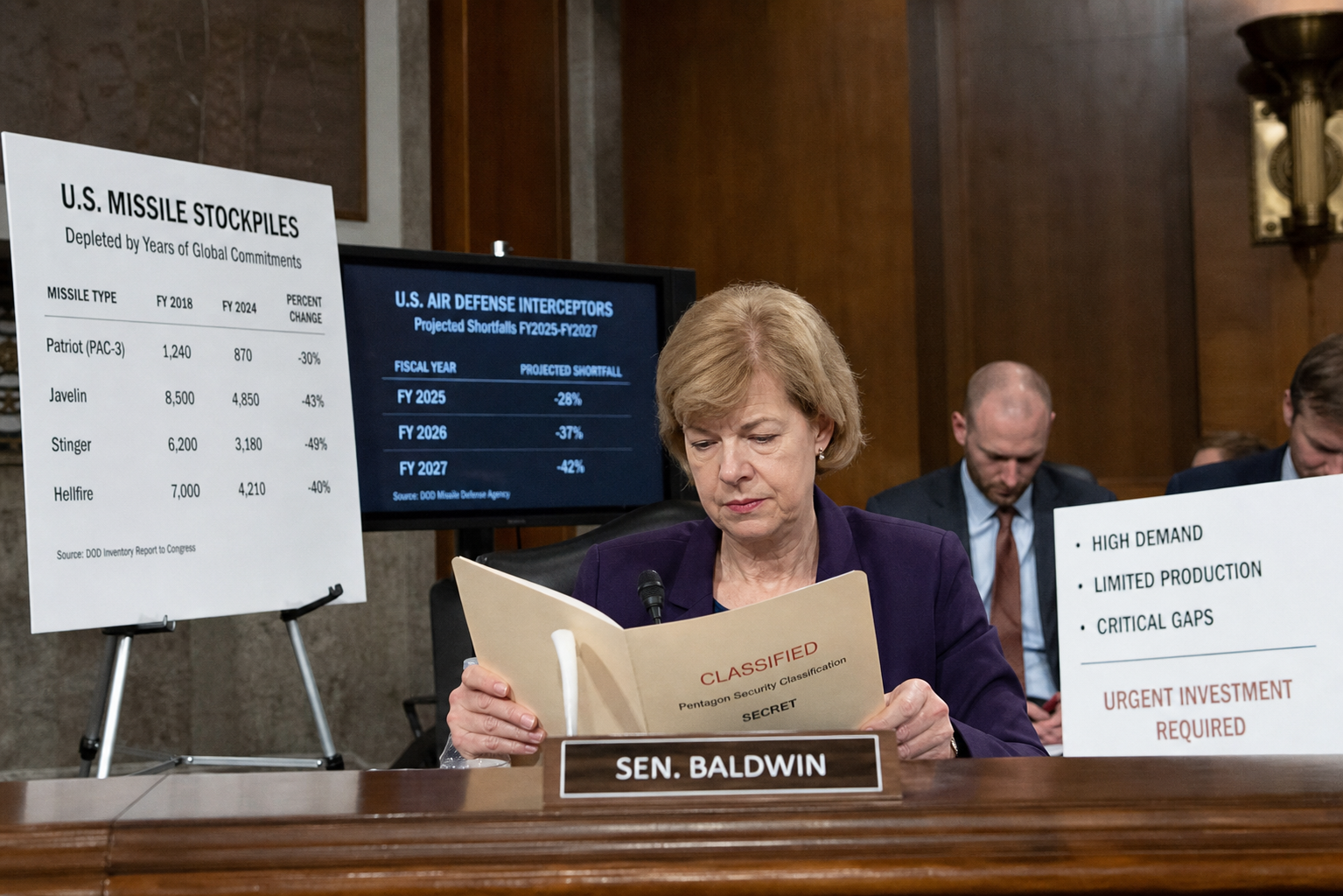
President Trump pushed back against media reports suggesting the United States is running short on key munitions amid the war with Iran, calling such claims false and accusing unnamed “leakers” of spreading treasonous information. In a Truth Social post, he said the U.S. has “massive amounts” of munitions, that more are being manufactured and shipped, and that defense companies are rapidly expanding production. His comments came after CBS News reported that U.S. stockpiles of long-range precision missiles and air-defense interceptors have fallen sharply because of wartime use. Sources told CBS that the U.S. has used nearly all of its ATACMS and Precision Strike Missiles, while stockpiles of Patriot and THAAD interceptors have also declined significantly, creating concern inside the administration. A CSIS analysis estimated that Patriot and THAAD inventories could take until at least mid-2029 to return to prewar levels. Pentagon spokesperson Sean Parnell defended the military’s readiness, saying the U.S. has everything it needs and a deep arsenal of capabilities. Defense Secretary Pete Hegseth similarly dismissed the shortage narrative as a media-manufactured story, insisting stockpiles are strong and growing.
Entities: Donald Trump, CBS News, Truth Social, Iran, Pentagon • Tone: analytical • Sentiment: neutral • Intent: inform
06-08-2026
CBS News reports that the United States has exhausted nearly all of its global stockpile of long-range precision missiles in the war with Iran, according to two sources familiar with the matter. The article says the U.S. has used virtually all of its Army Tactical Missile Systems (ATACMS) and Precision Strike Missiles, adding to earlier CBS reporting that U.S. inventories of both offensive munitions and defensive interceptors have been shrinking under the strain of the conflict. The most acute concern, officials say, is the limited supply of Patriot and THAAD missile interceptors, which are being expended faster than industry can replenish them. A Center for Strategic and International Studies report cited in the piece estimates that U.S. Patriot and THAAD inventories have fallen sharply and may not return to pre-war levels until at least mid-2029.
The story also places the stockpile issue in a broader policy and military context. Pentagon spokesman Sean Parnell insists the U.S. military remains fully capable and has the necessary capabilities to operate at the president’s direction, while Defense Secretary Pete Hegseth has publicly rejected concerns about depleted inventories as media-driven exaggeration. The article notes that U.S. strikes on Iran have been paused to allow diplomacy over the Strait of Hormuz, but President Trump is still threatening renewed large-scale attacks if Iranian terms are not met. Overall, the article highlights a tension between public assurances from officials and reports from sources and analysts suggesting the U.S. is under significant munitions pressure after sustained combat operations.
Entities: United States, Iran, CBS News, Reuters, Operation Epic Fury • Tone: urgent • Sentiment: negative • Intent: inform