05-06-2026
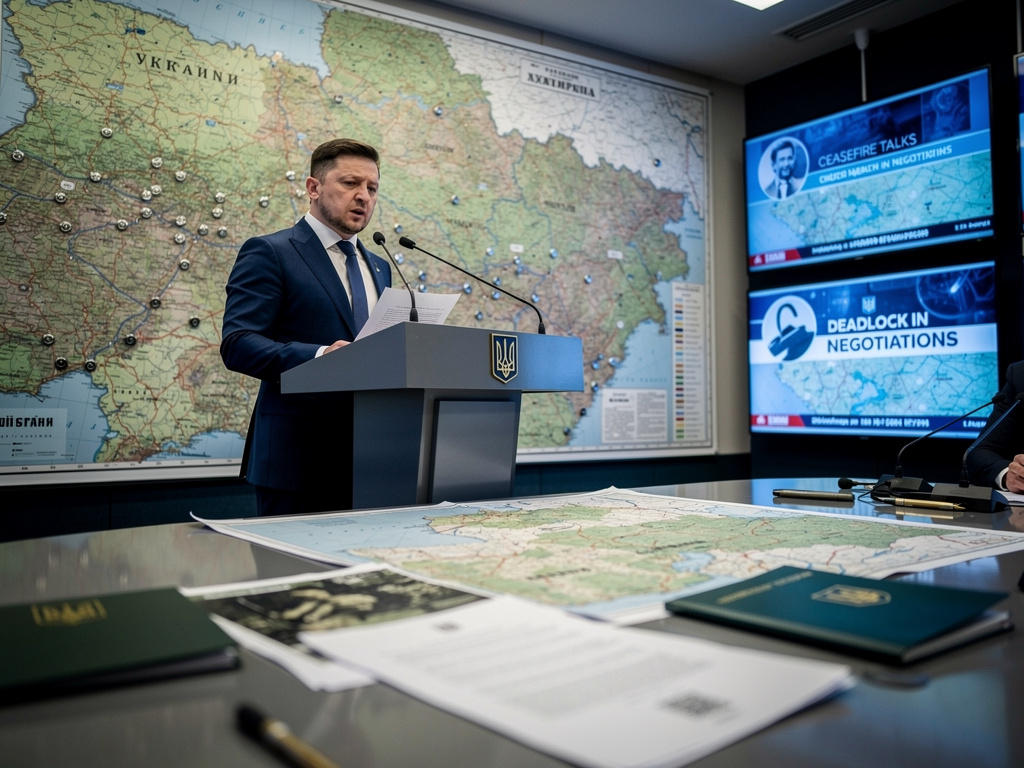
Ukrainian President Volodymyr Zelensky has renewed his push for direct peace talks with Russian President Vladimir Putin, issuing a public letter that calls for a face-to-face meeting and a full ceasefire during negotiations. Zelensky argued that Ukraine and Russia should not wait for the war to fade from the US agenda, especially as Washington is currently focused on Iran, and said peace can only come through direct engagement. The open letter was notably defiant in tone, mocking Putin’s age and highlighting Ukraine’s recent strikes on Russian territory.
The Kremlin acknowledged receipt of the letter, but Putin responded sceptically. Speaking in St Petersburg, he said Russia was willing to reach an agreement, but only if compromises were made—implying Ukraine should surrender territory and abandon Nato ambitions. He also questioned Zelensky’s legitimacy, repeating a longstanding Russian argument about Ukraine’s delayed elections under martial law.
The article places the proposal in the context of stalled ceasefire talks in Geneva, Abu Dhabi and Istanbul, ongoing Russian demands for territorial concessions, and continued military exchanges including drone attacks and strikes in Crimea. US President Donald Trump said he would welcome a meeting between the two leaders and claimed the US had helped bring both sides closer to peace. Overall, the piece shows a renewed diplomatic attempt amid entrenched positions and continuing violence.
Entities: Volodymyr Zelensky, Vladimir Putin, Donald Trump, Andriy Sybiha, Ukraine • Tone: analytical • Sentiment: neutral • Intent: inform
05-06-2026
Ukrainian President Volodymyr Zelensky issued an open letter calling on Russian President Vladimir Putin to meet directly in order to end the war in Ukraine, arguing that Russia is increasingly feeling the costs of the conflict and that continued delays would not change the battlefield outcome. He said Moscow had repeatedly missed self-imposed deadlines to capture Ukrainian territory, specifically Donetsk, and insisted that a genuine peace process requires direct engagement and a full ceasefire. Zelensky proposed that the meeting take place in a third country with a fixed date, and made clear that traveling to Moscow is not an option.
The appeal came while Putin was speaking at the St. Petersburg International Economic Forum and one day after Ukrainian strikes on a Russian city. Kremlin spokesperson Dmitry Peskov said Putin had been informed of the letter and noted that Zelensky could come to Moscow if he wanted a meeting. Zelensky rejected that idea in the letter. Separately, Putin said proposals from U.S. President Donald Trump could form the basis of peace agreements, but only if both Russia and Ukraine made compromises. He said Russia had broadly agreed to those compromises and was waiting to persuade Ukraine. The article highlights the continuing diplomatic stalemate, the role of U.S. attention shifting toward Iran, and the lack of any immediate path to negotiations.
Entities: Volodymyr Zelensky, Vladimir Putin, Ukraine, Russia, Donetsk • Tone: analytical • Sentiment: neutral • Intent: inform
05-06-2026
President Vladimir Putin said Russia will bolster its air defenses after a series of Ukrainian drone attacks reached deep into Russian territory, including strikes near St. Petersburg that damaged an oil terminal and hit a naval base. Speaking on the sidelines of the St. Petersburg International Economic Forum, Putin acknowledged that some drones are getting through and said Russia would improve its defenses. He also repeated that Moscow is open to a compromise on Ukraine based on understandings he says were reached with Donald Trump in Alaska, but only if Ukraine accepts them. The article also covers Ukrainian President Volodymyr Zelenskyy’s proposal for direct talks with Putin, Trump’s reaction that such a meeting “would be great,” and Kremlin spokesman Dmitry Peskov’s insistence that Zelenskyy could come to Moscow. Putin rejected the idea of European Union mediation, questioned Western accusations that Russia has conducted sabotage and cyberattacks across Europe, and defended Russia’s use of the Oreshnik missile. He reiterated Russia’s war aims in Ukraine, including control of the Donetsk region, and said Russian troops were advancing along the front. The article also notes the embarrassment and disruption caused by drone attacks in St. Petersburg, including smoke over the city, flight delays, and internet restrictions, underscoring Ukraine’s ability to strike inside Russia while Moscow continues its attacks on Ukrainian cities.
Entities: Vladimir Putin, Volodymyr Zelenskyy, Donald Trump, Dmitry Peskov, St. Petersburg • Tone: analytical • Sentiment: neutral • Intent: inform
05-06-2026
President Volodymyr Zelensky published an open letter to Vladimir Putin that combined a renewed offer of cease-fire talks with sharp taunts about Russia’s battlefield difficulties, economic strain, dependence on China, and Putin’s age. The letter came amid a wave of Ukrainian drone strikes deep inside Russia, including one that hit an oil depot outside St. Petersburg and sent smoke over the route to an upcoming economic conference where Putin was scheduled to speak. Zelensky’s message also appeared aimed beyond Putin, likely at President Trump and Western audiences, as it criticized the stalled U.S.-led negotiation process and referenced alleged understandings reached between Trump and Putin in Alaska.
The article frames the letter as one of Zelensky’s most direct and scathing public addresses to Putin. While offering direct talks outside the Trump administration’s channels, Zelensky proposed that any meeting include European nations and possibly be held in Switzerland, Turkey, or an Arab state. The piece notes that Zelensky has made similar offers before without success. It also raises uncertainty about whether the letter was meant primarily to advance diplomacy, publicize Ukrainian military gains, or pressure Putin psychologically and politically.
The article situates the letter within shifting wartime conditions that, according to the piece, currently favor Ukraine more than in earlier phases of the war. It suggests Zelensky may be trying to capitalize on Russia’s vulnerabilities, including gasoline shortages, inflation, and war fatigue, though it notes that many independent analysts do not believe Putin is genuinely vulnerable to internal unrest. Overall, the article portrays a blend of diplomacy, propaganda, and wartime messaging designed to influence multiple audiences at once.
Entities: Volodymyr Zelensky, Vladimir V. Putin, Ukraine, Russia, St. Petersburg • Tone: analytical • Sentiment: neutral • Intent: inform