Articles in this Cluster
25-07-2026
US President Donald Trump used remarks at the White House Correspondents’ Association dinner to both acknowledge and needle the press, mixing jokes, praise, and criticism in an event meant to celebrate press freedom after the previous dinner was cancelled by a shooting. The dinner returned in a more subdued, heavily secured form at the Washington Hilton, where Trump appeared in a relatively conciliatory mood compared with his usual attacks on journalists. He said the “show must go on,” called on Americans to defend freedom of speech, and argued that disagreements should be settled through “open and vigorous debate,” not violence.
At the same time, Trump repeatedly mocked the media, reviving his familiar attacks on “fake news” and claiming the room was filled with people suffering from “Trump Derangement Syndrome.” He joked that some journalists were “lucky” the earlier event had been cut short because he had intended to “go after” them. The article also notes the symbolic and security-heavy context of the dinner: it was much smaller than the original April event, with tighter screening and a large police and National Guard presence after the earlier shooting incident. The WHCA framed the night as a refusal to let violence have the final word, while awards were presented, including one to a Wall Street Journal team for reporting on Trump’s links to Jeffrey Epstein and another to an officer who was shot during the April incident.
Entities: Donald Trump, White House Correspondents' Association (WHCA), Weijia Jiang, Washington Hilton, New York Times • Tone: analytical • Sentiment: neutral • Intent: inform
25-07-2026
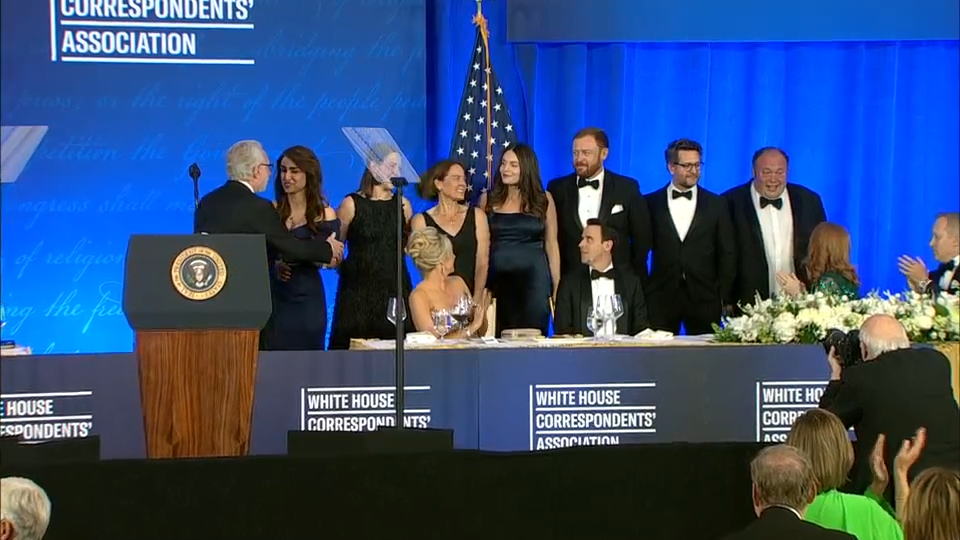
President Trump attended a rescheduled White House Correspondents’ Dinner at the Waldorf Astoria in Washington, D.C., after the original April event was disrupted by an armed attack outside the Washington Hilton. The article describes the evening as a carefully secured “do-over” that highlighted Trump’s contentious but often performative relationship with the press. Trump joked about journalists, politicians, and the news media, including comments about how his absence might hurt their business and a teasing reference to a "Trump 2028" hat. While he sparred rhetorically with the press, he also appeared more restrained than expected, even shaking hands with award winners and laughing at some remarks.
The dinner also emphasized the security concerns surrounding presidential events after the April shooting, which had led to Secret Service action and broader scrutiny of threats against public officials. White House Correspondents’ Association president and CBS News senior White House correspondent Weijia Jiang underscored the difference between criticizing the press and undermining it, and the association honored a Secret Service officer injured in April along with the Washington Hilton staff. Security for the event was significantly tightened, with QR code ticketing, government-issued ID checks, private security coordination, and layered ballroom screening.
Overall, the article presents the dinner as both a political-media spectacle and a security-conscious reprise of an event that had been violently interrupted months earlier.
Entities: Donald Trump, Weijia Jiang, Wolf Blitzer, Oz Pearlman, Todd Blanche • Tone: analytical • Sentiment: neutral • Intent: inform
25-07-2026
This CNN Politics item is a short video article about how the revamped White House Correspondents’ Dinner (WHCD) in July 2026 differed from the earlier April event, which had been interrupted and ultimately postponed after a shooting incident at the Washington Hilton. The piece centers on CNN’s Betsy Klein reporting on the changes to the event after that disruption, emphasizing that the July gathering was held under very different circumstances and likely with heightened attention to security, logistics, and the tone of the evening. Because the article is presented as a video roundup inside CNN’s politics vertical, most of the surrounding page is composed of unrelated recommended videos and other CNN segments. The core reporting itself is brief and factual, focused on the contrast between the planned April WHCD and the rescheduled July version. The article does not provide detailed narrative analysis in the text shown, but the available framing suggests it is about how Washington’s political media culture adapted after a major interruption and how the dinner was reshaped in response to that earlier tragedy.
Entities: White House Correspondents' Dinner (WHCD), CNN, Betsy Klein, Ellen Rittiner, Washington Hilton • Tone: analytical • Sentiment: neutral • Intent: inform
25-07-2026
CNN Business analyzes President Donald Trump’s appearance at the rescheduled White House Correspondents’ Dinner, arguing that his performance was not only widely regarded as a failure but also inadvertently highlighted the value of the First Amendment. The article describes Trump’s hour-long speech as rambling, repetitive, and mostly unfunny, with insults aimed at journalists, political opponents, and media executives. Rather than dominating the room, he reportedly lost the audience’s attention as attendees checked phones, talked, ate dessert, or left the room, reinforcing the sense that the routine fell flat. The piece also notes that Trump mixed a few nods to unity—such as praising the Secret Service and condemning political violence—with repeated attacks on the press and self-referential jokes about his own media power. A major theme is Trump’s desire to control or influence media coverage, illustrated by his public comments about CNN journalists, Paramount, CBS News, and allies in the media industry. The article also highlights the evening’s symbolic tension: Trump sat through journalism awards, including one honoring Wall Street Journal reporters for investigative work tied to Jeffrey Epstein and Trump, while the event itself became a demonstration of press freedom and public ridicule. Overall, the article frames the dinner as an embarrassing moment for Trump that still underscored the resilience of American media criticism and constitutional protections.
Entities: Donald Trump, White House Correspondents’ Dinner, White House Correspondents’ Association, First Amendment, CNN • Tone: analytical • Sentiment: negative • Intent: analyze
25-07-2026
The article describes President Donald Trump’s abrupt shift from joking at the White House Correspondents’ Dinner to commenting seriously on the war in Iran. According to the CNN video piece, Trump used his remarks to claim that the conflict is progressing well for the United States and to reject criticism by saying, “Don’t believe the fake news.” He then asserted that the U.S. has “hit Iran very hard” and suggested that Iran no longer has functioning Navy and Air Force capabilities. The piece frames this as a stark pivot in tone, contrasting lighthearted remarks with a hardline statement about an active war. Because the content is a brief video item rather than a full written report, the article mainly captures Trump’s remarks and CNN’s characterization of the moment, with limited additional context or analysis. The overall focus is on the political and rhetorical significance of the president’s comments, especially as they relate to the ongoing Iran conflict and his public messaging at a high-profile Washington event.
Entities: Donald Trump, Iran, United States, White House, White House Correspondents’ Dinner • Tone: analytical • Sentiment: neutral • Intent: inform
25-07-2026
President Donald Trump returned to the rescheduled White House Correspondents’ Association dinner three months after the April shooting that had forced the original event’s postponement. In a long, rambling speech at the Waldorf Astoria Washington DC, Trump mixed praise for some journalists with insults and jokes aimed at political figures, celebrities, late-night hosts, and even his own speechwriters. He also joked about a constitutionally barred third term, ending with a red “Trump 2028” cap and a mock announcement that he was running again.
The dinner, relocated to a smaller and more tightly secured venue, was framed by White House Correspondents’ Association president Weijia Jiang as a reaffirmation that the press and the event would not be intimidated by violence. The program included new awards honoring Secret Service agent Victor Gonzales, who was wounded during the April attack, and the staff of the Washington Hilton hotel, recognized for their professionalism during the crisis. The event also retained lighter elements such as awards presentations, dinner service, and mentalist Oz Pearlman’s performance.
At the same time, the article underscores the uneasy relationship between Trump and the press. It notes that Trump has attacked, sued, and taken administrative action against media organizations since returning to office, and that some observers questioned whether the dinner should have been rescheduled at all because of the optics of journalists socializing with the people they cover. Overall, the piece presents the night as both a symbolic return after trauma and a reminder of the continuing tension between Trump and the news media.
Entities: Donald Trump, Weijia Jiang, White House Correspondents' Association (WHCA), Waldorf Astoria Washington DC, White House • Tone: analytical • Sentiment: neutral • Intent: inform
25-07-2026
The article reports on President Donald Trump’s reaction at the rescheduled White House Correspondents’ Dinner after Wall Street Journal reporters were recognized for their investigative reporting on his alleged ties to Jeffrey Epstein. According to the piece, Trump smiled, laughed, and appeared to mouth “I don’t know” while the journalists received the Katharine Graham Award for Courage and Accountability for a report about a birthday card and drawing purportedly associated with Trump and included in an Epstein birthday book compiled by Ghislaine Maxwell. The article describes Trump as handling the moment lightheartedly, shaking hands with the reporters and joking during his remarks that the evening had been difficult because of the awards, asking, “Do I have a say?”
The story also recaps the broader controversy surrounding the WSJ report, which alleged that Trump wrote a letter to Epstein and included a crude drawing. The report prompted renewed political pressure for the release of Epstein-related documents, some of which were later released and reportedly included the disputed letter. The article notes that Trump filed a $10 billion defamation lawsuit against The Wall Street Journal after the story ran, but that a federal judge dismissed the case in April because Trump did not show the paper acted with actual malice. Trump has continued to deny the letter’s authenticity and later filed an amended suit that remains active.
Overall, the article blends a light, anecdotal description of Trump’s public demeanor with a factual recounting of the defamation case and the ongoing dispute over the Epstein-related reporting.
Entities: Donald Trump, The Wall Street Journal, Jeffrey Epstein, Ghislaine Maxwell, White House Correspondents’ Dinner • Tone: analytical • Sentiment: neutral • Intent: inform
25-07-2026
President Trump returned to the White House Correspondents’ Association dinner in a rescheduled, security-heavy gala held at the Waldorf Astoria after the original April event was disrupted by an attempted assassination outside the Washington Hilton. In a long, joke-filled speech, Trump mixed humor with pointed political attacks, praising law enforcement and the Secret Service for their response to the shooting while also mocking political rivals, media figures, and even members of his own administration. He joked about a possible third and “fourth term,” donned a “Trump 2028” hat, and riffed on topics including Robert F. Kennedy Jr., Joe Biden, Alexandria Ocasio-Cortez, Gavin Newsom, Bruce Springsteen, and roadkill, drawing laughter throughout the room.
The article emphasizes the contrast between the evening’s lighter entertainment and the trauma of the earlier attack. Trump repeatedly framed the event as proof that “the show must go on” and that political violence would not intimidate the country. He praised reporters and lawmakers in attendance, though he also took the opportunity to insult the press, calling them the largest gathering of people suffering from “Trump derangement syndrome.”
Before Trump spoke, journalism awards and scholarships were presented, including recognition of a Wall Street Journal team whose work on Trump’s ties to Jeffrey Epstein drew an awkward but ultimately cordial reaction from the president. The dinner’s new venue and tighter security reflected lessons learned from the shooting, with multiple checkpoints, digital passes, and limited capacity. Overall, the piece portrays a flamboyant, combative Trump using the rescheduled dinner to both acknowledge a serious act of violence and turn the night into a political performance.
Entities: Donald Trump, White House Correspondents’ Dinner, White House Correspondents’ Association (WHCA), Waldorf Astoria, Washington Hilton • Tone: analytical • Sentiment: neutral • Intent: inform
25-07-2026
The article centers on President Donald Trump’s appearance at the rescheduled White House Correspondents’ Association dinner, which was moved from April after a security breach involving a man who tried to force his way through security and fired a shotgun. The event took place at the Waldorf Astoria in Washington, D.C., and included a mix of political figures, journalists, and media personalities. The photo-led coverage highlights Trump greeting attendees such as Secret Service officer Victor Gonzales and CBS White House correspondent Weijia Jiang, as well as the presence of senior administration officials like Health and Human Services Secretary Robert F. Kennedy Jr., Commerce Secretary Howard Lutnick, White House Press Secretary Karoline Leavitt, and Deputy Chief of Staff Stephen Miller.
The article also emphasizes the heightened security atmosphere around the dinner, with police officers on guard and attendees viewing a video of the earlier security incident that caused the original dinner to be postponed. Other notable figures shown arriving or attending include Fox News correspondent Jacqui Heinrich and CNN’s Kaitlan Collins. The Wall Street Journal staff were recognized with the Katherine Graham Award for Courage and Accountability, underscoring the journalistic themes of the evening. Overall, the piece captures a major Washington media event marked by Trump’s return, strong security, and a mix of adversarial and ceremonial optics after a violent interruption earlier in the year.
Entities: Donald Trump, White House Correspondents’ Association (WHCA) Dinner, Waldorf Astoria, Washington, D.C., Secret Service • Tone: neutral • Sentiment: neutral • Intent: inform
25-07-2026
At a smaller, more secure redo of the White House Correspondents’ Association dinner held at the Waldorf Astoria in Washington, President Trump delivered a meandering hourlong speech that mixed self-aware jokes, praise for journalists, and aggressive political attacks. He opened by acknowledging how strange the event felt and joking about whether he was supposed to be serious or funny, but quickly shifted between scripted quips and sharp insults. The article emphasizes the awkward atmosphere in the room as Trump alternated between cordial gestures toward reporters and attacks on his enemies, including politicians, celebrities, and media figures.
The dinner took place against a backdrop of escalating tension between Trump and the press. The New York Times notes that the administration had recently subpoenaed Times reporters for records related to stories about security concerns involving a Qatari-donated Air Force One, though the subpoenas were later withdrawn after a judge criticized the Justice Department. Trump also faced scrutiny for lawsuits and hostility toward journalists, including a $20 billion suit against The Wall Street Journal. Despite some applause for reporters receiving awards, the speech grew increasingly combative and derisive, with Trump mocking individuals in the room and outside it. By the end, he was losing the audience, and his final flourish—a “Trump 2028” hat—underscored the event’s mix of spectacle, antagonism, and political theater.
Entities: Donald Trump, White House Correspondents’ Association dinner, Waldorf Astoria, Washington, D.C., The New York Times • Tone: analytical • Sentiment: negative • Intent: inform
25-07-2026
This CNN item reports on President Donald Trump joking about the possibility of running for president again in 2028 while attending the White House Correspondents’ Dinner. According to the article, Trump appeared in a “Trump 2028” hat and made comments that seemed to riff on his repeated claims about the 2020 election, including the persistent argument that he was denied a proper victory. The piece is presented as a short political video write-up rather than a long-form report, and its focus is on the symbolism of Trump’s joke, the public setting in which it occurred, and the broader political context surrounding his continued influence and his refusal to let go of the 2020 election narrative. The article does not develop a deep policy angle; instead, it highlights a provocative, newsworthy moment that blends political theater, campaign-style messaging, and Trump’s signature media persona. The surrounding page also includes links to other CNN videos, but the central story is Trump’s lighthearted but pointed reference to a 2028 bid and what it suggests about his ongoing dominance in Republican politics.
Entities: Donald Trump, Mason Winterhalter, CNN, White House Correspondents’ Dinner, Trump 2028 • Tone: analytical • Sentiment: neutral • Intent: inform