29-10-2026
The article examines unresolved questions about the cause of a deadly collision between two high-speed trains in Spain’s Toledo region. At least 68 people were killed and dozens injured when a state-owned RENFE train struck the rear of a stationary Iryo train on Wednesday morning. Spanish Transport Minister Óscar Puente and the private operator have given conflicting accounts of what happened after a signalling failure. Puente said a computer malfunction disabled signalling across a 63-kilometre stretch, requiring trains to stop. Iryo reportedly remained stationary while carrying out a system reset and says it never received an instruction to resume. Puente, however, said some trains were told to move, and that RENFE was instructed to continue at normal speed despite an active stop signal. The speed of the RENFE train at impact is not yet known. Recorded communications between drivers and controllers are expected to be central to the investigation.
The collision occurred on the Madrid-Seville high-speed line, which uses the LZB signalling system. LZB reportedly failed and the affected trains were moved to manual control. The article says the subsequent events are currently understood to involve human error rather than being directly caused by the technical failure. The line is in the process of being upgraded to the newer European Rail Traffic Management System (ERTMS), and local media report the crash section was still being upgraded.
The crash has renewed scrutiny of Spanish rail safety. A CSIF trade union called for Puente’s resignation while also urging the government to respect the investigation and avoid making Adif’s traffic-operations chief a scapegoat. The union had raised concerns after another collision on the same high-speed line near Adamuz in January killed 46 people. That accident, like the current one, was among Spain’s deadliest in recent years. Prime Minister Pedro Sanchez announced three days of mourning and said it was unacceptable for two high-speed collisions to occur within months. Despite significant investment and national pride in the system, Spain’s network has seen about 26 million passenger journeys from January to August this year.
Entities: Óscar Puente, Pedro Sanchez, RENFE, Iryo, Adif • Tone: analytical • Sentiment: negative • Intent: inform
29-10-2026
Rescue workers continued searching the wreckage of a fatal train collision near Urda after nightfall, using heavy cranes to lift damaged sections from the tracks. Emergency teams worked under artificial lighting among the mangled carriages, and footage showed a crane raising what appeared to be part of a train’s wheel assembly. The crash occurred when one train struck another that had stopped. The article describes it as Spain’s second deadly rail collision of the year and one of Europe’s deadliest railway accidents of the century.
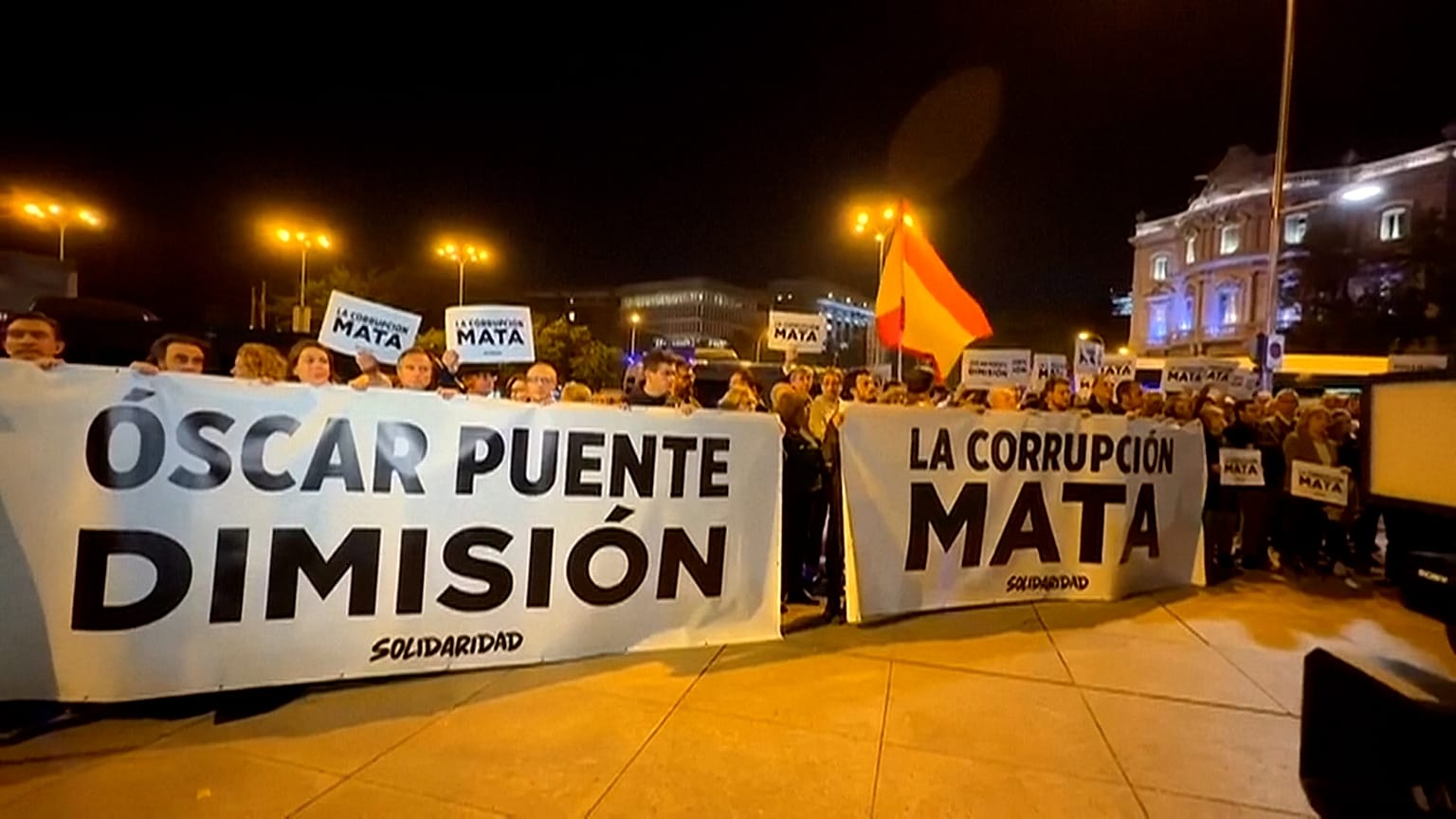
In Madrid, dozens of people gathered outside City Hall in Cibeles Square for a minute of silence in memory of those killed. The tribute was organised by the Spanish Federation of Municipalities and Provinces and attended by opposition leader Alberto Núñez Feijóo, Madrid regional president Isabel Díaz Ayuso, Mayor José Luis Martínez-Almeida, and central government delegate Pilar Trinidad. The memorial gathering also became a protest against the government. Some participants displayed signs reading “Corruption kills” and called for Transport Minister Óscar Puente to resign.
The collision involved two high-speed trains near Toledo in central Spain on 28 October. At least 68 people died and more than 100 were injured. Fifteen injured people remained in critical condition at the time of the report. The article presents both the continuing emergency response and the public reaction in Madrid, where mourning for the victims occurred alongside political criticism.
Entities: Urda, Toledo, Madrid, Cibeles Square, Spain • Tone: neutral • Sentiment: negative • Intent: inform
29-10-2026
A collision between two high-speed trains in Spain’s Toledo province killed at least 68 people and left 58 others receiving hospital treatment, according to local authorities. The crash happened Wednesday morning near Urda, when a RENFE train traveling from Madrid toward Seville struck the rear of a stopped IRYO train. Two cars derailed, and rescue crews continued searching the wreckage for survivors and bodies. Rail service between Madrid, Ciudad Real and Andalusia was suspended.
Transport Minister Óscar Puente said a computer malfunction had disabled a security system on a 63-kilometer stretch of track at about 8:30 a.m., requiring trains to stop. He said a central command center then instructed the RENFE train to resume without speed restrictions, despite an active stop signal. The trains collided at about 8:53 a.m. Authorities were still investigating the train’s speed; it may have been traveling at up to 200 kph. Puente said the engineers were not to blame and described his comments as a statement of facts rather than an attribution of responsibility.
Prime Minister Pedro Sánchez announced three days of national mourning and called for stronger safety measures, saying it was unacceptable for Spain to experience two high-speed rail accidents in one year. The January crash in southern Spain killed 45 people, adding to concerns about confidence in the country’s high-speed rail network. The latest crash occurred in open countryside between Urda and Los Yébenes, where wreckage was scattered down a gravel slope. Passengers described being thrown about by the impact, while emergency personnel focused on the most damaged train cars.
Entities: Pedro Sánchez, Óscar Puente, Mónica García, Ignacio Relaño, ADIF • Tone: analytical • Sentiment: negative • Intent: inform
29-10-2026
A deadly collision between two high-speed trains near Urda in central Spain has left at least 68 people dead and more than 100 injured, including 15 people who remain in critical condition. The crash occurred on 28 October when one train struck another that had stopped. It is described as Spain’s second deadly rail collision this year and one of Europe’s deadliest railway accidents of the century.
Rescue teams continued working through the night at the crash site. Under artificial lighting, emergency workers searched the damaged carriages while heavy cranes lifted sections of wreckage from the tracks. Video footage showed a crane raising what appeared to be part of a train’s wheel assembly.
In Madrid, dozens gathered outside City Hall in Cibeles Square for a minute of silence to remember those killed. The tribute was organised by the Spanish Federation of Municipalities and Provinces and attended by opposition leader Alberto Núñez Feijóo, Madrid regional president Isabel Díaz Ayuso, Mayor José Luis Martínez-Almeida and central government delegate Pilar Trinidad.
The memorial gathering also became a protest against the government. Some participants displayed placards reading “Corruption kills” and chanted for Transport Minister Óscar Puente to resign. The article thus reports both the ongoing emergency response and the public grief and political anger following the disaster.
Entities: Toledo, Spain, Urda, Madrid, Cibeles Square, High-speed train collision • Tone: neutral • Sentiment: negative • Intent: inform
29-10-2026
Spain has begun three days of national mourning after a collision between two high-speed trains in Castilla-La Mancha killed 68 people and injured scores. The crash occurred on Oct 28, when a Renfe train struck the rear of a stationary Iryo train on the line connecting Madrid and Seville. Emergency crews worked through the night, using cranes to move wreckage and search for victims. Survivors described violent impact, severe disarray and narrowly escaping death.
Relatives gathered at a support centre in the nearby village of Urda to seek information about missing family members. Red Cross workers, police, local clergy and other responders provided practical and emotional support. Red Cross psychologist Carmen Garcia warned that families faced “long and hard hours” and would respond to the tragedy in different ways. The Civil Guard opened offices in Madrid, Toledo, Cordoba and Seville to collect DNA samples for identification, while blood donation points were established in Castilla-La Mancha and Madrid.
The disaster has renewed scrutiny of rail safety in Spain. Transport Minister Oscar Puente said an automatic control system had failed along 69 kilometres of track, stopping trains. He said the control centre nevertheless resumed traffic in “inexplicable” circumstances and had time to identify and correct the error. The Renfe train then travelled 25 kilometres before hitting the stationary Iryo train.
The crash is Spain’s second fatal high-speed rail collision in 2026. In January, 46 people died in Andalusia when a train derailed and crossed onto an adjacent track, colliding with another train. The investigation into that accident remains ongoing, and the government has faced criticism over its handling of the rail network. The latest disaster also comes shortly before Prime Minister Pedro Sanchez’s Socialist government faces an early general election on Nov 29, amid unfavourable polls.
Entities: Spain, Castilla-La Mancha, Urda, Madrid–Seville rail line, Renfe • Tone: analytical • Sentiment: negative • Intent: inform
29-10-2026
After a train crash in Toledo killed 68 people, Spanish Prime Minister Pedro Sánchez expressed condolences and pledged a firm response if investigators confirm failures in railway safety systems. He said the government’s immediate priorities are caring for victims and their families, finding survivors, and providing practical and psychological support. Sánchez also praised emergency and Civil Protection teams and the coordination among national, regional and local authorities.
The Rail Accident Investigation Commission, the courts and the Ministry of Transport are working to establish what caused the crash. The transport minister had described an “error” and “inexplicable circumstances” connected to the accident, which has renewed scrutiny of safety on Spain’s rail network. Sánchez said the government would act decisively if safety failures were confirmed and called it “unacceptable” for two rail tragedies to occur in the same year.
The article also recalls a January collision in Andalusia, where 46 people died after one high-speed train derailed and crossed onto an adjacent track. That investigation is still underway, and the government has faced criticism over its handling of the railways. Sánchez pledged to restore public confidence in railway safety and public transport.
Castilla-La Mancha president Emiliano García-Page reported that 53 people had received medical treatment, including 15 in serious condition, and thanked authorities and other regions for their assistance. Sánchez announced three days of official mourning. He made his remarks without taking questions from journalists.
Entities: Pedro Sánchez, Emiliano García-Page, Toledo, Los Yébenes, Castilla-La Mancha • Tone: urgent • Sentiment: negative • Intent: inform