29-10-2026
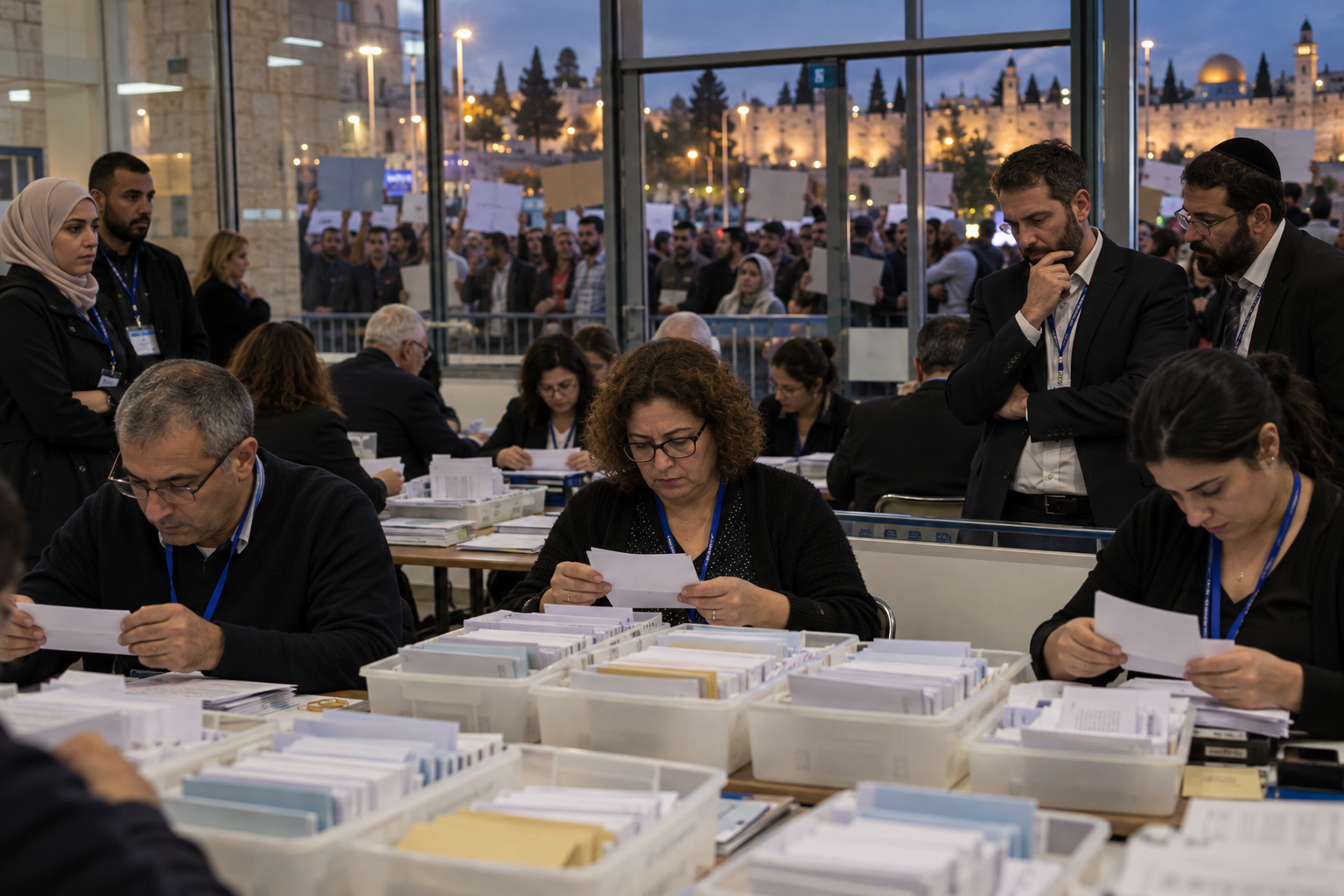
The France 24 liveblog reports that Israel’s parliamentary election results remained inconclusive as counting continued on October 29, 2026. With more than 90% of ballots counted, Prime Minister Benjamin Netanyahu’s bloc had won 53 seats, while the opposition had 67. The opposition total included 48 seats for a centrist bloc led by Gadi Eisenkot and 19 for Arab-majority parties. The figures indicated that neither side had an outright majority and that the Arab-majority parties could be influential in efforts to form a government.
Israel’s president urged political parties to do everything possible to assemble a governing coalition and avoid another election. The liveblog’s recap of the previous day said there was no clear winner and described the contest as a standoff between Netanyahu’s right-wing bloc and Eisenkot’s centrist rival. It also reported that Netanyahu’s Likud party accused Arab parties of stealing the election, amid the possibility that they could hold a kingmaker role in coalition negotiations.
The article additionally noted a reaction from Hezbollah chief Naim Qassem. He said the Iran-backed Lebanese movement was not concerned about the Israeli election results and would continue its resistance against Israel regardless of who won. The report is a brief live-update page rather than a full account of the election, and the supplied text ends with a notice that the requested content is unavailable. Its central focus is the unresolved seat count and the challenge of forming a government.
Entities: Israel, Benjamin Netanyahu, Gadi Eisenkot, Likud, Bnei Brak • Tone: analytical • Sentiment: neutral • Intent: inform
29-10-2026
Israel’s Arab parties appeared poised for a record showing in the October 2026 parliamentary election, with the Joint List and Ra’am together projected to win about 19 Knesset seats—nearly twice their existing representation. Their gains could give them leverage in efforts to replace Prime Minister Benjamin Netanyahu’s government, although the parties differ over whether and how to support a potential government led by Gadi Eisenkot. Joint List leader Yousef Jabareen said his alliance would use its projected 12 seats to help change the political situation, but ruled out joining an Eisenkot government because of its backing for Israel’s military campaign in Gaza and its occupation of southern Lebanon. He left open the possibility of supporting a minority government from outside, while seeking improved rights and equality for Arab citizens. Ra’am leader Mansour Abbas, by contrast, said his party would be willing to join an Eisenkot-led government and indicated that senior figures had discussed a possible arrangement with him. Eisenkot had publicly rejected forming a government with Arab parties, citing a lack of shared values and their position on Israel as a Jewish and democratic state. Netanyahu’s Likud party also ruled out negotiations with Arab parties. The article profiles Abbas’s pragmatic focus on domestic issues such as crime, inequality, infrastructure and municipal funding, and notes that Ra’am joined a governing coalition from 2021 to 2022. It describes the Joint List as an alliance formed in 2015 to unite Arab voters, with a platform including civil equality and opposition to occupation. Arab citizens make up about 20% of Israel’s population and have significant representation in health care and other public professions. The story places the parties’ potential influence in the context of a longer history of external support for Israeli governments and the landmark participation of Ra’am in a governing coalition in 2021.
Entities: Yousef Jabareen, Mansour Abbas, Benjamin Netanyahu, Gadi Eisenkot, Joint List • Tone: analytical • Sentiment: neutral • Intent: inform
29-10-2026
Hundreds of people rallied in Jerusalem, Tel Aviv and Haifa to call for an inclusive Jewish-Arab government while votes were still being counted in Israel’s closely contested election. About 300 demonstrators gathered at Paris Square in Jerusalem, Mesila Park in Tel Aviv and Unesco Square in Haifa. Their placards included calls for freedom “from the river to the sea” and support for a Jewish-Arab government. Reports cited by the article said participants shared a demand for more inclusive governance.
Partial election figures showed no political bloc with a clear route to a parliamentary majority. With results based on 90 per cent of votes counted across 97.5 per cent of ballot boxes, the pro-Netanyahu bloc had 53 seats and the opposing camp had 67 seats in the 120-member Knesset. However, the opposing camp was divided: Jewish-led parties held 48 seats and Arab-led parties 19, while most Jewish-led factions had said they were unwilling to partner with Arab-led parties.
Yashar chairman and opposition candidate Gadi Eisenkot called the results a vote of no confidence in Benjamin Netanyahu’s government and said his side would continue trying to replace it. He criticized Netanyahu and his allies over the government’s record and military conscription, and said his camp was focused on change and forming a Zionist government committed to conscription.
Several parties remained below Israel’s 3.25 per cent electoral threshold. Election officials cautioned that the published figures were provisional and could change as counting continued. Ballots in double envelopes, including votes from active-duty soldiers, are usually counted later in the process.
Entities: Israel, Jerusalem, Tel Aviv, Haifa, Jewish-Arab government • Tone: neutral • Sentiment: neutral • Intent: inform
29-10-2026
Israel’s election results appeared deadlocked as vote counting neared completion, leaving Prime Minister Benjamin Netanyahu and opposition leader Gadi Eisenkot without an apparent path to a parliamentary majority. Early media projections gave Likud and its allied parties 53 seats, Eisenkot’s Yashar-led bloc 48, and Arab-led parties 19—short of the 61 seats required in the 120-member Knesset. With 85% of votes counted, Likud had 20.8% of the vote, Yashar 16.1%, and Arab-led parties 14.9%. Absentee ballots, including votes from military personnel and diplomats, were expected to be counted through Thursday evening.
The Arab-led parties’ strong showing was historic, but whether other parties opposed to Netanyahu would cooperate with them remained uncertain. Netanyahu rejected such a partnership, calling it treasonous; Arab-led parties had also ruled out joining his government. Eisenkot, a centrist and former military chief, left open the possibility of working with Arab parties if they recognized Israel as a Jewish state and Hamas as an extremist group. Some of his potential partners had already rejected such an alliance.
Nearly 78% of eligible voters participated, the highest turnout since 1999. Voting reflected concern about Netanyahu’s alliance with far-right parties and anger over military draft exemptions for ultra-Orthodox Jews. Likud’s vote share fell from 23.4% in 2022, but Netanyahu’s opponents did not appear to have converted public grief following the Hamas-led October 7, 2023 attack into a decisive electoral defeat for him. Far-right National Security Minister Itamar Ben-Gvir also lost support.
Likud was projected to remain the largest party and therefore the likely first choice for President Isaac Herzog to form a government, though Herzog is not required to appoint the leader of the largest party. He urged politicians to avoid another election, as coalition negotiations could take weeks and another vote remained a possibility.
Entities: Benjamin Netanyahu, Gadi Eisenkot, Likud, Yashar, Arab-led parties • Tone: analytical • Sentiment: neutral • Intent: inform