04-11-2026
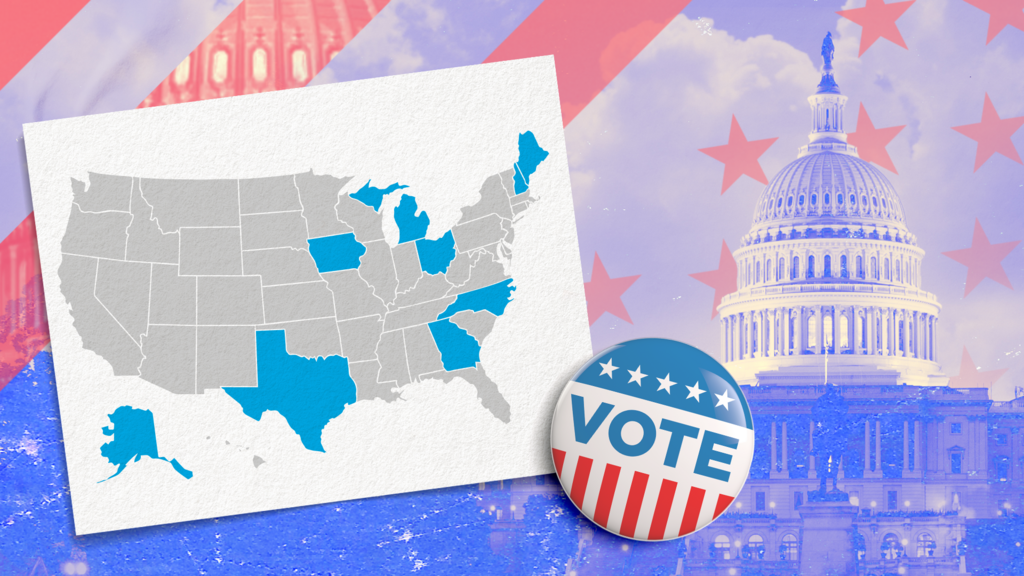
Democrats have won control of the US Senate and are projected by multiple media outlets to take the House of Representatives, ending the Republican Party’s control of Congress after the 2026 midterm elections. The party flipped six Republican Senate seats and about two dozen House seats, including in traditionally Republican states. The results exceed the Democrats’ required net gains of four Senate seats and three House seats. Notable Senate victories included Roy Cooper in North Carolina, Annie Andrews in South Carolina, James Talarico in Texas, Sherrod Brown in Ohio and Adam Hamilton in Kansas. Jon Ossoff also won re-election in Georgia. Several of the states where Democrats prevailed had backed Donald Trump by substantial margins in 2024, making the results a major setback for the president and his party.
With Democrats controlling both chambers, Trump is likely to face obstacles advancing his legislative agenda and will need bipartisan support to pass legislation. The article also expects a Democrat-controlled House to increase oversight of his administration through investigations, subpoenas and hearings. Trump said he would accept the results and work with Democrats, but also argued they would not truly be in control because he could veto legislation. He claimed he would have won by a landslide had he been on the ballot. Trump acknowledged that the war with Iran had affected Republican candidates, while also defending his actions in the conflict. The article describes the election as a significant reversal for Republicans, who entered the midterms with narrow majorities in both chambers.
Entities: Democratic Party, Republican Party (GOP), Donald Trump, Annabel Bowles, United States Congress • Tone: analytical • Sentiment: neutral • Intent: inform
04-11-2026
After Democrats won control of both the House of Representatives and the Senate in the 2026 midterm elections, President Donald Trump’s Republican Party will have less ability to pass legislation and confirm nominees. The article explains what the change could mean once the new Congress takes office on January 3. Democrats plan to use their House majority to block Republican bills and introduce an early legislative package addressing tariffs, the Iran war and health insurance costs. However, their ability to enact those proposals will be constrained: most Senate bills require 60 votes to advance, and Trump can veto legislation unless it has two-thirds support in both chambers.
The House majority will give Democrats stronger investigative powers, including the ability to subpoena records and witnesses. Party leaders and members have signalled interest in investigating Trump, his family’s business interests and government agencies such as the Justice Department and FBI. Some Democrats also want to impeach Trump for a third time, but the party is divided, and removing him would require a two-thirds Senate vote. Defense Secretary Pete Hegseth may be a more plausible impeachment target: a resolution has already been introduced by outgoing Republican Thomas Massie, and Jeffries has said Democrats may address the matter if Trump does not remove Hegseth.
Before the new Congress is sworn in, the current Congress must return on November 9 and address government funding. Funding expires on December 11, and failure to pass new bills could trigger another shutdown. The Democratic Senate majority will also make it harder for Trump to confirm nominees, including potential Supreme Court justices. The article notes that Justices Clarence Thomas and Samuel Alito are older, but both reportedly intend to remain on the court for now. Trump, however, retains the power to fire cabinet members and could replace them without Senate confirmation.
Entities: Donald Trump, Hakeem Jeffries, Alexandria Ocasio-Cortez, Pete Hegseth, Thomas Massie • Tone: analytical • Sentiment: neutral • Intent: inform
04-11-2026
ABC Americas editor John Lyons argues that the Republicans’ devastating losses in the 2026 US midterm elections demonstrate that Donald Trump has lost his political touch, but do not make him a powerless lame-duck president. The results included Democratic Senate victories in traditionally Republican states: North and South Carolina, Texas, and Kansas. Lyons points to Trump’s final pre-election speech, in which he praised renovations to a Washington reflecting pool and the White House lawn while many Americans were struggling with sharply rising petrol costs, as evidence that he had misread the public mood. The defeat of Ken Paxton in Texas is another example: Trump backed Paxton over incumbent Republican senator John Cornyn, and a huge spending effort—including money from Trump ally Elon Musk—failed to prevent Democrat James Talarico from winning. The result also suggests that campaign spending and Trump’s influence have limits, and that the money devoted to Texas could have been used in more competitive races elsewhere.
However, Trump retains two years in office and remains commander-in-chief. Lyons warns that describing him as a lame duck could underestimate the risks of a president who feels wounded and humiliated. The article recalls Trump’s refusal to accept his 2020 defeat and the subsequent storming of the US Capitol by supporters. Even with a hostile Congress, Trump can use executive orders, which may take months to challenge in court. Lyons sees foreign policy as an especially serious area of concern, citing Trump’s actions involving Iran and Venezuela and his closer relationship with Russia. He could conclude that he has little to lose and escalate involvement with Iran or Cuba. The article closes by asking whether Trump will heed the message voters have sent.
Entities: Donald Trump, John Lyons, 2026 US midterm elections, Republican Party, Democratic Party • Tone: analytical • Sentiment: negative • Intent: analyze
04-11-2026
The Democratic Party has regained control of the US Senate in the 2026 midterm elections, according to Associated Press projections. Democrats needed a net gain of four seats and had captured at least seven by late Tuesday, securing at least 53 seats in the 100-member chamber while some races remained uncounted. The result reverses the Republican majority and ends the party’s control of the presidency, Senate and House that followed the 2024 election, though the article does not report the outcome of the House races.
Democratic victories included several states considered Republican strongholds. Annie Andrews won in South Carolina, where a Democrat had not won a Senate seat since 1998; Roy Cooper flipped North Carolina; and James Talarico defeated Texas Attorney General Ken Paxton in Texas, where Democrats had not won a statewide election since 1994. Sherrod Brown, Adam Hamilton, Troy Jackson and Josh Turek also defeated Republican opponents in Ohio, Kansas, Maine and Iowa, respectively. Democrats also defended seats, including Jon Ossoff’s in Georgia and Mark Warner’s in Virginia.
President Donald Trump acknowledged that Democrats had performed well but suggested the war on Iran and the resulting cost of gasoline may have contributed to Republican losses. He also distanced himself from the outcome, noting he had not been on the ballot. The article explains that Senate races are staggered, with only about a third of seats contested at a time, and that 35 races were held in this cycle, including two special elections. Trump said he expected to veto Democratic proposals he considered unacceptable, but predicted the parties would eventually work together.
Entities: Democratic Party, 2026 US midterm elections, US Senate, Associated Press, Donald Trump • Tone: analytical • Sentiment: neutral • Intent: inform
04-11-2026
Al Jazeera’s short video report, presented by correspondent Alan Fisher, describes a worse-than-expected performance for Republicans in the 2026 US midterm elections. The report says the party’s internal polling did not anticipate the scale of the potential losses it was facing in either chamber of Congress: the Senate or the House of Representatives. Its headline characterizes the setback in emphatic terms, saying that Donald Trump and Republicans were “trampled” in the midterms.
The item focuses on the gap between Republicans’ expectations, as reflected in their internal polling, and the apparent scale of their electoral difficulties. It does not provide vote totals, identify particular races or states, give seat projections, or explain the causes of the party’s performance. Nor does the supplied text establish final outcomes; it describes losses as potential. The report is therefore a concise election update rather than a detailed account of results or an analysis of why voters may have shifted. Its central point is that Republican polling failed to capture the severity of the party’s midterm troubles across both the Senate and the House. The article also does not include additional reaction from candidates, voters, or party officials in the provided content.
Entities: Donald Trump, Alan Fisher, Al Jazeera, United States, 2026 US midterm elections • Tone: analytical • Sentiment: negative • Intent: inform
04-11-2026
The article examines how a Democratic sweep of Congress in the 2026 midterm elections could affect U.S. stocks. Investors were not strongly positioned for Democrats to win both chambers, and some analysts expect an immediate market dip if that outcome is confirmed. JPMorgan estimated a possible decline of about 0.5% for the S&P 500, while a Republican hold on the Senate could instead produce a modest rally. Historically, stocks have tended to rise in the year after midterms, but the article cautions that this pattern may not hold: the S&P 500 has already gained double digits in 2026, and it has not experienced the typical midterm-year drawdown. One technical analyst therefore sees a post-election decline as more likely than the consensus rally.
The article also describes possible sector effects. Democrats’ increased influence could raise concerns about restrictions on data centers and AI infrastructure, potentially adding pressure to technology-related stocks already weakened by turbulence in the AI trade. A Democratic win in Texas, where Republican Gov. Greg Abbott is running, could intensify those concerns. Defense stocks might face pressure if spending growth is constrained, while healthcare stocks could benefit from Democratic efforts to restore Affordable Care Act subsidies or reverse Medicaid changes. Financial stocks could also be vulnerable if lawmakers pursue credit-card interest-rate caps as part of an affordability agenda.
Finally, the article identifies a potential resumption of conflict with Iran as a separate market risk. Renewed strikes could unsettle markets and lift energy stocks. Overall, it presents the election’s market effects as uncertain, distinguishing possible short-term reactions from longer-term historical patterns and highlighting policy and geopolitical risks.
Entities: 2026 U.S. midterm elections, Democratic sweep / blue wave, S&P 500, Tobin Marcus, Wolfe Research • Tone: analytical • Sentiment: neutral • Intent: analyze
04-11-2026
The article presents scenes and results from the U.S. midterm elections, which it describes as a major setback for President Donald Trump and his party. Democrats won a series of high-profile races, flipped Republican-held seats, and were projected to regain control of both the House and Senate. The results could limit Trump’s legislative agenda during the final two years of his presidency.
Texas was among the biggest surprises. Democrat James Talarico defeated Republican Ken Paxton to become the state’s first Democratic U.S. senator since 1988. Democrat Gina Hinojosa also defeated Republican Gov. Greg Abbott, becoming Texas’s first Latina governor and ending more than three decades of Republican control of the office. In North Carolina, former Democratic Gov. Roy Cooper won a Republican-held Senate seat against Trump-backed Michael Whatley. He will succeed retiring Sen. Thom Tillis, who had clashed with Trump over tax and spending legislation.
Georgia Democrats also had notable victories: Sen. Jon Ossoff won reelection against Trump-backed Mike Collins, and former Atlanta Mayor Keisha Lance Bottoms won the governor’s race, becoming the first Black woman elected governor of a U.S. state. In Ohio, former Democratic Sen. Sherrod Brown returned to the Senate after defeating Republican incumbent Jon Husted.
The article accompanies its account with descriptions of voters, election workers, candidates, and supporters at polling places and election-night events. It says the elections were widely viewed as a referendum on Trump’s second term, amid voter concerns about the cost of living, inflation, and the war in Iran.
Entities: Donald Trump, James Talarico, Ken Paxton, Gina Hinojosa, Greg Abbott • Tone: analytical • Sentiment: neutral • Intent: inform
04-11-2026
The article reports that Democrats have gained control of the US Senate in the 2026 midterm elections after flipping six Republican-held seats in North Carolina, South Carolina, Ohio, Kansas, Texas and Iowa. With 51 seats, Democrats cross the threshold for a Senate majority. House results are still incomplete: Democrats are reported at 204 seats and Republicans at 123, with 218 needed for a majority. The article says all 435 House seats and 35 Senate seats were contested, and explains that control of Congress will shape federal policymaking over the next several years.
It also examines voter demographics and attitudes using a representative survey of nearly 80,000 verified voters conducted by SSRS for the Associated Press and other news organizations. Democrats performed strongly among Black women, Latino voters, younger people, urban residents and college graduates. Republicans remained stronger among white men, older voters and rural residents. Compared with the 2022 midterms, Republican support declined across the demographic groups discussed.
Economic concerns were prominent: nearly half of respondents said their family was worse off financially than two years earlier, and voters who felt worse off overwhelmingly supported Democrats. Views on immigration, democracy, the economy, the Iran war, US support for Israel, ICE, tariffs and the country’s direction were sharply divided along partisan lines. The article notes that immigration-focused voters and those who approved of ICE’s actions leaned heavily Republican, while voters most concerned about democracy or dissatisfied with the country’s direction leaned Democratic. It frames the midterms as a referendum on President Donald Trump and Republican governance, but the supplied article text cuts off before the section on Trump’s approval ratings is complete.
Entities: Donald Trump, Democratic Party, Republican Party, US Congress, US Senate • Tone: analytical • Sentiment: neutral • Intent: analyze
04-11-2026
Democrats are projected to take control of both chambers of the US Congress after major gains in the 2026 midterm elections, including victories in states that have traditionally favored Republicans. The result would give the party a significant check on President Donald Trump and could enable investigations of his administration and greater pressure on the White House’s policies.
In the Senate, Democrats won key races in South Carolina and Texas. James Talarico defeated Republican Ken Paxton in Texas, while Annie Andrews won in South Carolina. Democrats also recorded historic Senate victories in Iowa and Kansas. In the House of Representatives, the party flipped seats around the country and is projected to reach a majority. Democrat Amy Acton also defeated Vivek Ramaswamy in Ohio’s gubernatorial election, another notable result in a state that has leaned Republican in recent years.
Trump responded to the results with posts on Truth Social, saying he had not been on the ballot and claiming that he would have won decisively if he had. He also said he planned to comment publicly on why candidates won or lost. Before polls closed, Trump had warned that he could veto Democratic legislation if Democrats took either chamber, describing veto power as his “ultimate power.” He later told The New York Times he was willing to accept the election results and ready to work with Democrats.
The article explains the congressional numbers and the significance of the midterms. Around one-third of the Senate’s 100 seats were contested, with 51 needed for a majority; Republicans entered election night with 53 seats, Democrats with 45, and two independents. A party needs 218 seats to control the House, the number Republicans held before the vote. Midterms occur every two years, halfway through a president’s four-year term, and are often viewed as a referendum on the president’s performance.
Entities: Democratic Party, Republican Party (GOP), Donald Trump, James Talarico, Ken Paxton • Tone: analytical • Sentiment: neutral • Intent: inform
04-11-2026
The live report says Democrats made sweeping gains in the 2026 US midterm elections, securing control of the Senate and being projected to win the House of Representatives. Together, those victories would give Democrats a significant check on President Donald Trump’s agenda for the remainder of his term, including opportunities to investigate his administration and apply political pressure. The election is characterized as a referendum on Trump’s second term, with gains in states traditionally loyal to Republicans adding to the scale of the result.
Among the highlighted Senate victories, James Talarico defeated Trump ally Ken Paxton in Texas, becoming the first Democrat to represent the state in the Senate in more than three decades. Talarico said his campaign had taken on powerful opponents, including Trump, Elon Musk, and Washington’s political establishment. Other Democratic gains or notable wins included Sherrod Brown in Ohio, Annie Andrews in South Carolina, Roy Cooper in North Carolina, Adam Hamilton in Kansas, and Josh Turek in Iowa. The report also lists Senate results in several other states, including Republican victories.
The article gives a broad account of gubernatorial races, reporting Democratic wins in states including Ohio, Texas, Pennsylvania, and Georgia, alongside Republican victories in Florida, Wyoming, South Carolina, and Arkansas. It also records Trump’s varied response: he told The New York Times he would accept the results and work with Democrats, but later posted a “VETO” image on Truth Social, criticized Texas Governor Greg Abbott after his defeat, and said he might become a political pundit. The supplied article text ends mid-sentence after Trump says, “I wasn’t on the ballot,” so that update is incomplete.
Entities: Donald Trump, James Talarico, Ken Paxton, Elon Musk, Greg Abbott • Tone: analytical • Sentiment: neutral • Intent: inform
04-11-2026
The France 24 video report, issued on November 4, 2026, describes early results from the US midterm elections as a growing setback for Republicans and President Donald Trump. According to the article’s brief accompanying text, Democrats recorded a series of early victories on Tuesday, including flipping a Senate seat previously held by Republicans. They also made gains in conservative House districts, suggesting that their progress extended beyond a single race or region. The report frames these results as a potentially “bruising” verdict on Trump, who faced the prospect of an election setback as results came in.
France 24’s Douglas Herbert provides analysis in the video, but the supplied page text does not include a transcript or further details of his remarks. It therefore does not establish the final national balance of power, explain the causes of the Democratic gains, or describe the results of individual House races. The page lists related coverage concerning Senate contests in Georgia, Michigan and North Carolina, as well as Democratic candidate James Talarico’s campaign in Texas and early voting. Those headlines are separate items and should not be treated as details confirmed by this report’s text.
Overall, the article presents the early election picture as favorable to Democrats and politically damaging to Trump, while stopping short of offering comprehensive results. The report’s focus is on the significance of the initial wins and the possibility that they signal a broader midterm rebuke. Because the source provided is a short video-page description rather than the full video transcript, the available information supports only a high-level account of the election developments and the report’s framing.
Entities: Donald Trump, Douglas Herbert, Democratic Party, Republican Party, United States • Tone: analytical • Sentiment: neutral • Intent: inform
04-11-2026
The article reports that Democrats won control of the US Senate in the 2026 midterm elections, overturning expectations that the chamber would be closely contested. Republicans entered the election with a 53–47 majority, and Democrats needed a net gain of four seats. The results described in the article include Democratic victories in North Carolina, South Carolina, Texas, Ohio, Kansas and Iowa, alongside the re-election of Georgia Senator Jon Ossoff. The article presents the wins as a series of significant upsets in states that had recently favored Republicans.
In North Carolina, former governor Roy Cooper defeated Trump-backed Republican Michael Whatley, campaigning on affordability and the cost of food and energy. In South Carolina, pediatrician Annie Andrews narrowly defeated Darline Graham, who had been appointed to temporarily fill the seat after her brother, Senator Lindsey Graham, died. In Texas, James Talarico defeated Attorney General Ken Paxton, making history as the first Democrat to win statewide office there since 1994; Elon Musk reportedly spent more than $200 million supporting Paxton.
Former senator Sherrod Brown won Ohio’s special election against Jon Husted. Kansas Democrat Adam Hamilton defeated incumbent Roger Marshall, becoming the first Democrat to win a Senate seat in the state since 1932. In Iowa, Josh Turek beat Ashley Hinson for an open seat, amid economic pressures and substantial campaign spending. Georgia’s Ossoff held his seat against Mike Collins, after running as a prominent critic of President Donald Trump. The article emphasizes the results’ implications for Trump and the Republican Party, while reporting candidates’ statements, campaign factors and media projections.
Entities: Democratic Party, Republican Party, US Senate, 2026 US midterm elections, Donald Trump • Tone: analytical • Sentiment: neutral • Intent: inform
04-11-2026
France 24’s liveblog reports that Democrats have retaken control of the US Senate after making major gains in traditionally Republican states. The article characterizes the result as a decisive rebuke of Republican governance in Washington and says it opens a new period of congressional resistance to President Donald Trump. It notes that the outcome followed an unusual route to victory through some of the country’s most conservative states, but the supplied excerpt does not provide the final seat count or results by state.
The liveblog’s recap of the previous day highlights three developments. In Michigan, Representative Haley Stevens made a high-profile break with her party by endorsing Republican Senate candidate Mike Rogers instead of Abdul Al-Sayed, the Democrat who defeated her in the primary. President Trump, meanwhile, appeared at Washington’s Reflecting Pool in an effort to rally Republicans against an expected Democratic victory. The article connects the landmark’s botched renovation with what it describes as the chaotic character of Trump’s second term. Finally, the Supreme Court rejected an effort to have California set aside 20,000 mail ballots from people whom the Trump administration claims are not citizens.
The page identifies its reporting as a France 24 live update by Louise Nordstrom, drawing on reporting from Reuters, the Associated Press and Agence France-Presse. The excerpt is a brief snapshot rather than a complete liveblog: it directs readers to follow ongoing developments, while the page text also includes a notice that requested content is unavailable.
Entities: Donald Trump, Louise Nordstrom, James Talarico, Haley Stevens, Mike Rogers • Tone: analytical • Sentiment: neutral • Intent: inform
04-11-2026
House Democratic Minority Leader Hakeem Jeffries said on Nov. 3 that Democrats would pursue accountability for corruption if they gained control of the House of Representatives in the midterm elections. With Democrats apparently on course for a sweeping victory and Jeffries expected to become Speaker, he accused people in high office of prioritizing personal enrichment, their families, friends and donors over improving Americans’ lives. He said voters had rejected extremism and corruption and wanted Congress to deliver for them.
The article describes affordability as a central theme of the Democratic campaign. High gasoline prices and persistent inflation had weighed on voters; the article attributes some of the economic pressure to President Donald Trump’s unpredictable tariff policies and the US war on Iran. Democrats’ focus on the cost of living appeared to resonate nationally, even as Republican donors—including Elon Musk, described as the world’s richest man—spent hundreds of millions of dollars on advertising for candidates the article characterizes as unpopular.
Jeffries called the election a mandate for dramatic change, arguing that the wealthy and well-connected had tried to buy the outcome but that voters had shown “America is not for sale.” The article presents his remarks in the context of alleged corruption by Trump being prominent in voters’ minds, and of Democratic gains in seats that had previously been considered reliably Republican. It does not detail specific investigations or identify particular actions Democrats would take to pursue accountability.
Entities: Hakeem Jeffries, Donald Trump, Elon Musk, United States House of Representatives, Democratic Party • Tone: analytical • Sentiment: neutral • Intent: inform
04-11-2026
The White House projected defiance on Nov. 3 as election results suggested Democrats could make major gains in the 2026 US midterms, potentially winning control of both the House and Senate. A White House official told AFP to “Buckle up” and argued that some Republican candidates had performed poorly, despite President Donald Trump’s endorsements and campaign appearances. The official also predicted that voters who backed Democrats would regret their choice if gas prices fell after the Iran conflict was resolved, while warning that Trump’s determination to oppose the “Radical Left” would intensify.
Trump appeared agitated even before the first results were announced, posting angry messages on Truth Social criticizing Fox News. He accused the broadcaster of being insufficiently loyal, blamed it for falling ratings, insulted a host, and dismissed a Fox voter poll as unreliable. Earlier in the campaign, he had urged Republicans to act as if he were on the ballot, even as his approval ratings were at record lows.
At the White House, Trump watched the results with Cabinet officials and political advisers. Journalists were excluded from the gathering, and the article describes an increasingly bunker-like atmosphere. Some staffers ate food from The Cheesecake Factory, a pointed reference to former president Barack Obama’s joke that Trump’s White House renovations looked as if Saddam Hussein had opened a branch of the restaurant.
The results threatened to weaken Trump’s influence during his final two years in office and potentially loosen his control over the Republican Party. In a Nov. 2 interview, Trump said he would become “Mr Veto” and block Democratic legislation if Democrats won. The article also notes that, despite Trump’s statement that a deal with Iran might be near, speculation continued that he could resume large-scale military operations after the midterms. Voter polls had repeatedly indicated anger over the Iran war and rising living costs, concerns the White House dismissed.
Entities: Donald Trump, White House, Democratic Party, Republican Party, 2026 US midterm elections • Tone: neutral • Sentiment: neutral • Intent: inform
04-11-2026
Asian equities and US stock futures fell as early results in the 2026 US midterm elections indicated that Democrats could take control of both chambers of Congress. The S&P 500 futures dropped 1.06 per cent after reversing an earlier gain, Nasdaq 100 futures fell 1.9 per cent and Dow Jones futures declined 0.7 per cent. The US dollar weakened against other major currencies, while US Treasuries rose: the 10-year Treasury yield fell seven basis points to 4.89 per cent.
Investors were concerned that Democratic control of the House and Senate could bring tighter regulation and closer scrutiny of technology businesses, including artificial intelligence companies. At the same time, political gridlock could restrict government spending and ease concerns about borrowing, supporting Treasuries. A Nomura strategist said the prospect of a “blue wave” was generally negative for the dollar and positive for Treasuries. A Saxo strategist said markets might also be responding to reduced expectations for additional fiscal stimulus.
Asian markets reversed earlier gains. The MSCI index of Asia-Pacific shares excluding Japan fell 0.5 per cent; South Korea’s Kospi dropped 3.6 per cent, Japan’s Nikkei declined 3.5 per cent, Hong Kong’s Hang Seng slipped 0.22 per cent and China’s Shanghai index fell 0.21 per cent. Indian stocks were expected to open lower.
Election projections pointed to substantial Democratic gains. Democrats were projected to win a Senate seat in North Carolina and a governorship in Georgia, and Roy Cooper was reported to have flipped a North Carolina seat. With many Senate races still uncalled, Democrats had not yet secured the 51 seats needed for a majority. CNN and CBS projected that Democrats had taken the House, having surpassed the three Republican-held seats they needed to flip. Control of the chamber would allow them to block President Donald Trump’s legislative agenda and investigate his administration during the final two years of his term.
Entities: Donald Trump, Sarmad Khan, Andrew Ticehurst, Charu Chanana, Democratic Party • Tone: analytical • Sentiment: negative • Intent: inform
04-11-2026
The article reports a major Democratic breakthrough in the 2026 midterm elections, with Democrats winning the Texas governorship and a Senate seat in a state that had been a Republican stronghold for decades. State legislator Gina Hinojosa is projected to defeat incumbent Governor Greg Abbott, who was seeking a fourth term. If confirmed, Hinojosa would become Texas’s first Latina governor, its third woman governor, and the first Democrat to hold the office since 1995. Former President Donald Trump criticized Abbott after the result, blaming him for the loss in a Truth Social post.
State legislator and former teacher James Talarico defeated Texas Attorney General Ken Paxton in the Senate race. The article describes Talarico’s campaign themes as fighting political corruption and lowering costs, and quotes him saying the victory was for Texans who had wondered whether anyone was listening. The article gives two different dates for the last time a Democrat won a Texas Senate seat: its opening summary says 1993, while the main report says 1988.
Democrats also performed strongly in House contests. Of 21 races called by the Associated Press at the time of publication, Democrats had won 11 and Republicans 10. The report cites large projected margins in District 29 and District 33, although it gives conflicting names for the Democratic District 33 candidate: its introductory summary names Frederick Haynes III, while the main article names Colin Allred. It also notes that Texas Republicans had approved an unusual mid-decade redistricting the previous year, targeting several Democratic-held seats.
The article reports another historic result in Kansas, where Democrat Adam Hamilton was projected to defeat Republican incumbent Roger Marshall. Hamilton, a Methodist pastor and author, would be the first Democrat elected to the Senate from Kansas since 1932. His stated priorities included bridging partisan divides and working to end the war in Iran.
Entities: Gina Hinojosa, James Talarico, Greg Abbott, Ken Paxton, Donald Trump • Tone: analytical • Sentiment: neutral • Intent: inform
04-11-2026
The supplied material identifies a National article about the 2026 US midterm elections and their possible implications for the Middle East. Its headline promises an analysis of the election results, while the subtitle frames the midterms as a referendum on President Donald Trump’s second term and says the outcome is likely to affect US foreign policy. The article is credited to The National and dated November 4, 2026; the page metadata says it was updated at 5:13 a.m. that day.
However, the supplied text does not include the article’s body or a detailed account of the results and their consequences. It therefore does not establish which party won control of Congress, explain specific Middle East policy effects, or present arguments and evidence from analysts or officials. Headlines elsewhere on the page mention early results favoring Democrats, a Democratic victory in Lindsey Graham’s Senate seat, and a Democratic claim that voters rejected Trump’s “corruption.” These are snippets in the surrounding page material, not enough to reconstruct the article’s analysis or verify its conclusions.
The article’s stated purpose appears to be explanatory: to unpack election results and consider what they mean for the region, particularly through the lens of US foreign policy and the political standing of Trump’s administration. Since the actual article text is absent, any more detailed summary of its findings would require information not present in the submission.
Entities: 2026 US midterm elections, The National, Donald Trump, United States, Middle East • Tone: analytical • Sentiment: neutral • Intent: analyze
04-11-2026
The National’s “Trending Middle East” podcast briefing for November 4, 2026, rounds up several major political, security, financial and regulatory stories. It reports that Democrats are projected to take control of both chambers of the US Congress in the midterm elections. The result could affect the next phase of the US-Iran war, although the article does not specify how. In a last-minute effort to attract voters, President Donald Trump announced that the United States would end its nearly $4 billion in annual military aid to Israel at the end of the year.
The briefing also describes growing emergency preparations across the Middle East as governments face uncertainty over the US-Iran conflict and diplomatic talks that have stalled. Separately, cryptocurrency platform Binance says hackers stole $6.3 billion the previous week by using fake job interviews and a compromised artificial-intelligence tool.
The item concludes with new UAE traffic regulations: each person will be limited to registering five cars, while vehicle registrations may be issued for two years rather than one. The article presents these developments as a concise regional news roundup, rather than providing detailed analysis or additional reporting on each item. It notes that the podcast is AI-assisted, based on original reporting published in The National and curated and edited by humans.
Entities: Democratic Party, Donald Trump, United States Congress, US midterm elections, US-Iran war • Tone: neutral • Sentiment: neutral • Intent: inform
04-11-2026
France 24’s video report, issued on November 4, 2026, examines the momentum behind Democrats in the US midterm elections. Its introduction says that polling suggests the night could be “a good night or a historic night for Democrats,” then asks what is driving that momentum. The report discusses the question with Mallory Newall, identified as a senior vice president at Ipsos.
Newall says Ipsos polling conducted in recent weeks and months has found that voters have become increasingly frustrated with President Donald Trump. This is the article’s central explanation for the Democratic momentum, though the supplied text does not provide polling figures, identify specific voter groups, or detail particular causes of that frustration. Nor does it report a final election result or establish that Democrats’ prospects are certain. Rather, it presents the polling as evidence of voter sentiment and frames the election as potentially favorable to Democrats.
The page is primarily a short preview or description of a video interview, rather than a full written account. The included material offers only the headline, a brief introduction, and one quoted observation from Newall. Additional page text consists of site controls and links to other election-related videos, which do not add reporting details to this item. Overall, the report focuses on the relationship between voter dissatisfaction with Trump and the apparent Democratic momentum in the midterms, while leaving the underlying polling evidence and broader analysis to the video itself.
Entities: Donald Trump, Mallory Newall, Ipsos, France 24, United States • Tone: analytical • Sentiment: neutral • Intent: analyze
04-11-2026
James Talarico, a Democrat and former schoolteacher, won Texas’s US Senate race, defeating Republican Ken Paxton and becoming the first Democrat to win statewide office in Texas since 1994, according to projections cited by the article. The result is presented as a significant setback for President Donald Trump, who endorsed Paxton, campaigned for him in Texas, and had made the state a priority. Democrat Gina Hinojosa also defeated incumbent governor Greg Abbott, adding to the scale of the party’s gains. The article suggests these victories could make Texas—a state with 40 electoral votes—more competitive in future national elections.
Talarico campaigned on a combination of Christian faith, economic populism, and a message he called a “politics of love.” He appealed to independents, younger voters, and Republicans dissatisfied with their party, framing the contest as ordinary people versus wealthy and politically powerful elites. His campaign also criticized some of former president Joe Biden’s immigration policies as it sought broader appeal. Talarico, 37, had served in the Texas House since 2018 and gained national attention through speeches and a 2025 appearance on Joe Rogan’s podcast.
The race was exceptionally expensive: more than US$560 million was spent or reserved for political advertising, according to AdImpact. Elon Musk, a vocal opponent of Talarico with major business interests in Texas, spent more than US$200 million supporting Paxton, federal filings showed. Paxton, 63, was a close Trump ally who had survived a 2023 impeachment by the Texas House and was acquitted by the state Senate. He denied wrongdoing and characterized his legal troubles as political attacks. Voters quoted in the article describe Talarico as honest, kind, and a source of hope, while a local Democratic leader says his message crossed traditional party divisions.
Entities: James Talarico, Ken Paxton, Donald Trump, Elon Musk, Gina Hinojosa • Tone: analytical • Sentiment: neutral • Intent: inform