04-11-2026
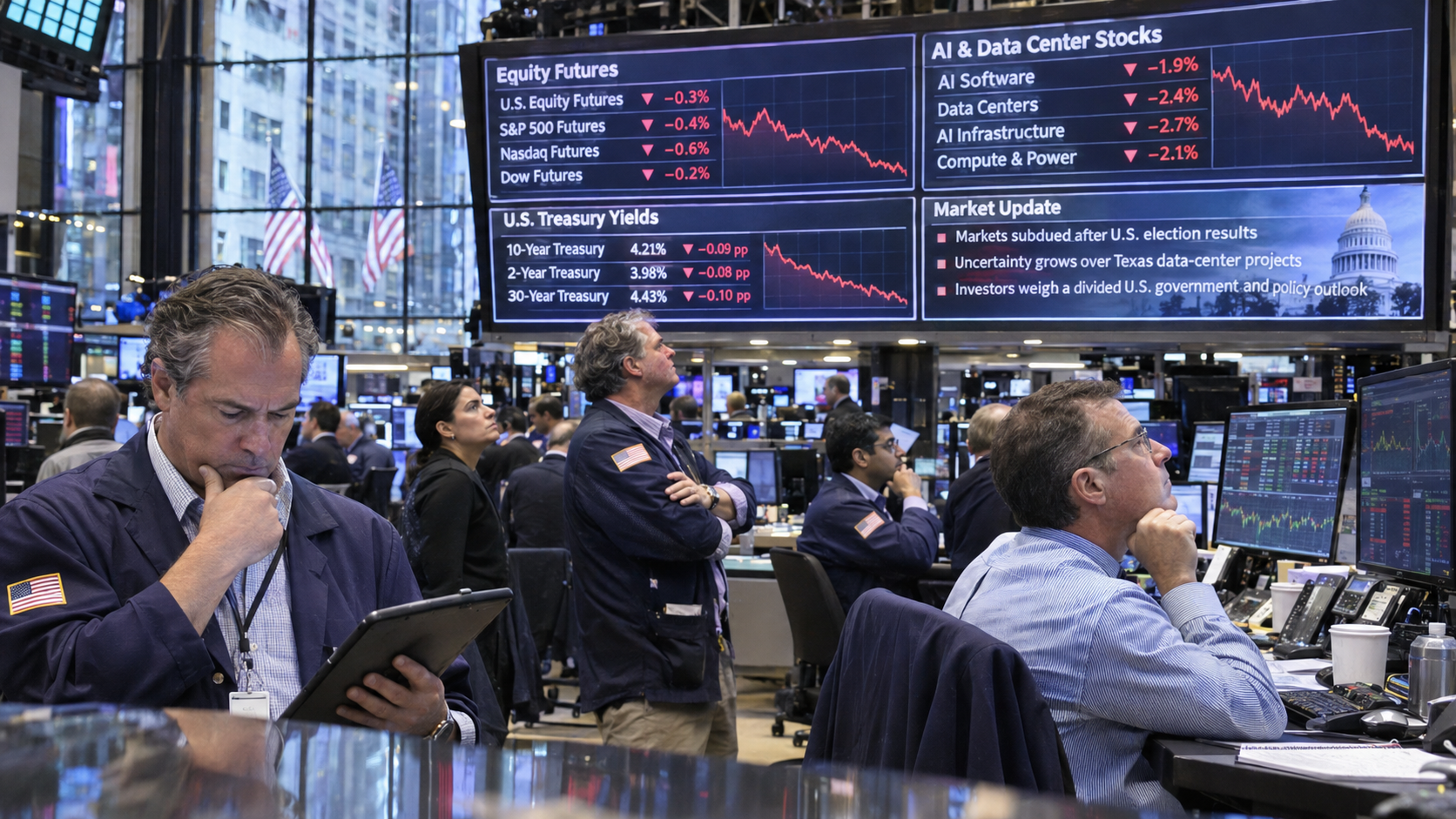
AI-related stocks and Nasdaq-100 futures fell in overnight trading after Democrat Gina Hinojosa was projected to defeat incumbent Republican Gov. Greg Abbott in Texas. The article says investors viewed the result as significant because Hinojosa has supported a moratorium on AI data-center development, while Texas is a major destination for planned data-center projects. Nasdaq-100 futures dropped 0.8%, the State Street Technology Select Sector SPDR ETF fell 2%, and several companies with direct ties to AI infrastructure recorded larger declines: CoreWeave lost 7%, SpaceX 6%, Nebius Group 4%, and Oracle 4% on Robinhood.
Although markets had already anticipated Democratic gains in Congress, the Texas governor’s race appeared to be the most consequential election outcome for technology shares. Horizon Investments’ Scott Ladner said Texas had been fertile ground for data-center construction and warned that a Democratic victory could make it more difficult to build there. Wells Fargo estimates that Texas accounts for 27% of planned U.S. data-center capacity, measured in gigawatts. Georgia, another state where Democrats were projected to win or retain the governorship, represents 7%; Ohio and Pennsylvania each account for 5%.
The selloff adds political risk to an AI trade already under pressure. The Nasdaq-100 had entered correction territory at the end of October amid concerns that spending by major cloud companies and private AI firms OpenAI and Anthropic could slow. Wells Fargo strategist Ohsung Kwon described a Texas Democratic win as a potential “left-tail event” for AI stocks. Bank of America strategist Michael Hartnett had also warned that Democratic control of the Senate combined with a Texas governorship win could contribute to a stock-market slump of more than 10% by year-end. The article concludes that data centers have become politically contentious, and that election results may encourage officials to block, delay, or raise the costs of projects.
Entities: Gina Hinojosa, Greg Abbott, Texas, Nasdaq-100, CoreWeave • Tone: analytical • Sentiment: negative • Intent: analyze
04-11-2026
U.S. Treasury yields declined as investors moved toward government bonds amid a sell-off in stock futures following election results that pointed to significant Democratic gains in the 2026 U.S. midterm elections. The 10-year Treasury note yield fell nearly five basis points to 4.902%, while the 30-year bond yield dropped 5.29% and the two-year note yield declined six basis points to 4.55%. The article notes that one basis point is 0.01% and that bond prices and yields move in opposite directions.
A CNBC Election Desk projection said Democrats were expected to win the House. Control of the Senate remained uncertain, although Democrats had flipped a North Carolina seat, with former governor Roy Cooper projected to win. As results came in, stock futures dropped sharply: S&P 500-linked contracts lost 1.1%, and Nasdaq-100 futures fell 2%.
AI-related shares led the overnight equity decline. The article attributes investor concern to the possibility that Democratic gains could slow the expansion of data centers, a sector associated with the AI boom and recent stock-market gains. Overall, the report describes a shift toward Treasuries and away from equities as markets reacted to election uncertainty and the perceived implications of the results for technology investment.
Entities: U.S. Treasury yields, U.S. midterm elections, Democratic Party, 10-year Treasury note, 30-year Treasury bond • Tone: analytical • Sentiment: negative • Intent: inform
04-11-2026
Asian equities and the US dollar weakened on Wednesday as investors reacted to US midterm election results that gave Democrats control of the Senate and put them on course to win the House of Representatives. The results represented a setback for President Donald Trump and Republicans, who had held both chambers during the first two years of Trump’s second term. Cost-of-living concerns, including high fuel prices, and opposition to data-centre development contributed to Democratic gains. Investors are weighing whether the outcome could bring tighter regulation of artificial intelligence, as well as changes to policy on government finances, defence, healthcare, banking and cryptocurrency.
The prospect of divided government raised concerns about legislative gridlock. Trump said he would veto Democratic legislation, though he also suggested deals might eventually be possible. Analysts warned that disputes over spending and the debt ceiling, investigations and limited legislative progress could follow. They noted that the president would retain substantial executive powers, making the consequences for individual industries uncertain; markets may already have anticipated a narrow Democratic victory, while a decisive one could prompt investors to reassess Trump’s remaining agenda and the political outlook toward 2028.
The uncertainty weighed on markets. European index futures fell, the dollar declined against major currencies, and the yen strengthened, contributing to losses among Japanese exporters. Tokyo’s Nikkei 225 fell 2.85%, with declines also reported in Shanghai, Sydney, Seoul, Singapore and Taipei, while Hong Kong edged higher. Technology shares faced additional pressure amid concerns about AI regulation and whether the billions invested in the sector will generate returns. US markets had been mixed on Tuesday: the S&P 500 and Nasdaq rose, while the Dow fell. Oil prices also declined, with Brent below $104 a barrel and US crude near $96. Gold rose nearly 0.5%.
Entities: Donald Trump, Chris Weston, Jon Husted, Sherrod Brown, Democratic control of Congress • Tone: analytical • Sentiment: negative • Intent: analyze