30-10-2026
The article reports that Israeli Prime Minister Benjamin Netanyahu attacked Palestinian-Israeli parties after a final vote count left him short of a parliamentary majority. Netanyahu accused the parties of election fraud. The count placed them in a strong position to help determine which political bloc can form the next government, giving their role in coalition negotiations added significance. The supplied article text does not include further details about the allegations, the parties’ response, or the possible coalition arrangements.
Entities: Benjamin Netanyahu, Israel, Jerusalem, Palestinian-Israeli parties, Arab parties • Tone: analytical • Sentiment: neutral • Intent: inform
30-10-2026
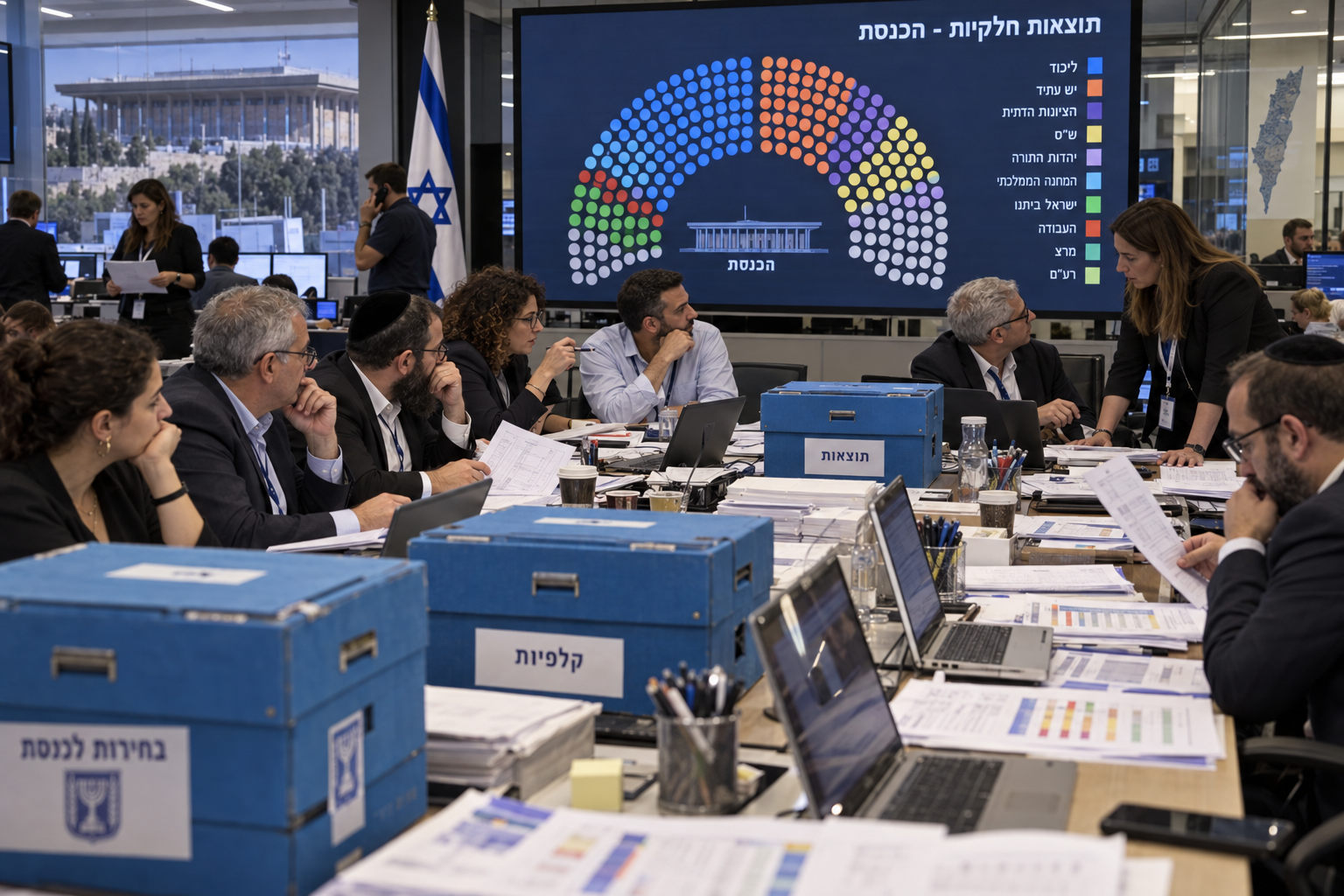
Israel’s final election count has left both Prime Minister Benjamin Netanyahu’s right-wing bloc and the opposition led by former military chief Gadi Eisenkot short of the 61 seats required to form a majority in the 120-seat Knesset. Likud and its hard-right allies won 53 seats, down from 64 in 2022, while Eisenkot’s bloc won 48. The Joint List and Ra’am, the Arab-led parties, together secured 19 seats, a record high. Because many opposition parties reject relying on those parties—and Eisenkot has said neither meets his conditions for partnership—his path to forming a government is difficult.
The result is expected to bring weeks of coalition negotiations and uncertainty. Likud has claimed, without presenting evidence, that Arab-led parties “stole” the election and alleged foreign interference. These claims followed a request by Supreme Court Justice Noam Sohlberg, chair of the Central Elections Committee, for the Shin Bet to investigate suspicions of improper influence through foreign funding. Sohlberg said he could not confirm the suspicions and asked agencies to verify them. Qatar, accused of trying to mobilize Arab voters, denied interference. Opposition leaders called for a full investigation while cautioning against using the allegations to undermine the results.
The count is complete, but results may receive minor corrections before certification and submission to President Isaac Herzog. The new Knesset is scheduled to be sworn in Nov. 10, and challenges to the results may be filed until Nov. 18. Herzog will consult the parties and designate the candidate he believes has the best chance of forming a government. Netanyahu could receive the first 28-day mandate, extendable by up to 14 days. If negotiations fail, Israel will hold another election, with Netanyahu remaining caretaker prime minister in the interim. A unity government is another possibility, though many opponents have ruled it out.
Political uncertainty has also weighed on Israeli financial markets. The shekel recorded its steepest intraday fall since 2023 before recovering, while Tel Aviv’s benchmark stock index fell 4.1% for the week through Friday morning. Analysts expect near-term volatility until a government is formed and makes decisions on fiscal consolidation and war spending, though Israel’s economic fundamentals and monetary policy may provide support. The article also identifies a possible return to war with Iran as a risk.
Entities: Benjamin Netanyahu, Gadi Eisenkot, Likud, Knesset, Central Elections Committee • Tone: analytical • Sentiment: neutral • Intent: inform
30-10-2026
Final results from Israel’s October 2026 general election put Prime Minister Benjamin Netanyahu’s right-wing and far-right coalition ahead, but without enough seats to govern alone. The coalition won 53 of the Knesset’s 120 seats, including 27 for Likud, while the opposition bloc led by centrist Gadi Eisenkot won 48. The Arab party groupings Raam and the Joint List secured 19 seats combined, potentially giving them leverage in coalition negotiations. With 61 seats required for a majority, the fragmented result is expected to lead to difficult talks and could trigger another election if no government can be formed.
The results were accompanied by a dispute over allegations that Arab-Israeli groups, particularly Raam, received foreign funding from Qatar to influence the vote. Netanyahu’s Likud party described the claims as a major scandal and alleged that the election had been stolen. Raam leader Mansour Abbas denied wrongdoing and welcomed an investigation; the Joint List accused Netanyahu’s allies of incitement against Arab voters. Qatar rejected the allegations, and officials had provided no evidence to support them.
Israel’s Shin Bet said it was investigating suspected irregularities but cautioned against blaming an entire community. The Central Elections Committee’s acting director general said claims of widespread problems were groundless. Police arrested three suspects in a cash-related incident, which the commission characterized as an isolated local case. Opposition figures accused Netanyahu of trying to delegitimize the election results, while Eisenkot said it was too early to determine whether any irregularities had occurred. Joint List leader Yousef Jabareen said he was willing to cooperate with the opposition to remove Netanyahu, but not to join an opposition-led government. The allegations also revived scrutiny of Netanyahu’s past links to Qatar, including the arrests of two aides last year over alleged payments from the Gulf state.
Entities: Benjamin Netanyahu, Gadi Eisenkot, Mansour Abbas, Yair Golan, Yousef Jabareen • Tone: analytical • Sentiment: neutral • Intent: inform
30-10-2026
Israel’s final election count left Prime Minister Benjamin Netanyahu’s Likud-led hard-right bloc with 53 parliamentary seats and the main opposition bloc, led by former military chief Gadi Eisenkot, with 48. Neither side reaches the 61 seats needed for a majority. Two Arab parties won 19 seats, their strongest result ever, potentially giving them significant influence in coalition negotiations. The tally is expected to receive minor corrections before being formalized on Nov. 4; parties can file complaints or legal challenges until Nov. 18.
President Isaac Herzog will consult party leaders and decide who has the best chance of forming a government. Eisenkot is considered likely to receive the first opportunity, since the leader with the most recommendations from other parties is generally given priority. A candidate has 28 days to assemble a majority and may request a 14-day extension. If successive candidates fail, Israel would hold another election, though Herzog has said every effort should be made to avoid one. Forming a government has historically taken between 20 and 100 days.
The vote was widely viewed as a referendum on Netanyahu and the first election since the Hamas-led Oct. 7, 2023 attack and the ensuing Gaza war. Turnout was the highest since 1999. Despite public anger over Netanyahu’s handling of the attack, the opposition did not win enough seats to remove him immediately; Netanyahu performed better than expected by emphasizing concerns about Arab political power and security. Eisenkot had accused Netanyahu of steering Israel toward authoritarianism and damaging its international standing.
The results leave the opposition facing a difficult choice: seek support from Arab parties, despite resistance among many Jewish parties and voters, or consider a unity government with Netanyahu. The blocs could also try to attract rival lawmakers. Analysts say prolonged negotiations could benefit Netanyahu, who would remain caretaker prime minister. The outcome has revived fears of the political paralysis Israel experienced from 2019 to 2022, when voters went to the polls five times.
Entities: Benjamin Netanyahu, Gadi Eisenkot, Isaac Herzog, Assaf Shapira, Israel • Tone: analytical • Sentiment: neutral • Intent: inform
30-10-2026
Final results in Israel’s general election show Prime Minister Benjamin Netanyahu’s bloc finishing ahead of the opposition but without enough seats to command a majority in the 120-member Knesset. Netanyahu’s right-wing and far-right coalition won 53 seats, including 27 for his Likud party, the largest single faction. The opposition, led by centrist Gadi Eisenkot, secured 48 seats. Arab parties Raam and the United Arab List together won 19 seats, giving them potential influence as coalition negotiations begin.
The Arab parties had been targeted by unproven fraud allegations circulated by Netanyahu’s camp. Politicians and media reports alleged that they received Qatari funds to finance vote-buying. Both the parties and Qatar denied the claims, while Eisenkot accused Netanyahu of trying to delegitimise the election results. Israel’s Shin Bet said it was investigating suspected irregularities, but stressed that the inquiry was not intended to cast suspicion on an entire community that had voted lawfully. The Central Elections Committee also said some information circulating about the allegations was entirely unfounded, and said its investigation would not affect the final results.
The results are due to be formally presented to President Isaac Herzog on Nov 4. Herzog will consult party leaders before asking one of them to attempt to form a government. With no bloc holding a majority, coalition talks could be difficult and last for weeks. If no government can be formed, Israel may have to hold another election, as it has several times before.
Entities: Benjamin Netanyahu, Gadi Eisenkot, Isaac Herzog, Israel, Jerusalem • Tone: analytical • Sentiment: neutral • Intent: inform
30-10-2026
The National’s editorial argues that Israel’s Arab citizens and their elected representatives should be included in negotiations to form the country’s next government. The latest election produced no clear governing majority, but Arab citizens turned out at a rate of about 80 per cent, helping the Arab-majority Joint List and Raam achieve a projected record 19 seats in the 120-seat Knesset. Their combined support could determine whether Prime Minister Benjamin Netanyahu remains in office or opposition leader Gadi Eisenkot forms an alternative government.
The editorial cautions against treating the Joint List and Raam as a single bloc: the former brings together left-wing, Arab nationalist and anti-Zionist parties, while Raam is Islamist. Despite ideological differences, both seek recognition of Arab citizens as legitimate participants in decisions about Israel’s future. The article describes the political marginalisation of roughly two million Arab citizens—about one-fifth of the population—as unjust and unsustainable.
Coalition-building faces resistance. Netanyahu has rejected an alliance with the Arab-majority parties, while Arab leaders have said they want to remove his government. Eisenkot and some potential partners are also wary of relying on Arab-party support, fearing voter backlash. The editorial points to former prime minister Naftali Bennett’s government, which was supported by Raam, as evidence that Jewish-Arab political cooperation is possible.
The article says a workable government is urgently needed amid economic uncertainty, strained regional relations and the unresolved Israeli-Palestinian conflict. It also cites Israel’s military campaigns and the devastation of Gaza as factors deepening the country’s international isolation. While an inclusive coalition would not automatically resolve the conflict or broader Jewish-Arab tensions, it could begin to reduce alienation and address crime, housing and underinvestment in Arab communities. The editorial concludes by urging Israel’s main political blocs to negotiate in good faith and accept the country’s diverse reality rather than govern according to an exclusionary vision.
Entities: Israel, Arab citizens of Israel, Joint List, Raam, Knesset • Tone: analytical • Sentiment: negative • Intent: persuade