30-08-2026
A flash flood and landslide disaster near Nepal’s border with Tibet has destroyed villages, killed many people and left almost 3,000 missing. The disaster was triggered when part of a Himalayan glacier broke off and crashed into a river, sending a wall of water and mud through the region. Survivors from Timure and other areas were airlifted to Kathmandu, but many arrived without clothing, money, accommodation or basic supplies.
Gosok Phuntsok Choeling monastery, normally home to monks, has become a makeshift evacuation centre for nearly 200 displaced people. Volunteers, many of them young people from affected communities, are registering arrivals, distributing donations and caring for survivors. Everyone at the centre has lost someone, including people who were partially buried or whose family members remain missing.
Bhujung Tamang said he escaped with his wife and two daughters after hearing a huge boom and seeing his home swept away. Alina Lama, a trekking guide whose relatives are missing, criticised the government for leaving some evacuees to find their own way after being airlifted from the disaster zone. She said authorities must plan not only for immediate rescues but also for the long-term education, housing and care of orphaned children.
Nineteen-year-old Aananda Thapa Magar lost numerous relatives, including his father, grandfather, siblings and young niece. Despite his grief, he is helping other survivors and focusing on rebuilding the future. He hopes families can recover the bodies of loved ones for proper burial and rituals. Nepal’s Finance Minister estimates reconstruction will cost between US$4 billion and US$5 billion, highlighting the enormous scale of the recovery ahead.
Entities: Nepal, Tibet, Kathmandu, Timure village, Rasuwa district • Tone: emotional • Sentiment: negative • Intent: inform
30-08-2026
The Al Jazeera Newsfeed video reports on severe flooding at the Nepal-Tibet border, where raging floodwaters have isolated a house and left people trapped on rooftops and balconies. The title describes the property as a “miracle home” amid widespread devastation, suggesting that the structure has remained standing or accessible despite the surrounding destruction. The footage focuses on the immediate physical danger created by the floodwaters and the isolation of those affected.
Authorities cited in the report say that at least 675 people have been killed and nearly 2,500 remain missing. These figures indicate a disaster of substantial scale, although the excerpt does not identify the specific flooding event, explain when the deaths occurred, or provide a breakdown of casualties by location. It also does not include details about rescue operations, the condition of the trapped people, damage to infrastructure, the causes of the flooding, or assistance being provided by government agencies.
Published on August 30, 2026, the short video item appears intended to convey the severity of the disaster through dramatic footage and a concise casualty update. Its focus is visual rather than analytical: viewers are shown floodwaters surrounding the home and people seeking safety above ground level, while the authorities’ figures communicate the broader human toll. The report presents the situation as an ongoing emergency, particularly because thousands of people are still unaccounted for. Beyond the location, the footage, and the reported death and missing-person figures, the supplied text provides no additional context about the affected communities or the wider response.
Entities: Nepal, Tibet, Nepal-Tibet border, Al Jazeera, raging floodwaters • Tone: urgent • Sentiment: negative • Intent: inform
30-08-2026
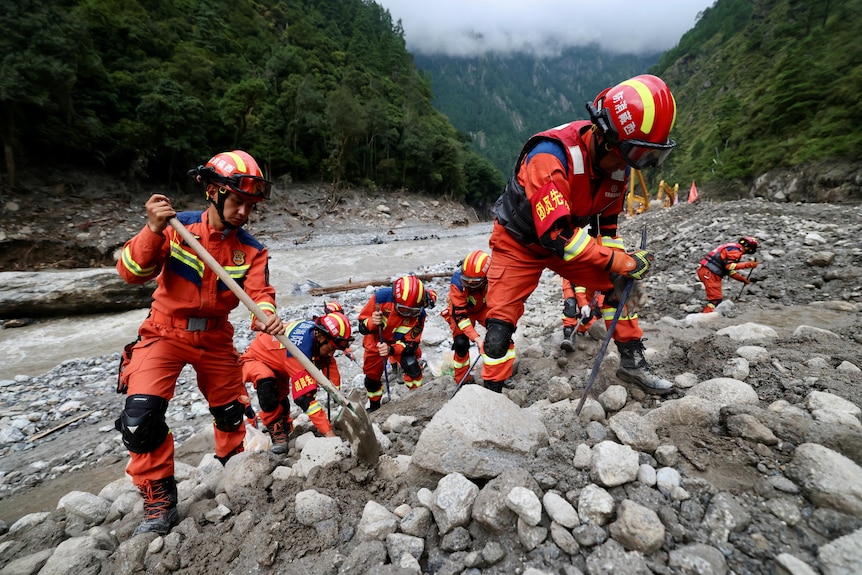
The death toll from devastating flash floods in Nepal and Tibet, an autonomous region of China, has risen to 691, while more than 3,000 people remain missing. Nepal reported 675 deaths and 2,498 missing people, while Chinese authorities reported 16 deaths and 546 missing. Poor weather, difficult Himalayan terrain, mud and debris have slowed aerial rescue operations, although helicopters have resumed flights in badly affected districts such as Nuwakot. More than 3,700 people have been rescued in Nepal, with aircraft delivering food, clothing and other supplies while evacuating survivors. Hundreds of missing people are believed to be foreign workers, trekkers or pilgrims.
Authorities have also warned of further flooding after the Bhotekoshi River rose in Rasuwa and a new lake formed high in the Himalayas. The United States has pledged more than $3.6 million in humanitarian assistance, including emergency food aid for as many as 10,000 households. India, China, Japan, Australia and other countries have also supplied relief materials.
Rescue teams are concentrating on hydropower tunnels where more than 100 workers may still be trapped, particularly at the Trishuli 3A and 3B projects. Rescuers have faced four to five feet of mud and limited landing areas. At Trishuli 3A, teams broke through enough mud to send air into the tunnel and began excavation and camera operations. Specialized rescue teams from India and China, along with Nepalese mountain-rescue experts, are assisting.
Families across Nepal are searching hospitals, relief centers and lists of missing people for information. A Kathmandu hospital has registered around 1,600 missing-person reports, while the Red Cross estimates that about 90,000 people have been affected. Officials say locating missing people is the national priority, and Nepal has requested additional expertise in tunnel rescue, survivor detection, forensic identification, DNA analysis and morgue capacity.
Entities: Nepal, Tibet and China, Nuwakot district, Rasuwa district, Bhotekoshi River • Tone: urgent • Sentiment: negative • Intent: inform
30-08-2026
The Straits Times roundup highlights five international stories reported around Aug 29-30, 2026. In Nepal, electrical technician Bikash Tharu and his co-workers narrowly survived the Aug 26 flash flood along the Bhote Koshi River because they overslept after a demanding workday. The delay allowed them to see the flood approaching and flee to higher ground before it destroyed an under-construction hydropower dam. Tharu later recounted the experience from a Nepali army relief camp in Nuwakot district.
In the United States, British far-right commentator Milo Yiannopoulos was deported to the United Kingdom after being arrested at New Orleans airport. US authorities said he had overstayed his welcome after entering the country legally in 2019. The article also reports on Norway’s new monarch, King Haakon VIII, who paid an emotional tribute to his late father, King Harald, in his first televised address to the nation. Harald died at 89 after more than three decades on the throne and was remembered as both a reformer and a devoted family man.
The roundup further describes a worsening power-supply situation at Ukraine’s Zaporizhzhia nuclear power plant. The facility has been without off-site electricity for more than a week and is relying on emergency diesel generators to keep its six shut-down reactors cool. The International Atomic Energy Agency said the plant had only about 10 days of diesel available and had not received a delivery to an off-site storage facility in roughly six months.
Finally, Tottenham Hotspur suffered a 2-0 defeat to Newcastle United after a promising first hour deteriorated into another second-half collapse. The result undermined coach Roberto De Zerbi’s efforts to rebuild the team’s relationship with its supporters.
Entities: Nepal flash flood of Aug 26, 2026, Bikash Tharu, Bhote Koshi River, Under-construction hydropower dam, Nepali army relief operation • Tone: neutral • Sentiment: neutral • Intent: inform
30-08-2026
The risk of a glacial lake bursting near the China-Nepal border has declined after the lake began shrinking and draining naturally, Chinese authorities reported on Saturday. The lake formed when glacier debris blocked or altered water flow near the site of a devastating flood earlier in the week. It lies at the confluence of two rivers and straddles China’s Tibet region and Nepal. Satellite imagery collected from Thursday through Saturday morning showed that water was gradually flowing out of the reservoir. By Saturday afternoon, sections of the lake bed were visible. The Chinese water resources ministry said the lake on the Purepu Tsangpo river covered approximately 99,000 square metres early Saturday—about the size of 14 soccer pitches—which was 21,000 square metres smaller than on Thursday. Authorities and experts had warned that the lake posed an extremely high risk of secondary disasters in the valley, potentially endangering downstream rescue operations. However, ministry experts said search-and-rescue work could safely continue if the lake’s outflow remained low or manageable and the water receded completely within two to three days. Rescue workers would also be alerted and evacuated if unusual changes were detected. According to CCTV, warnings could be issued more than 30 minutes in advance. The report presents the lake’s natural drainage as a significant reduction in the immediate threat, while emphasizing that monitoring remains necessary because abnormal outflows could still create danger for teams working downstream.
Entities: China-Nepal border, Tibet, Nepal, Purepu Tsangpo river, Chinese water resources ministry • Tone: analytical • Sentiment: neutral • Intent: inform