29-05-2026
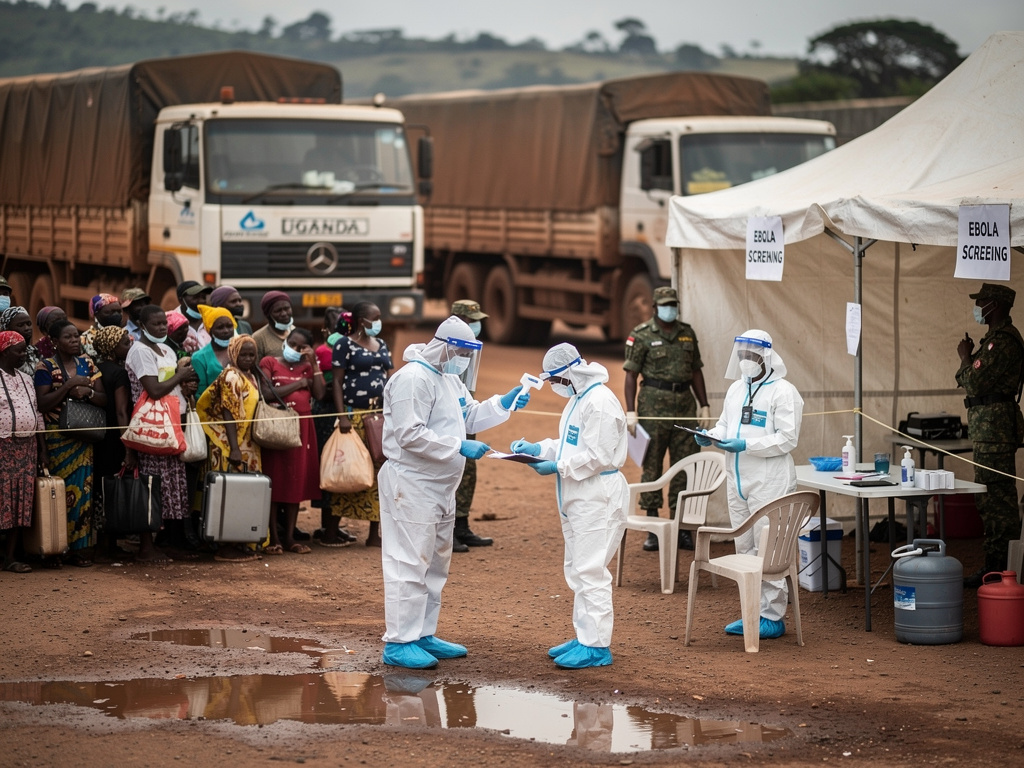
Uganda has closed its border with Congo in response to a worsening Ebola outbreak, despite guidance from the World Health Organization that discourages border closures. The outbreak involves Bundibugyo Ebola, a rare strain with no approved vaccines or medicines, and has already led to confirmed cases in both Congo and Uganda after Ugandan health workers were exposed to infected Congolese patients. Health officials in Uganda say crossings will be allowed only for emergencies, cargo, or security needs, and anyone entering under emergency circumstances will undergo mandatory 21-day isolation.
The article describes the scale and difficulty of the outbreak in eastern Congo, where the WHO says the outbreak is outpacing local response efforts amid armed conflict, displacement, and poor infrastructure. The WHO has declared the outbreak a public health emergency of international concern and says border closures can push travel to informal crossings, increasing transmission risk. Meanwhile, Congolese authorities reported that the first recovered patient from the Bundibugyo virus has been discharged from treatment.
The article also details U.S. measures aimed at preventing Ebola exposure from reaching America. The U.S. is establishing a facility in Kenya to monitor Americans exposed to or infected with Ebola, and recent travelers from Congo, Uganda, or South Sudan must enter through designated airports for enhanced screening. Some foreign nationals and green card holders with recent travel to those countries are barred from entering the U.S. Secretary of State Marco Rubio said the U.S. will not allow Ebola cases into the country.
Entities: Uganda, Congo, Ebola, Bundibugyo virus, World Health Organization (WHO) • Tone: urgent • Sentiment: negative • Intent: inform
29-05-2026
The article examines the worsening Ebola outbreak in eastern Democratic Republic of the Congo and argues that major cuts to Western humanitarian aid, especially the dismantling of USAID, have weakened the global response. The outbreak began in Ituri province, a conflict-hit mining region with overcrowded displacement camps, limited medical infrastructure, and ongoing insecurity that makes containment especially difficult. Health workers warn that Ebola may have been circulating before it was formally declared and that the lack of laboratory capacity, protective equipment, and rapid-response systems is hampering efforts to detect and isolate cases quickly.
Frontline staff are described as working under extreme conditions, with several doctors and nurses having died after treating patients. The article also highlights distrust among some local communities, rumors and conspiracy theories about Ebola, and occasional attacks on healthcare facilities and burial teams. These tensions complicate public health efforts, especially because safe burials are essential to controlling the virus.
Interviews with Dr Papys Lame of the NGO Alima and Mercy Corps’ Selena Victor underscore how hard it is to contain the outbreak now compared with the heavily supported response to the 2014 West African Ebola crisis. While some funding is still arriving, it is far below the resources previously deployed, and officials fear the outbreak could last for months or spread further across borders unless there is stronger international support, better community cooperation, and some reduction in conflict.
Entities: Ebola, Democratic Republic of the Congo (DRC), Ituri province, Bunia, Kampala • Tone: analytical • Sentiment: negative • Intent: inform
29-05-2026
World Health Organization chief Tedros Adhanom Ghebreyesus arrived in the Democratic Republic of the Congo and said the country’s Ebola outbreak “can be stopped,” despite the scale of the crisis and the challenges posed by conflict in the affected region. Tedros traveled to Kinshasa before heading to Ituri province, where the outbreak is centered, and urged armed groups to agree to a ceasefire so medical teams could operate more effectively. The WHO reported 10 confirmed and 223 suspected Ebola deaths out of more than 1,000 confirmed and suspected cases as of May 24, noting that the true spread may be broader because the virus may have circulated unnoticed for some time. This is the 17th Ebola outbreak in the DRC, and the current one is caused by the Bundibugyo strain, for which no vaccine or treatment is yet available. WHO advisory groups have recommended clinical trials for vaccines and treatments, while African Union health officials said a vaccine could be ready by year’s end. Neighboring Uganda closed its border with the DRC after recording one death and six additional cases, and the United States announced entry restrictions for infected individuals while preparing a treatment facility in Kenya for affected U.S. citizens. The article also notes international aid shipments, including 4.6 tonnes received by the WHO and 100 tonnes being sent by UNICEF, underscoring the urgency of the response.
Entities: World Health Organization (WHO), Tedros Adhanom Ghebreyesus, Democratic Republic of the Congo (DRC), Ituri province, Kinshasa • Tone: urgent • Sentiment: negative • Intent: inform