26-08-2026
The White House released a statement accusing Canada of abusing its trading relationship with the United States for decades, amid a worsening trade dispute and the collapse of tariff negotiations between Prime Minister Mark Carney and U.S. President Donald Trump. CBC News examines the statement’s claims and finds that some are factually accurate but often presented without important context, while others are opinions or debatable assertions.
The White House is broadly correct that Canada has retaliated against U.S. tariffs, unlike many other trading partners. Canada also imposed a 25 per cent tariff on certain U.S. vehicles, although it did so in response to an equivalent U.S. measure. Most Canadian provinces have removed American wine, beer and spirits from government liquor-store shelves, and U.S. alcohol exports to Canada reportedly fell sharply. However, the dairy claim is misleading: American dairy producers can export tariff-free within established quotas, and the higher over-quota tariffs—reportedly as high as 250 per cent—have never been applied. The current rules were also negotiated during Trump’s first term.
The White House’s claim about a roughly $50-billion annual U.S. goods trade deficit with Canada is technically accurate, but the deficit is primarily driven by Canadian oil exports. Excluding energy, the United States runs a goods surplus with Canada. Other claims, including that Canada could not survive without the U.S. market and that Canadian manufacturers are moving south because of failed Canadian policies, are presented as facts but are either hypothetical or based on evidence that does not support the stated conclusion. CBC concludes that the statement mixes accurate figures with selective framing, political opinion and assertions that cannot be definitively fact-checked.
Entities: White House, Canada, United States, Donald Trump, Mark Carney • Tone: analytical • Sentiment: neutral • Intent: analyze
26-08-2026
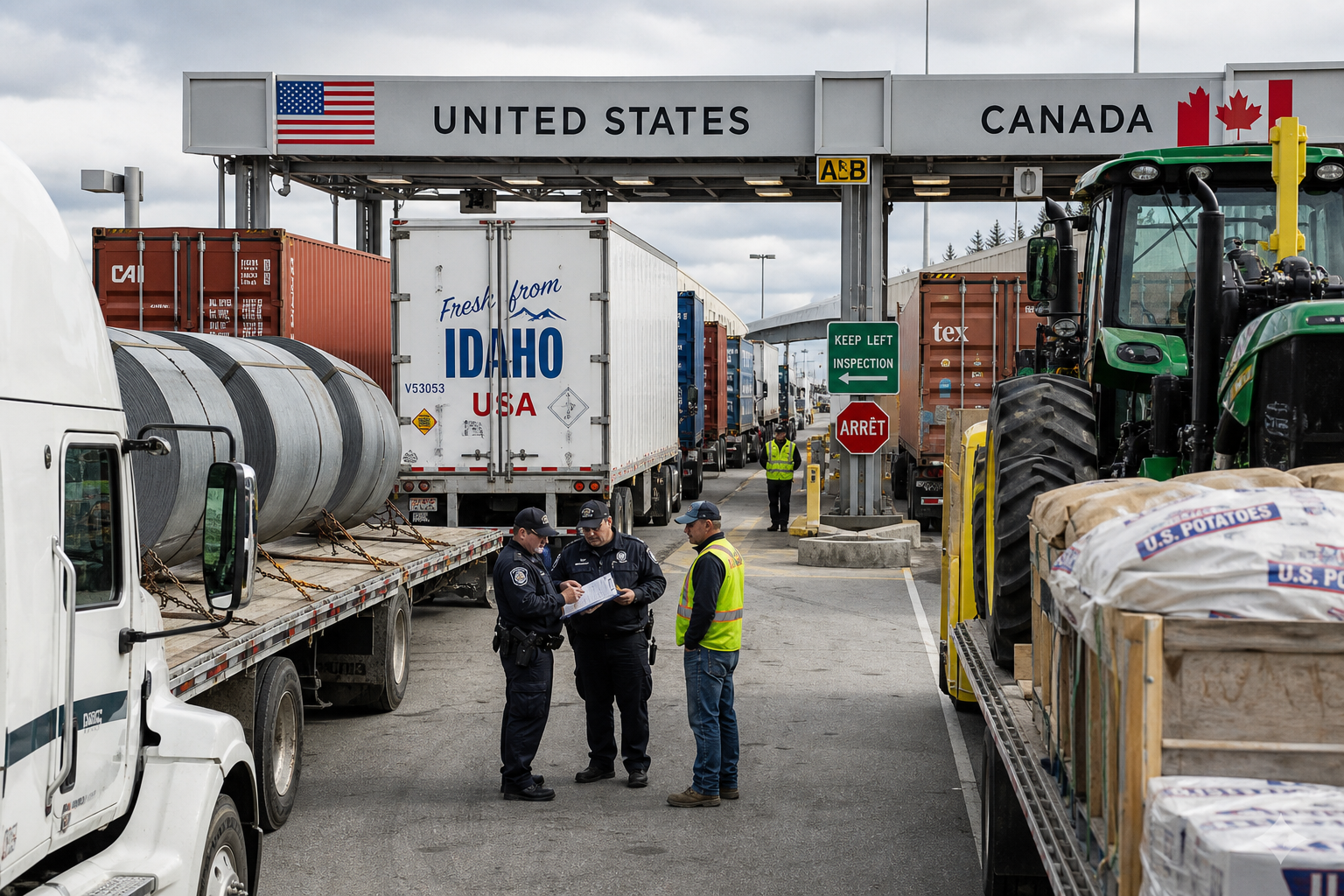
Canada announced retaliatory tariffs of up to 50 percent on hundreds of U.S. products, escalating a trade conflict with the United States that has intensified since President Donald Trump returned to the White House. Starting Sept. 8, Canada will raise tariffs on American steel and aluminum from 25 percent to 50 percent and impose duties ranging from 15 percent to 50 percent on roughly 700 additional products, including fish, dairy and other food products, plywood, plastics, appliances, agricultural equipment, motorcycles and electronics.
The measures respond to new U.S. tariffs of 50 percent on approximately $20 billion in Canadian goods, including whisky, dairy products, toys, clothing and hockey sticks. Canadian Prime Minister Mark Carney had promised a “dollar for dollar” response after trade talks in Washington collapsed. Finance Minister François-Philippe Champagne said the countertariffs are intended to protect Canadian industries affected by U.S. duties and help them compete in Canada.
The two countries have two weeks before the Canadian tariffs take effect, leaving time for negotiations, though no additional meetings were known to be scheduled. Trump continued criticizing Canada on social media, calling it difficult and unreasonable and suggesting he might rename Lake Ontario “Lake America.” He also threatened higher tariffs on Canadian vehicles, auto parts and steel beginning Jan. 1.
Although the affected goods represent relatively small portions of bilateral trade, the United States and Canada exchange more than $700 billion in goods annually and remain deeply integrated. Canadian potash supplies nearly 80 percent of the fertilizer used by U.S. farmers, Canadian hydropower supplies electricity to northern border states, and U.S. refineries depend on Canadian heavy crude oil. Analysts said the tariffs could pressure targeted industries and states and potentially push the Trump administration toward a deal. The dispute marks a significant deterioration in the traditionally close relationship between the two North American allies.
Entities: Canada, United States, Mark Carney, Donald Trump, François-Philippe Champagne • Tone: analytical • Sentiment: negative • Intent: analyze
26-08-2026
The article examines how escalating trade tensions between the United States and Canada are creating an opportunity for China to expand its global influence. According to the available text, President Donald Trump is imposing tariffs on goods from countries around the world, contributing to a broader disruption of established trade relationships. The U.S.-Canada conflict is presented as part of this wider breakdown in the international economic order.
Against that backdrop, China is attempting to position itself as an advocate of free trade and economic stability—roles historically associated with the United States. The article’s central argument is that while Washington adopts increasingly protectionist policies, Beijing is portraying itself as a more predictable and constructive participant in the global marketplace. This contrast could allow China to strengthen relationships with countries affected by U.S. tariffs and to gain diplomatic and economic influence.
The framing suggests that the trade war is not only a dispute over tariffs and market access. It is also a contest over which country will shape the rules and institutions of the global economy. The United States’ actions may weaken confidence among allies and trading partners, while China could benefit by presenting itself as a defender of stable markets. The article therefore highlights the possibility that American trade policy may produce strategic consequences beyond the immediate economic costs of tariffs.
Because the supplied webpage text contains only the headline, byline, introductory summary, and surrounding site material—not the full article—the analysis is limited to that available excerpt. No additional claims or details from the inaccessible body have been inferred.
Entities: United States, Canada, China, Donald Trump, Joshua Yang • Tone: analytical • Sentiment: negative • Intent: analyze
26-08-2026
CNBC’s Daily Open examines several ways the United States is using its economic and geopolitical power—and the retaliation or alternatives emerging in response. Canada has imposed roughly $20 billion in retaliatory tariffs on more than 700 U.S. goods, matching President Donald Trump’s newly announced 50% duties on a dollar-for-dollar basis. The measures target products including steel, aluminum, dairy, seafood, appliances, wood, paper and clothing, following a breakdown in trade talks.
The article also describes pressure on China over companies accused of helping Iran evade U.S. sanctions. Although Chinese banks remain dependent on access to the dollar-based financial system, China is gradually developing alternatives through its Cross-Border Interbank Payment System, or CIPS. The system’s activity has increased since the Russia-Ukraine war, suggesting Beijing is seeking a limited hedge against possible U.S. financial restrictions without abandoning dollar finance entirely.
In the Middle East, Iran is negotiating with Oman on a temporary joint shipping route and mine-clearing mission intended to restore navigation through the Strait of Hormuz, a vital oil-export corridor. Oman’s account appears to conflict with Trump’s claim that U.S. Navy personnel had already cleared mines from international waters.
Financial markets rose, led by chipmakers ahead of Nvidia’s earnings. Nvidia shares gained 2%, while AMD and Micron also advanced. Meanwhile, OpenAI’s head of data centers, Chris Malone, left the company, adding to a series of senior departures.
Apple announced updated Mac Mini and Mac Studio computers focused on artificial-intelligence applications. The Mac Mini can use the new M6 and M5 Pro chips, including the first Apple computer chip made on a 2-nanometer process. Its starting price rose to $899, which Apple attributed partly to higher memory costs.
Entities: Donald Trump, Mark Carney, United States–Canada trade dispute, Canada’s retaliatory tariffs, Iran • Tone: analytical • Sentiment: neutral • Intent: inform
26-08-2026
California Gov. Gavin Newsom says U.S. President Donald Trump will likely resume trade negotiations with Canada within days or, at most, two or three weeks. Newsom argues that Trump is facing mounting pressure from fellow Republicans, who risk losing control of both chambers of Congress in the November midterm elections. He says Trump cannot sustain a prolonged trade conflict with Canada because the tariffs are harming American businesses and voters.
The comments follow the collapse of Canada-U.S. trade talks. Prime Minister Mark Carney halted negotiations late the previous week, after which Trump imposed new tariffs on approximately $28 billion worth of Canadian goods. Newsom praised Carney’s response, saying Trump respects strength rather than weakness, and described the U.S. president as unable to afford a lengthy negotiating hiatus.
Newsom also strongly criticized Trump’s treatment of Canada, calling him an “invasive species” in the White House and saying he was “disgusted” and embarrassed as an American. California has been significantly affected by the trade dispute, particularly its wine industry. Canada had been the largest foreign market for California wine, but U.S. wine exports to Canada fell by US$343 million between 2024 and 2025. Canadian provinces have kept most California wines off their shelves for more than a year, creating frustration among producers.
Although California lawmakers have urged Quebec to restore U.S. alcohol sales, Newsom acknowledged that the province is unlikely to reverse its position soon after a proposed deal collapsed. He blamed the situation on Trump rather than California and said he understood Canada’s stance.
Newsom is not seeking another term as governor and is widely viewed as a possible Democratic candidate for president in 2028. He denied that his opposition to Trump’s tariffs is primarily intended to support a future campaign, while leaving open the possibility that he could run.
Entities: Gavin Newsom, Donald Trump, Mark Carney, Rosemary Barton, California • Tone: analytical • Sentiment: negative • Intent: inform