24-10-2026
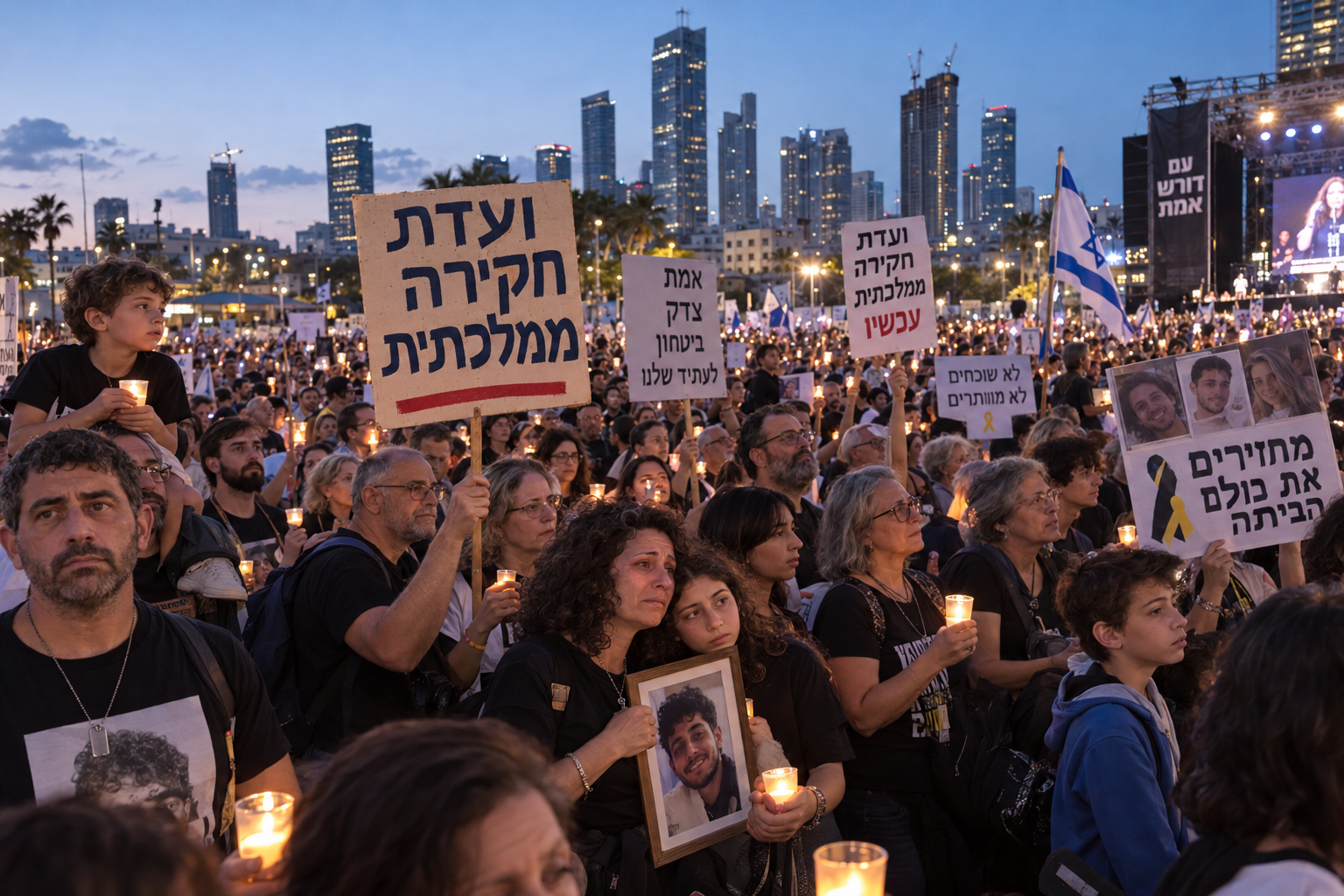
Thousands of people marched in Tel Aviv on October 24, three days before Israel’s general election, to protest Prime Minister Benjamin Netanyahu’s government and demand accountability for the failure to prevent the Hamas-led attack of October 7, 2023. The attack triggered the war in Gaza. The demonstration was organized by the October Council, founded by families of people killed or taken hostage during the attack. The group called for a state commission of inquiry, describing the rally as the culmination of three years of efforts to uncover the truth and secure accountability.
The demonstration began near Rabin Square, with marchers heading toward Hostages Square, a frequent site of protests calling for the release of captives held in Gaza. Opposition figures were expected to attend. The election was widely viewed as a referendum on Netanyahu, whose right-wing bloc was polling neck and neck with the bloc of centre-right rival Gadi Eisenkot. Polls published before a pre-election gag period indicated that neither bloc was projected to win a parliamentary majority.
Protesters also raised concerns about possible disruption by pro-government agitators. The October Council said it had alerted the police commissioner after receiving warnings about attempts by people linked to the governing coalition to interfere with the rally. One protester, Hadas Feuershtein, criticized the government’s performance and said Israel had never been in its current situation.
Israeli civil society groups and opposition parties have campaigned for an independent inquiry into the security failures preceding October 7. Netanyahu’s government has declined to establish one, proposing instead a commission whose members would be divided between government and opposition appointments. Opposition leaders have said they would boycott a body appointed by politicians.
Entities: Tel Aviv, Benjamin Netanyahu, Gadi Eisenkot, Hadas Feuershtein, October Council • Tone: analytical • Sentiment: neutral • Intent: inform
24-10-2026
Former Israel Defense Forces chief of staff Gadi Eisenkot is presenting himself as a potential alternative to Prime Minister Benjamin Netanyahu in Israel’s upcoming election, emphasizing the strategic relationship between Israel and the United States. He says Israel is a major US asset and shares democratic values, even as American public support for Israel has declined. Polls reportedly show Eisenkot leading and Netanyahu trailing, though Israel’s parliamentary system means the party with the most seats does not automatically get to form a government; a coalition of at least 61 of the Knesset’s 120 members is required.
Eisenkot’s political rise follows profound personal losses in the Gaza war: his son and two nephews were killed. The article portrays those losses as a turning point after Eisenkot served as IDF chief, briefly joined Netanyahu’s government after the October 7, 2023 attacks, and later became a prominent rival. Eisenkot praises President Donald Trump’s support for Israel, the strikes on Iran, and his role in securing the release of hostages. He also endorses Trump’s “peace through strength” approach, while warning about Iran’s nuclear ambitions and the strategies of Hamas and Hezbollah.
On Gaza, Eisenkot says a future government under his leadership would pursue a more realistic policy and honor commitments made to the United States, including steps toward a technocratic administration, reconstruction, and Israeli withdrawal in exchange for Hamas’s disarmament. He accuses Netanyahu of delaying US-backed arrangements for political reasons and of being constrained by coalition partners. Eisenkot also advocates expanding the Abraham Accords and proposes a US-backed regional security alliance involving Israel and moderate Sunni states. The article closes with his praise for US envoy Steve Witkoff and notes the inclusion of former hostage Ohad Ben Ami on Eisenkot’s party list.
Entities: Gadi Eisenkot, Benjamin Netanyahu, Israel Defense Forces (IDF), United States–Israel alliance, Gaza war • Tone: analytical • Sentiment: neutral • Intent: inform
24-10-2026
Gadi Eisenkot, a former chief of the Israeli military, is challenging Prime Minister Benjamin Netanyahu in Israel’s Oct. 27 election. He presents the contest as a choice between responsibility and evasion, arguing that Netanyahu has failed to accept blame for the security failures behind the Oct. 7, 2023, Hamas-led attack, weakened Israel’s international standing, encouraged authoritarianism and deepened divisions within Israeli society. Eisenkot promises an inquiry and a different approach to leadership, security and national unity. His candidacy is shaped by personal loss: his son Gal was killed while serving as a reservist in Gaza, as were two of Eisenkot’s nephews. Eisenkot says he hopes to honor the price his family has paid by creating a better future for Israeli children.
Eisenkot’s background and manner contrast sharply with Netanyahu’s. Born in Tiberias to Moroccan immigrants and raised in working-class Eilat, he could become Israel’s first Mizrahi prime minister. Supporters describe him as direct, strategic and committed to truth, while critics and supporters alike may find his understated, matter-of-fact campaign less inspiring than conventional political rhetoric. His limited experience in elected office, a shrinking polling lead and questions about how he would handle international pressure add to doubts about his ability to defeat Netanyahu.
The article also examines Eisenkot’s military record. He enforced discipline in the Golani Brigade, played a role in Israel’s response to the Second Intifada, opposed collective punishment of Palestinians and advocated political engagement to give them hope. At the same time, he took a hard line toward Hezbollah, including articulating the deterrence-focused “Dahiyeh doctrine.” The article portrays a security pragmatist whose character, personal grief and leadership style are central to an election increasingly framed around trust and responsibility.
Entities: Gadi Eisenkot, Benjamin Netanyahu, Israel's Oct. 27 election, Hamas-led attack of Oct. 7, 2023, Gaza Strip • Tone: analytical • Sentiment: negative • Intent: inform