23-08-2026
This brief Al Jazeera news report concerns an escalation in economic and political tensions between Iran and the United States. Mohsen Rezaei, identified as the secretary of Iran’s Supreme National Security Council, warns that countries that participate in what Tehran considers a US-led economic war against Iran will face retaliatory measures. He describes the anticipated response as “tit-for-tat” action, signaling that Iran intends to answer economic pressure with comparable actions against participating states.
The warning follows comments by US President Donald Trump, who threatened to impose or intensify “economic warfare” against Iran. The report frames the exchange as a confrontation in which economic restrictions and other forms of pressure could be used as instruments of conflict. While it refers to countries potentially joining the US effort, it does not identify those countries, specify the measures threatened by either side, or provide details about any new sanctions or policy decisions.
The language used by both sides reflects a highly adversarial relationship and suggests that the dispute could expand beyond direct US-Iranian relations if other governments become involved. Rezaei’s statement is presented as a warning intended to deter foreign governments from supporting Washington’s campaign. Trump’s remarks, meanwhile, are described as the immediate context for Iran’s response.
Overall, the article is primarily an alert-style account of threats exchanged over economic pressure. It does not offer independent analysis of the likely consequences, explain the legal or financial mechanisms involved, or report on an actual retaliatory action. Its central message is that Iran is warning third countries that participation in US economic measures could make them targets of Iranian countermeasures.
Entities: Iran, United States, Mohsen Rezaei, Iran’s Supreme National Security Council, Donald Trump • Tone: urgent • Sentiment: negative • Intent: inform
23-08-2026
This live update on the Iran war and related regional tensions reports developments involving cyberattacks, the Strait of Hormuz, Israel’s occupation of Palestinian territories, Gaza’s humanitarian crisis, and shifting international policies. It says hackers affiliated with Iran shut down a relatively small British power plant for four days in July, during a wider period of attacks on US water infrastructure. The British government has not identified the facility, citing security concerns.
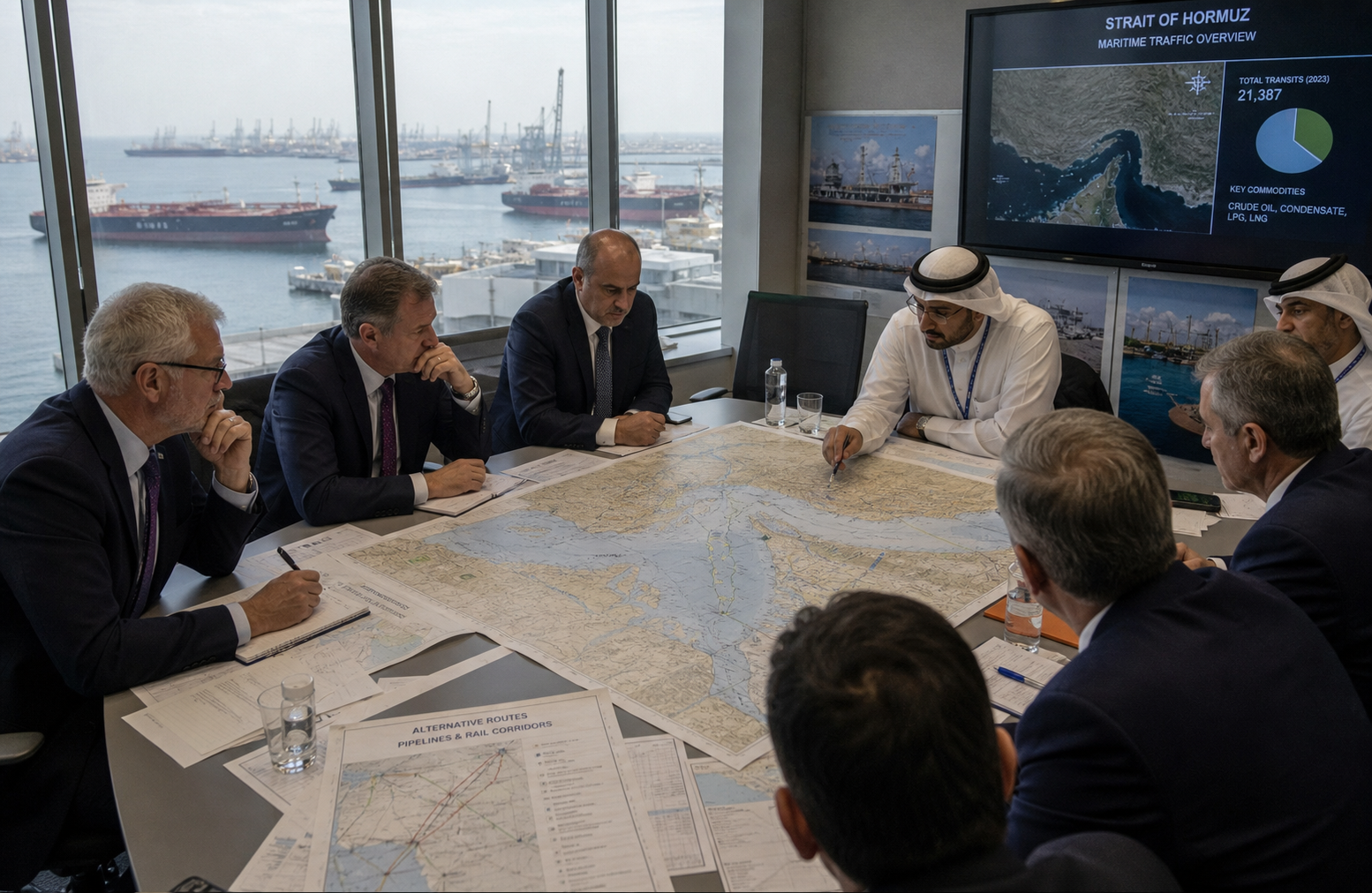
French President Emmanuel Macron is due to host Saudi Crown Prince Mohammed bin Salman in Paris, where they are expected to discuss alternative trade and energy routes to reduce dependence on the Strait of Hormuz. Proposed measures include expanding the use of Omani ports, increasing Saudi and regional pipeline capacity, and developing new rail links. Former US diplomat Joey Hood disputed President Donald Trump’s claim that the strait is US territory, while warning that Iran’s Islamic Revolutionary Guard Corps can threaten commercial shipping with drones and missiles. Trump repeated his claim in a Truth Social post.
The update also reports that the United States is preparing to remove Syria from its State Sponsors of Terrorism list. In the occupied West Bank, a Palestinian commission says 592 Israeli settlements and outposts are home to more than 700,000 settlers, while another figure cited by the commission places the total in the West Bank and East Jerusalem at 780,000. Dutch protesters demonstrated against trade in goods produced in Israeli settlements, as several European countries move toward national bans while the European Union delays a bloc-wide decision.
In Gaza, the report describes an acute shortage of burial space after more than 73,000 Palestinians were killed, according to the article, and 40 burial sites were destroyed. Families are reportedly burying victims in gardens, schools, tents, and displacement camps. The update also reports alleged property theft by Israeli settlers near Abu Falah and Israeli military activity in Qalqilya. The excerpt ends with former Israeli diplomat Alon Pinkas arguing that European condemnations do not influence Israel.
Entities: Iran, United Kingdom, United States, French President Emmanuel Macron, Saudi Crown Prince Mohammed bin Salman • Tone: urgent • Sentiment: negative • Intent: inform
23-08-2026
Iran has warned neighboring countries that it will regard them as enemies and target their interests if they participate in a US campaign designed to weaken Iran’s economy. Mohsen Rezaei, secretary of Iran’s Supreme National Security Council, delivered the warning in an interview with state broadcaster IRIB, saying Tehran would initially seek negotiations and de-escalation, then attempt to persuade regional governments to distance themselves from Washington. Countries that continued supporting the United States could ultimately face Iranian action.
The warning follows a sharp escalation in US economic threats. President Donald Trump said the United States would launch its “most crushing economic operation” against Iran and threatened “tremendous economic consequences” for any country providing Tehran with a lifeline. Treasury Secretary Scott Bessent reinforced the message by saying countries were either “with us or against us.” Rezaei argued that Washington hopes economic pressure will fracture Iranian society and provoke protests that would support US military operations.
The broader conflict between Iran, the United States, and Israel has continued since February 28, while negotiations have stalled after a June 17 memorandum of understanding calling for an immediate and permanent end to military operations failed. Control of the Strait of Hormuz remains a major dispute. Iran closed the strategic shipping lane early in the war, causing prices for oil and fertilizer to surge and prompting Middle Eastern countries to seek alternative trade routes.
Rezaei warned that Iran could target those substitute oil-shipping routes if regional states joined the US economic campaign. Iran’s Foreign Ministry separately condemned the planned US measures as an assertion of “extraterritorial sovereignty” over UN member states. Reports also suggest Tehran may expand its potential targets beyond the Middle East to US allies in Europe that have supported Trump’s actions.
Entities: Iran, Mohsen Rezaei, Iran’s Supreme National Security Council, Islamic Republic of Iran Broadcasting (IRIB), United States government • Tone: urgent • Sentiment: negative • Intent: inform
23-08-2026
This live update article describes escalating military, diplomatic and economic tensions in the war between the United States and Iran. Iranian President Masoud Pezeshkian claimed that the world had effectively recognized Iran’s victory and said the conflict should end, while also arguing that the United States had become globally “hated.” Iran separately warned that countries participating in U.S.-led sanctions would be treated as enemies and threatened to harm their interests. A senior Iranian politician also warned U.S. allies in the Gulf—including Qatar, Kuwait and the United Arab Emirates—that they could become targets because of their military and logistical support for Washington.
At the same time, Egypt attempted to revive U.S.-Iran diplomacy. Its foreign minister spoke with Iran’s foreign minister about de-escalation, ongoing Iranian-Omani discussions concerning the Strait of Hormuz, and potentially returning to a June memorandum of understanding between Washington and Tehran. Iran also permitted some Iraqi oil tankers to pass through the strait after requests from Baghdad.
The article reports that President Donald Trump is seeking an unprecedented campaign of economic isolation against Iran and has called on U.S. allies to participate. China, however, rejected sanctions it described as unilateral and illegal. The conflict has also fueled calls in Europe for a windfall tax on oil companies benefiting from soaring energy profits. Separately, France and Saudi Arabia are exploring alternative energy and trade routes to reduce the impact of the Strait of Hormuz closure, including expanded pipelines, Omani ports and new rail connections.
The update also reports an Israeli drone strike in southwestern Syria that wounded at least one person, with Syria accusing Israel of violating its sovereignty and Israel saying it targeted a person preparing terrorist attacks.
Entities: Iran, United States, Masoud Pezeshkian, Donald Trump, Strait of Hormuz • Tone: urgent • Sentiment: negative • Intent: inform
23-08-2026
Iran has warned governments not to participate in the United States’ campaign to economically isolate Tehran, saying countries that impose restrictions will be treated as enemies. Mohsen Rezaei, secretary of Iran’s Supreme National Security Council, issued the warning on Iranian state television and threatened a major retaliation if US President Donald Trump takes further action, describing the potential confrontation as being “like an earthquake.”
The warning follows Trump’s announcement of what he called the “most crushing economic operation” against Iran. Washington is urging other countries to support expanded sanctions and economic pressure. US Treasury Secretary Scott Bessent is expected to provide additional details about the measures and has characterized the effort as the largest coordinated economic isolation campaign in history, presenting governments with a choice between supporting the United States or opposing it.
China, one of Iran’s principal strategic partners, has rejected the campaign, arguing that sanctions and pressure will not resolve the dispute. Chinese Foreign Ministry spokesperson Lin Jian called on all sides to pursue political and diplomatic solutions. The United Arab Emirates, however, announced that it would suspend financial and economic ties with Tehran until further notice, citing regional escalations that threaten peace and security.
Talks between Washington and Tehran remain suspended after nearly six months of war, which the article says began when the United States and Israel launched airstrikes against Iran on February 28. Iran has faced almost five decades of economic sanctions since the 1979 Islamic Revolution. The latest developments raise the prospect of broader international economic divisions and further escalation between Iran, the United States, and their allies.
Entities: Iran, United States, Tehran, Mohsen Rezaei, Supreme National Security Council • Tone: urgent • Sentiment: negative • Intent: inform
23-08-2026
Iran has warned neighbouring countries that they could face retaliation if they support the United States in intensifying economic pressure on Tehran. Mohsen Rezaei, Iran’s newly appointed head of the Supreme National Security Council, said countries cooperating with Washington’s campaign would be regarded as enemies and that Iran could target their interests. He specifically warned that Iran might attack oil-shipping routes outside the Strait of Hormuz if neighbouring states became involved in what he called an economic war against Iran.
Rezaei’s comments followed US President Donald Trump’s pledge to impose an “unprecedented” level of economic warfare and isolation on Iran, which has been under sanctions for years. In an interview broadcast by Iranian state television, Rezaei said Tehran would respond to any US action “in a seismic manner.” He also cautioned Washington against deploying additional military personnel to the region, accused the US of worsening global nuclear insecurity and said Iran would revise its diplomatic approach while developing new capabilities for a possible future conflict.
The threats were issued as diplomatic and regional activity continued. Egypt’s foreign minister discussed efforts to revive US-Iran negotiations with Iran’s foreign minister. Iraq and Iran also said Tehran had helped some Iraqi oil tankers pass through the Strait of Hormuz. Meanwhile, France and Saudi Arabia were expected to discuss alternative routes around the strategic waterway. The article also notes that Israel had carried out strikes in Syria and Gaza, adding to the wider regional tension.
The warning raises concerns about the security of oil transportation and the possibility that economic pressure on Iran could trigger retaliation affecting neighbouring states and major energy routes.
Entities: Iran, Mohsen Rezaei, Supreme National Security Council, United States, Donald Trump • Tone: urgent • Sentiment: negative • Intent: inform