22-10-2026
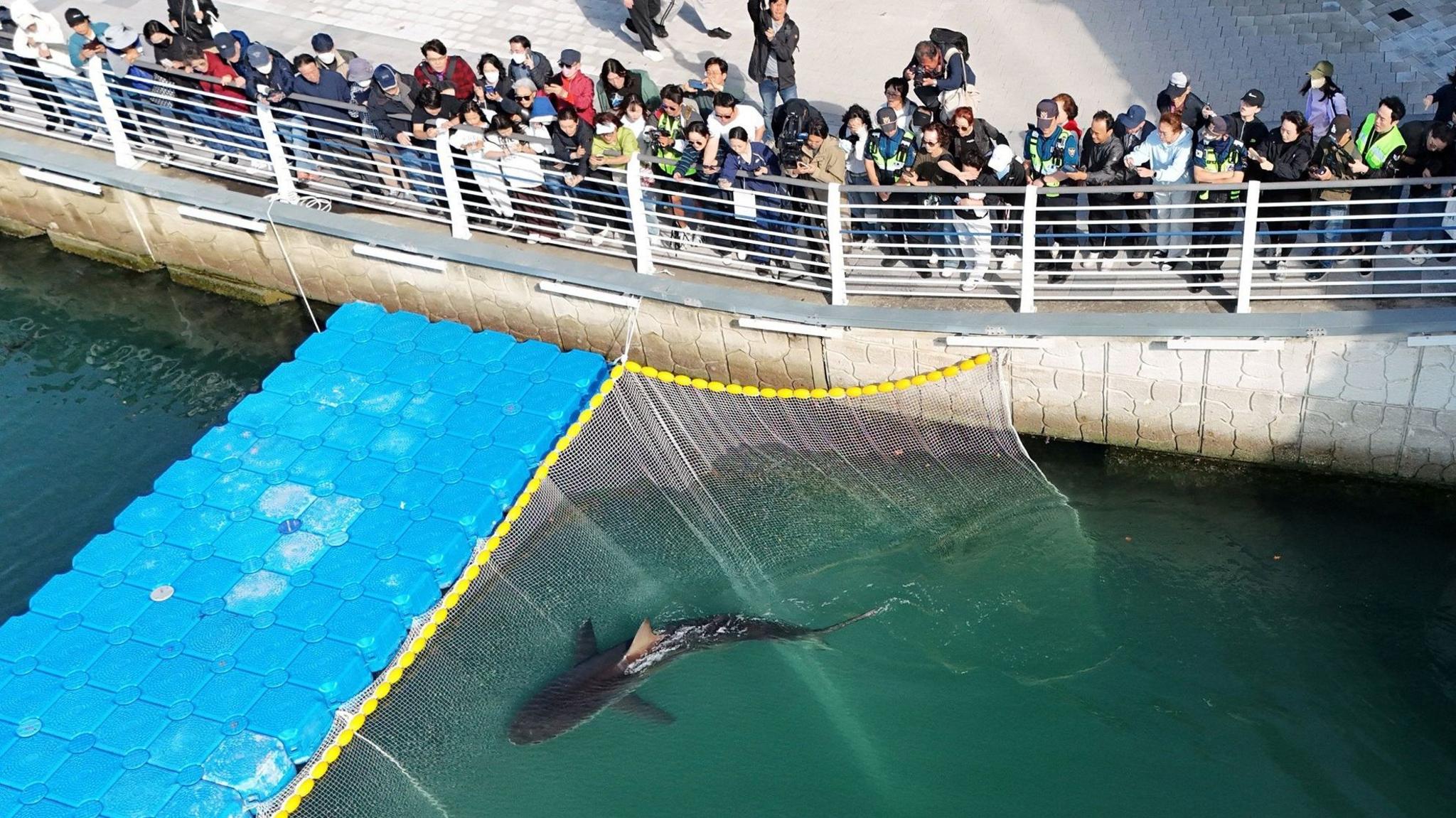
An endangered dusky shark known as Bukangi has been trapped in a canal in the South Korean port city of Busan for nearly a month after entering it in September. The three-metre shark has become a major attraction: more than 1.6 million people have visited Busan to see her, and she has even been adopted as a city mascot. Mayor Chun Jae-soo credited the shark with generating publicity that would otherwise have cost “trillions.”
Authorities have tried three times to guide Bukangi back to the sea. The latest effort, a large operation on Wednesday, used floating platforms, nets and divers over several hours. However, the oceans ministry said she later swam under one of the nets and returned to the canal. Officials said her condition was stable, but they are concerned that she may not be feeding regularly and could be at risk as water temperatures fall.
Kim Hyun-woo, a senior researcher at South Korea’s National Institute of Fisheries Science, said vessel noise and bright lights may have affected the shark’s senses and that she may now regard the canal as a safe place. He advised allowing about a week for her to leave voluntarily rather than expecting her to head directly into open water. Officials have opened the outer net while strengthening barriers to stop her moving farther into the canal. Environmentalists suggest warming ocean temperatures associated with climate change may have contributed to her entering the waterway. Dusky sharks are classified as endangered by the International Union for Conservation of Nature.
Entities: Bukangi, Dusky shark, Busan, South Korea, Chun Jae-soo • Tone: analytical • Sentiment: neutral • Intent: inform
22-10-2026
An endangered shark has returned to a canal in South Korea after rescuers guided it back out to sea. The animal reportedly swam beneath a net that had been installed to stop it from re-entering the waterway. The rescue effort therefore did not keep the shark out of the canal, and it was back in the area after the attempted intervention. The canal has become a popular attraction because of the shark, drawing 1.6 million visitors. The report does not identify the shark species or the canal’s precise location, and it gives no details about when the animal first entered the waterway, how the rescue was carried out, or what authorities plan to do next. It also does not explain whether the shark’s return poses a risk to the animal, visitors, or other people using the canal. The central event is the failed effort to guide the endangered shark back to the sea and prevent its return: despite rescuers’ actions and the barrier net, it swam back into the canal. The article presents this as a brief wildlife news update, emphasizing the unusual return and the waterway’s substantial visitor interest rather than offering broader commentary or detailed analysis.
Entities: South Korea, Endangered shark, Canal, Rescuers, Rescue attempt • Tone: neutral • Sentiment: neutral • Intent: inform
22-10-2026
Bukangi, a three-metre-long dusky shark that became a local celebrity after appearing in a canal in Busan, South Korea, has not yet moved out to sea despite an eight-hour rescue operation. On Wednesday, workers used nets to guide the shark toward open water while hundreds of spectators watched and cheered. Bukangi reportedly returned to the canal the following morning after breaking through a barrier. It was briefly trapped between two layers of netting, but rescuers freed it by removing the outer layer. Authorities reinforced the remaining barrier and said the shark has since ventured farther out, though it continues to circle back to the canal’s mouth. Officials have ended their rescue operations.
The shark is thought to have entered the canal because of unusually warm water and abundant fish. Experts say warming seas could bring more sharks to Busan. Bukangi’s month-long presence attracted more than 1.6 million visitors and gave the city’s tourism a boost, making the animal an unofficial mascot. At the same time, officials and observers worried about its apparent injury, lack of appetite and possible vulnerability as the water cools. Videos circulating online appear to show blood around its snout.
Residents disagree about whether the shark should remain in the canal or return to the sea. Some supporters protested the effort to move it, arguing that the canal had become its home and that nets or open water could endanger it. Others believed Bukangi looked thinner than when it first arrived and would be healthier feeding freely at sea. One admirer said he was sad to see the shark leave but hoped it could resume a normal life. After two earlier failed attempts to guide it out, the shark’s repeated returns leave its eventual fate uncertain.
Entities: Bukangi, Dusky shark, Busan, South Korea, North Gyeongsang province • Tone: analytical • Sentiment: neutral • Intent: inform