18-02-2026
Iran and the US have reached an understanding on 'guiding principles' to resolve their dispute over Tehran's nuclear programme during indirect talks in Geneva. Iranian Foreign Minister Abbas Araghchi stated that work still needs to be done, while the US said 'progress was made'. The talks follow repeated US military threats against Iran over its nuclear activities and deadly crackdown on anti-government protests. The US suspects Iran is moving towards developing a nuclear weapon, which Tehran denies. The negotiations concluded with 'good progress' towards identifying common goals and technical issues.
Entities: Iran, US, Geneva, Abbas Araghchi, Donald Trump • Tone: neutral • Sentiment: neutral • Intent: inform
18-02-2026
The US and Iran held high-stakes talks in Geneva, mediated by Oman, to negotiate a new nuclear deal. Iran's Foreign Minister Abbas Araghchi said the discussions were 'more constructive' and a 'clearer path ahead' had emerged. The talks come amid threats from President Trump to launch a new attack on Iran if a deal is not reached. The US is seeking to constrain Iran's nuclear capabilities, while Iran wants to ease damaging US economic sanctions. The negotiations are a continuation of previous talks, with the two sides exchanging drafts of a potential agreement and agreeing to meet again.
Entities: Abbas Araghchi, Ayatollah Ali Khamenei, Donald Trump, Benjamin Netanyahu, Oman • Tone: neutral • Sentiment: positive • Intent: inform
18-02-2026
US special envoys Jared Kushner and Steve Witkoff led diplomatic talks in Geneva, addressing Iran's nuclear program and the war between Russia and Ukraine. The negotiations were part of a broader effort by the US to engage with Tehran while also positioning military forces in the region. The talks aimed to ease tensions and potentially end the conflict in Ukraine.
Entities: Jared Kushner, Steve Witkoff, Geneva, Iran, Russia • Tone: neutral • Sentiment: neutral • Intent: inform
18-02-2026
Iran conducted naval drills in the Strait of Hormuz, firing live missiles and signaling readiness to close the waterway if ordered. The drills coincided with nuclear talks between Iran and the US in Geneva, with US envoys Steve Witkoff and Jared Kushner meeting senior Iranian officials. The Trump administration has increased its military presence in the Middle East, with US officials indicating that any nuclear deal must address broader security concerns, including Iran's ballistic missiles and sponsorship of terrorist organizations.
Entities: Iran, Strait of Hormuz, US, Geneva, Steve Witkoff • Tone: neutral • Sentiment: negative • Intent: inform
18-02-2026
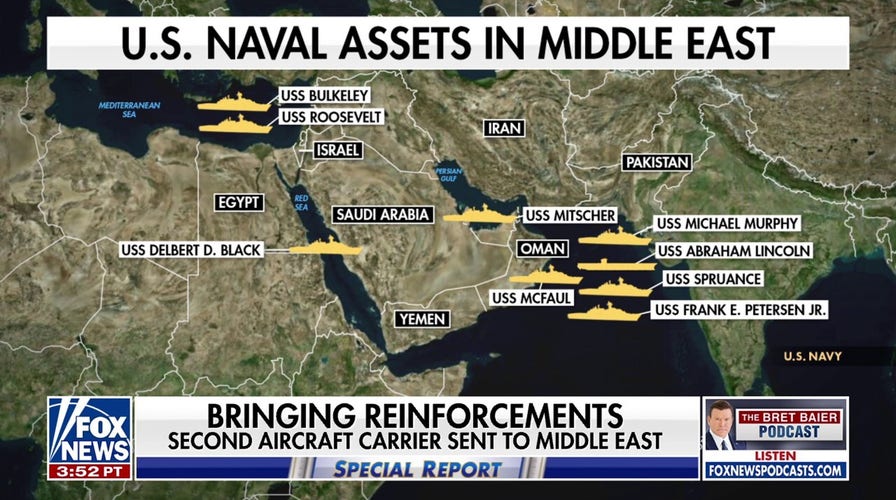
Iran launched a naval drill in the Strait of Hormuz on Monday, hours before nuclear talks resumed in Geneva between the U.S. and Iran. The drill, called 'Smart Control of the Strait of Hormuz,' was led by the naval forces of the Islamic Revolutionary Guard Corps (IRGC) and aimed to assess the readiness of operational units and rehearse scenarios for responding to security and military threats. The exercises came as the U.S. and Iran resumed diplomatic efforts to revive negotiations over Iran's nuclear program, with Iranian Foreign Minister Abbas Araghchi stating that Iran is in Geneva with 'real ideas to achieve a fair and equitable deal.' The U.S. has ordered a buildup of military forces in the Middle East, with the USS Abraham Lincoln aircraft carrier conducting around-the-clock flight operations in the region.
Entities: Iran, Strait of Hormuz, Geneva, U.S., Islamic Revolutionary Guard Corps (IRGC) • Tone: neutral • Sentiment: negative • Intent: inform
18-02-2026
Iran and the US have reached an understanding on 'guiding principles' after fresh talks on Tehran's nuclear capabilities in Geneva, mediated by Oman. Iran's foreign minister, Abbas Araghchi, said the 'path has started' towards an agreement, although an accord may not be reached soon. The talks come amid heightened tensions, with the US sending a second aircraft carrier to the Middle East and Iran conducting a military drill in the Strait of Hormuz. US President Donald Trump warned Iran of 'consequences' if the negotiations fail, while Iran's supreme leader, Ayatollah Ali Khamenei, struck a confrontational tone, saying the US could not topple his government.
Entities: Iran, United States, Geneva, Oman, Abbas Araghchi • Tone: neutral • Sentiment: negative • Intent: inform
18-02-2026
The Middle East is edging closer to war as the US and Iran engage in a standoff. The US has moved warships to the region, with the USS Lincoln aircraft carrier strike group conducting exercises. Iran has responded with its own military drills, including missile strikes and simulated tanker seizures, in the strategic Strait of Hormuz. Iran's Supreme Leader Ayatollah Ali Khamenei has threatened to sink US warships, while US President Donald Trump has warned that failure to reach a deal could lead to US strikes. Despite talks between the two countries, the prospects for a diplomatic solution appear uncertain, with Iran refusing to compromise on its nuclear enrichment program.
Entities: Donald Trump, Iran, US, Ayatollah Ali Khamenei, Strait of Hormuz • Tone: urgent • Sentiment: negative • Intent: inform
18-02-2026
Iran is attempting to entice the US into a nuclear deal by framing it as a 'trillion-dollar opportunity' for American firms to access its vast energy and mineral reserves. Despite this effort to speak the language of US President Trump, known for his deal-making, deep mistrust and domestic opposition on both sides pose significant challenges to the success of the talks. Iranian officials have emphasized that for the agreement to be durable, the US must also benefit in areas with high and quick economic returns, highlighting common interests in oil, gas, and mining investments as part of the negotiations.
Entities: Iran, US, Trump, Tehran, Geneva • Tone: neutral • Sentiment: neutral • Intent: inform
18-02-2026
Iran and the US held talks in Geneva, mediated by Oman, to avoid conflict over Iran's nuclear program. Iran's Foreign Minister Abbas Araghchi said the talks were 'more constructive' than the previous round and that they agreed on 'guiding principles' for a potential agreement. However, US Vice-President JD Vance stated that Iran had not yet acknowledged all of Washington's 'red lines'. The talks come amid heightened tensions, with the US deploying two aircraft carriers to the region and Iran conducting war games in the Strait of Hormuz.
Entities: Iran, United States, Geneva, Oman, Abbas Araghchi • Tone: neutral • Sentiment: negative • Intent: inform