15-10-2026
The live update reports a widening conflict involving Iran, the United States, Israel, Saudi Arabia, and Yemen’s Houthi rebels. Explosions were heard over Riyadh after the Houthis launched a ballistic missile that Saudi Arabia says it intercepted. The Houthis threatened further attacks on Saudi airports and oil infrastructure, while President Donald Trump said he was considering U.S. strikes against them. The rebels warned that U.S. action could prompt attacks on American personnel and interests across the Middle East, potentially drawing Washington further into the broader war that began with U.S.-Israeli strikes on Iran.
Other updates describe mounting tensions beyond Yemen. Iran’s parliament speaker, Mohammad Bagher Qalibaf, said Iran must remain ready for war even while negotiating with Washington, arguing that an agreement would not ensure the United States kept its promises. Trump, speaking at a rally in Arizona, said leakers of potential U.S. attack plans should be dealt with harshly, after reports that the Pentagon had developed options for strikes against Iran. U.S. Central Command also said American forces destroyed an Iran-affiliated dhow in the Gulf of Oman after it allegedly conducted surveillance and targeted Navy ships; the crew had been removed, but their status was unclear.
Yemen’s foreign minister, Afrah Alzouba, said her government sought U.S. training and intelligence assistance, continued political and economic support, and expanded sanctions against the Houthis, but did not mention a request for U.S. military support. She said Yemen was prioritizing military operations over negotiations, while emphasizing that the campaign was Yemeni-led. The report also notes the collapse of a four-year ceasefire and previous Houthi attacks on Saudi civilian infrastructure.
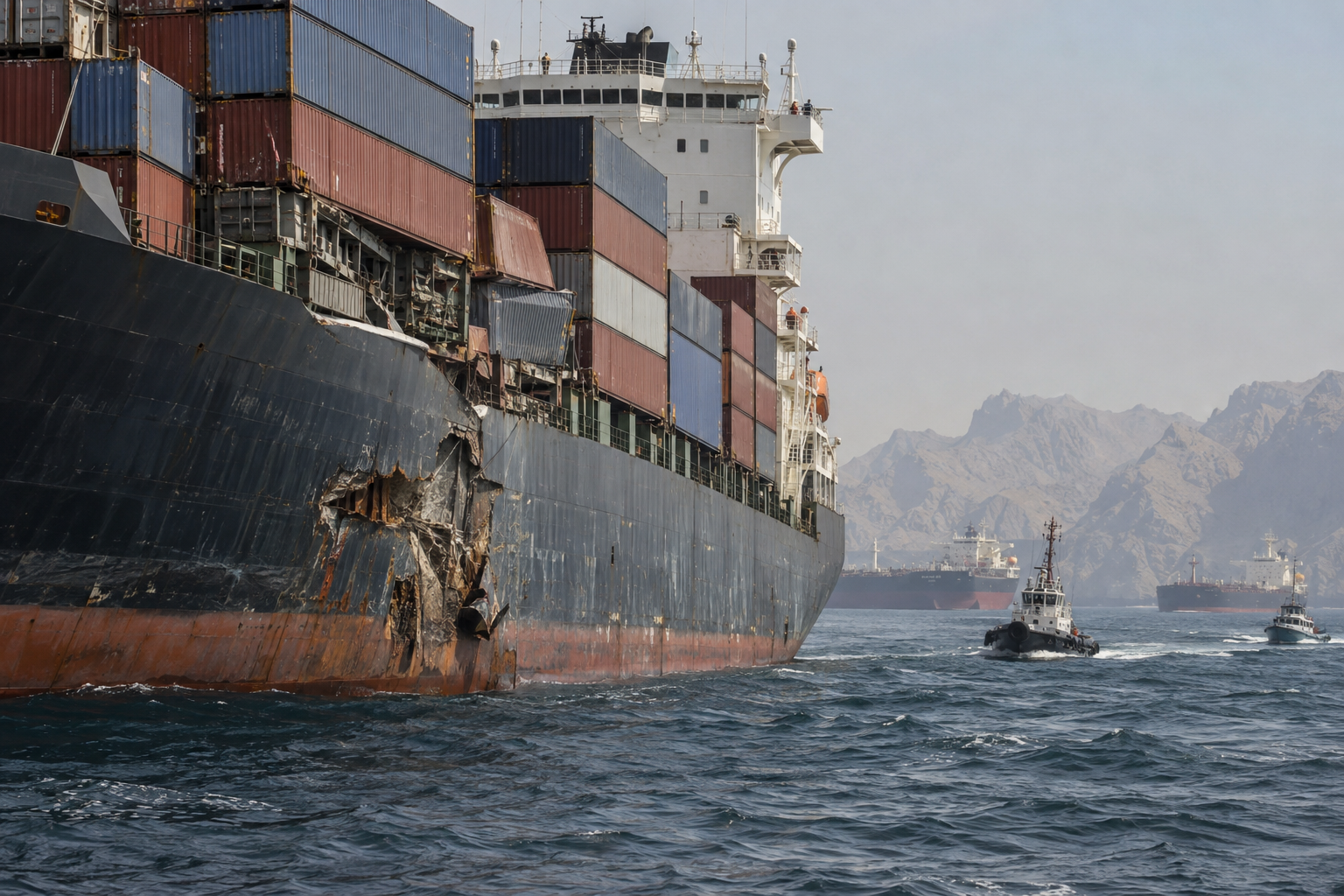
Separately, Britain’s MI5 chief warned of expanding Iranian and Russian-linked hybrid threats, including intimidation and attacks affecting Jewish communities and military sites. Maritime data showed at least 10 attacks on vessels in or near the Strait of Hormuz since Sunday, including four on Tuesday and six on Sunday. Two seafarers were missing, and a container ship reportedly sank, amid continued disruption to shipping through the strategic waterway.
Entities: Donald Trump, Mohammad Bagher Qalibaf, Afrah Alzouba, Sir Ken McCallum, Saudi Arabia • Tone: urgent • Sentiment: negative • Intent: inform
15-10-2026
Oil prices fell on Thursday as traders weighed escalating security risks around the Strait of Hormuz against factors limiting the potential for a sharp supply shock. Brent crude futures for December delivery declined 1.66% to $104.31 a barrel, while U.S. West Texas Intermediate futures for November fell 1.09% to $94.05 per barrel.
Market concerns followed the sinking of a Singapore-registered vessel in the strategically important Strait of Hormuz. Singapore’s maritime authority condemned the attack as unprovoked, unjustifiable, and a breach of international law. Iran also issued a threat directed at U.S. warships, heightening fears that the conflict in the Middle East could persist and disrupt oil shipments.
The International Energy Agency’s October oil-market report warned that constraints in diesel markets could continue well into next year. The report also noted that new attacks on Saudi Arabia could undermine a recovery in oil supply. Separately, Reuters reported that the Trump administration was considering easing sanctions on vessels in the so-called “shadow fleet,” which transports oil and petroleum products from countries including Russia.
Despite the risks, alternative routes for Saudi crude exports and accelerated emergency stock releases by IEA members are helping cushion markets, according to Firas Bechwaty, head of business development at trading platform ICM. Bechwaty said the lack of progress in U.S.-Iran diplomacy left little immediate prospect of fully reopening the waterway, but that these supply buffers were preventing prices from rising sharply. The article therefore depicts a market balancing serious geopolitical and supply concerns against measures that are limiting immediate price pressure.
Entities: Brent crude, West Texas Intermediate (WTI), Strait of Hormuz, Singapore-registered vessel, Singapore maritime authority • Tone: analytical • Sentiment: negative • Intent: inform
15-10-2026
Jihad Azour, the International Monetary Fund’s director for the Middle East and Central Asia, said that buffers have so far limited the economic effects of the Iran war, but warned that they are running down and the regional outlook remains highly uncertain. The prolonged closure of the Strait of Hormuz, Iranian attacks on shipping and infrastructure, and the risk of renewed disruption have unsettled energy markets. Brent crude is 47 per cent above prewar levels, though it has not reached the previously feared $200 a barrel. The IMF kept its 2026 global growth forecast at 3.1 per cent and raised its 2027 projection slightly to 3.4 per cent, while higher oil prices contributed to a higher 2026 inflation forecast of 4.7 per cent.
Several factors have cushioned the shock: Gulf exporters have rerouted supplies, International Energy Agency members agreed to release up to 425 million barrels from reserves, non-Gulf producers have increased output, and energy demand has adjusted. Gulf crude exports rose by 4.4 million barrels a day in September, reaching more than 75 per cent of prewar levels. However, the IMF cautioned that inventories are lower and spare capacity tighter, making future disruptions potentially more damaging. The UK Maritime Trade Operations agency reported at least 12 tanker attacks in and around the Strait in the past week; a cargo ship also sank after striking a mine, while Houthi rebels attacked Saudi Aramco’s headquarters, with no casualties reported.
The IMF forecasts steep 2026 contractions in several regional economies, including Kuwait, Iraq, Qatar and Bahrain, while Saudi Arabia and the UAE are also projected to shrink. Growth is expected to rebound in 2027, but output would remain below its pre-conflict trajectory. Azour warned that a longer conflict could weaken activity, raise inflation and strain public finances, particularly where governments have large financing needs. He urged countries to protect price stability and rebuild fiscal buffers. UAE Central Bank Governor Khaled Balama pointed to the UAE’s fiscal reserves, low public debt and sovereign assets as supports for resilience and investor confidence.
Entities: Jihad Azour, International Monetary Fund (IMF), Strait of Hormuz, Iran war, International Energy Agency (IEA) • Tone: analytical • Sentiment: negative • Intent: inform
15-10-2026
The supplied page identifies a live Middle East news update published by The National on October 15, 2026. Its headline reports that Saudi Arabia intercepted a Houthi drone in the kingdom’s eastern region. The provided material does not include the article’s full report: it gives no further details about when or where the drone was intercepted, whether it caused damage or injuries, or which Saudi authority reported the incident. As a result, those details cannot be confirmed from the text supplied.
The page also displays headlines for other coverage, including a report that a container ship sank after a strike in the Strait of Hormuz, footage of the destruction of an Iran-affiliated dhow, and an earlier Houthi ballistic missile interception in Riyadh that reportedly injured one person with shrapnel. Other teasers refer to economic risks raised by the International Monetary Fund, regional de-escalation, attacks in Riyadh, and developments involving Iran and the United States. These are separate headlines and videos on the page, not details substantiating the eastern-region drone interception.
Most of the remaining supplied text consists of website navigation, sharing and printing controls, video labels, and subscription or notification prompts. The available report is therefore too brief to establish the circumstances or broader implications of the interception. This analysis is limited to the headline and page text provided; it does not infer missing facts or treat the surrounding teaser headlines as part of the article’s account.
Entities: Saudi Arabia, Houthi movement, eastern region of Saudi Arabia, Houthi drone interception, Riyadh • Tone: neutral • Sentiment: neutral • Intent: inform
15-10-2026
CNBC’s Daily Open reports on rising tensions in the Strait of Hormuz after the Singapore-registered container ship GFS Pride was struck by an unidentified projectile and sank. Its 21 crew members were evacuated safely. A second Singapore-registered vessel, the GFS Giselle, was damaged but reached safe anchorage. Iran’s Revolutionary Guard issued threats against U.S. warships, while U.S. Central Command said American forces and regional partners control the strait. Attacks on shipping and Saudi Aramco facilities have helped push oil prices higher, with Brent reaching $106.06 per barrel and U.S. West Texas Intermediate $95.09.
Higher energy costs contributed to U.S. September inflation exceeding forecasts: headline CPI rose 3.7% year over year and core CPI increased 2.6%. Stocks fell after the report, and Asian markets followed Wall Street lower. U.S. gasoline averaged $4.33 per gallon, compared with about $3.08 a year earlier. Analysts said President Donald Trump’s temporary easing of restrictions on Russian diesel exports was unlikely to meaningfully reduce fuel prices for truckers and farmers.
The article also covers Netflix’s plan to cut roughly 6% of its workforce, or about 1,000 jobs, mainly in product, technology, legal and human resources. Separately, eight U.S. states sued OpenAI, alleging ChatGPT is unsafe and has harmed children and misled parents. Finally, G20 finance ministers and central bank governors are meeting in Bangkok, though U.S. Treasury Secretary Scott Bessent will not attend. IMF Managing Director Kristalina Georgieva said relying on economic growth alone will not reduce U.S. deficits and debt quickly enough, and called for additional fiscal measures.
Entities: Strait of Hormuz, GFS Pride, GFS Giselle, Maritime and Port Authority of Singapore, Iran • Tone: analytical • Sentiment: negative • Intent: inform