15-06-2026
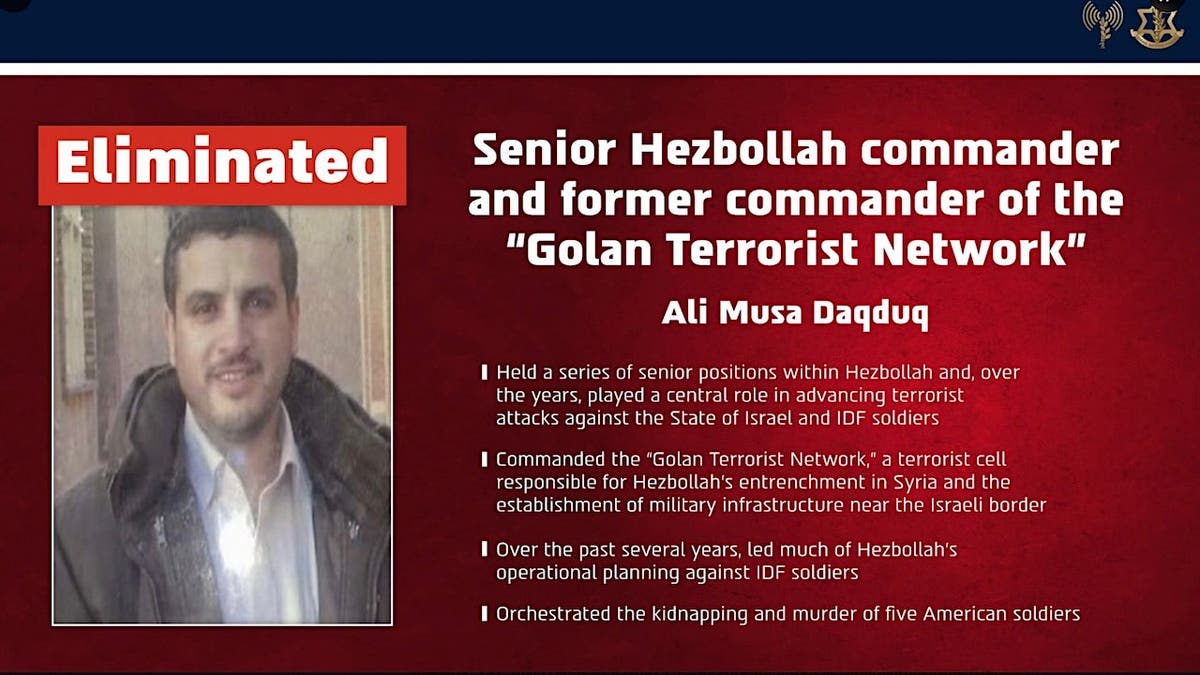
The article reports that the Israel Defense Forces (IDF) killed Ali Musa Daqduq, a senior Hezbollah commander, in a strike in southern Lebanon. The IDF says Daqduq played a central role in Hezbollah operations for years and specifically orchestrated the 2007 kidnapping and murder of five American soldiers in Iraq. According to the article, Daqduq held multiple high-level roles within Hezbollah, including positions tied to Nasrallah’s security detail, the Radwan Force, the Operations Department of the Nasser Unit, Hezbollah’s Infantry Unit, and the group’s Golan network. Israeli officials framed his death as a major blow to Hezbollah’s command structure and to the group’s ability to conduct attacks against Israeli civilians, IDF soldiers, and American servicemembers.
The story places the strike within a wider escalation between Israel and Hezbollah, noting that Israel also struck targets in Beirut’s Dahieh district, which the IDF described as Hezbollah infrastructure. Israeli leaders said the strikes were a response to Hezbollah fire into Israeli territory and warned Israel would not tolerate attacks on its soil. The article also connects the military developments to ongoing U.S.-backed diplomatic efforts involving Iran and President Donald Trump. It says the latest strikes could complicate those negotiations, and it quotes Trump expressing frustration with Israeli Prime Minister Benjamin Netanyahu over the Beirut attacks while still hoping for a deal with Iran to be finalized soon. Overall, the piece ties a targeted Israeli military action to broader regional tensions and delicate diplomacy involving Hezbollah, Israel, Iran, and the United States.
Entities: Israel Defense Forces (IDF), Hezbollah, Ali Musa Daqduq, American soldiers, southern Lebanon • Tone: analytical • Sentiment: negative • Intent: inform
15-06-2026
The article reports that Iran’s planned July funeral for Supreme Leader Ayatollah Ali Khamenei is being treated by experts as both a security gamble and a political signal tied to a possible U.S.-Iran peace deal. Counterterrorism expert Dr. Omar Mohammed argues that the public, multi-city funeral is a deliberately “target-rich” event that Iran would only stage if it believes a ceasefire or deal will hold. He says the timing is meant to send a message to the United States as much as to Iranians: that the regime wants to portray Khamenei not as a victim of U.S.-Israeli strikes, but as a victor whose burial marks the end of a conflict on Iran’s terms. The article emphasizes that the funeral schedule overlaps with Muharram, a major Shia mourning period, and includes stops in Tehran, Qom, and Mashhad, with the burial at the Imam Reza shrine. According to Mohammed, these religious dates and locations create a powerful martyrdom narrative and a permanent mobilization site for the regime. The piece also connects the funeral timing to President Donald Trump’s announcement that a peace deal with Tehran is expected soon, suggesting Iran may be betting that negotiations and a ceasefire will survive into July. Overall, the article frames the funeral as a high-risk event that combines security vulnerability, religious symbolism, and geopolitical messaging amid fragile diplomacy.
Entities: Ayatollah Ali Khamenei, Mojtaba Khamenei, Dr. Omar Mohammed, George Washington University, Program on Extremism • Tone: analytical • Sentiment: neutral • Intent: inform
15-06-2026
The article reports widespread unease in Israel over an emerging US-backed ceasefire deal with Iran, portraying the agreement as deeply unpopular among Israeli media and political circles. The main example is the front page of Yediot Aharonot, which bluntly labeled the deal “Bad Deal,” reflecting a broader sense that Washington is pushing a settlement that may not fully address Israel’s security concerns. The piece frames this discontent against Prime Minister Benjamin Netanyahu’s earlier assertion that Israel’s war aims included removing “existential threats” to the country, suggesting that many Israelis view the deal as potentially at odds with that objective.
Although the provided text is largely a teaser rather than the full article, it clearly indicates that the story is about the tension between US diplomacy and Israeli security priorities. The emerging ceasefire agreement with Iran appears to be raising alarm in Israel because of fears it may leave Iran’s regional threat, including its nuclear program or military posture, insufficiently constrained. The article’s framing suggests that the deal is being interpreted not simply as a diplomatic breakthrough, but as a politically and strategically fraught compromise. Overall, the article captures a moment of transatlantic disagreement: the United States pursuing de-escalation and Israel reacting with suspicion and dissatisfaction.
Entities: Israel, Iran, United States, Jerusalem, Yediot Aharonot • Tone: negative • Sentiment: negative • Intent: inform