15-03-2026
Former US President Donald Trump has urged the UK and other nations to send warships to the Strait of Hormuz to secure the key shipping route amid escalating tensions with Iran. The US and Israel launched a war against Iran two weeks ago, resulting in attacks on tankers and a significant rise in global oil prices. Trump claimed that 100% of Iran's military capability had been destroyed but warned that Tehran could still pose a threat to the strait. The UK Ministry of Defence responded by stating it was discussing options to ensure shipping security in the region with allies. Other countries like France and Japan were also mentioned as potential contributors to the effort. The situation remains tense, with Iran threatening to block the strait and target tankers bound for the US, Israel, or their partners.
Entities: Donald Trump, Strait of Hormuz, Iran, UK, US • Tone: urgent • Sentiment: negative • Intent: inform
15-03-2026
The Trump administration has ordered the release of 172 million barrels of oil from the U.S. Strategic Petroleum Reserve, the second-largest release in its history. The move aims to stem oil prices, which have risen amid the conflict with Iran. The release will bring the nation's oil reserves to 243 million barrels, the lowest level in 44 years. The U.S. Secretary of Energy has stated that the reserves will be replenished with approximately 200 million barrels within the next year. The Strategic Petroleum Reserve was created in 1975 in response to the energy crisis, and previous releases have been made in response to natural disasters and conflicts.
Entities: U.S. Strategic Petroleum Reserve, Trump administration, Joe Biden, Iran, Department of Energy • Tone: neutral • Sentiment: negative • Intent: inform
15-03-2026
The article discusses the impact of the conflict between the United States and Iran on the global economy, particularly the oil market. President Donald Trump, facing midterm elections and voter concerns about inflation, has signaled an end to his campaign against Iran, causing oil prices to drop. The closure of the Strait of Hormuz by Iran has blocked 15% of global oil supply, and Trump's decision is seen as a retreat from his previous stance, similar to his withdrawal from the trade war last spring. The article suggests that the energy markets have been permanently changed by these events.
Entities: Donald Trump, Iran, United States, Strait of Hormuz, oil market • Tone: analytical • Sentiment: neutral • Intent: inform
15-03-2026
The article discusses the limited options available to Donald Trump to cool oil prices, particularly in the context of the ongoing conflict between America and Israel with Iran, which has led to a surge in oil prices. The International Energy Agency (IEA) recently released 400m barrels of crude from their emergency reserves, but this move failed to impress oil markets, with Brent crude rising by nearly 10% after the announcement. The article highlights the challenges faced by policymakers in addressing the energy crisis and the potential consequences for the global economy.
Entities: Donald Trump, International Energy Agency (IEA), America, Israel, Iran • Tone: neutral • Sentiment: negative • Intent: inform
15-03-2026
The Economist's finance and economics section features various articles discussing the impact of the Iran war on global markets, the limitations of Donald Trump's options to cool oil prices, and the potential for investing in 'rubbish stocks.' Other topics include the effect of the war on Asia's energy supplies, the role of firms in country growth, and the size of India's economy. The articles provide analysis on various economic issues, including the global energy market, financial markets, and economic growth.
Entities: Vladimir Putin, Iran, Donald Trump, Asia, Gulf • Tone: analytical • Sentiment: neutral • Intent: inform
15-03-2026
The ongoing American-Israeli war with Iran has severely impacted global energy supplies, causing a significant increase in oil and natural gas prices. The conflict has halted seaborne oil exports from major Gulf producers, leading to a 40% surge in Brent crude prices. The effects are being felt globally, with American motorists paying higher petrol prices and European natural gas prices rising by 92%. The energy crisis is reverberating across financial markets, drawing comparisons to the economic impact of the Ukraine invasion.
Entities: Iran, America, Israel, Gulf, Brent crude • Tone: analytical • Sentiment: negative • Intent: inform
15-03-2026
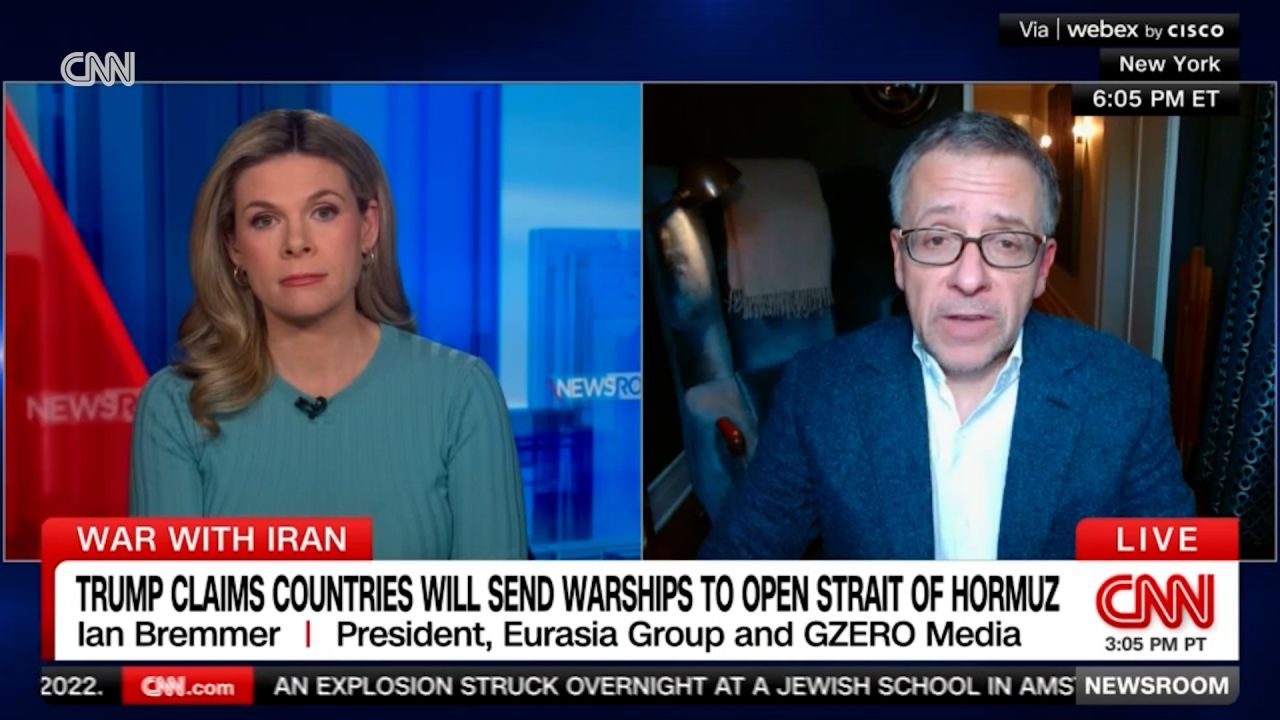
US President Donald Trump claimed that the US had 'decimated Iran' and called on other countries to help secure the Strait of Hormuz. Ian Bremmer, president of Eurasia Group and GZERO Media, was interviewed by CNN to explain how this could play out. The article discusses Trump's statement and its potential implications for the region.
Entities: Donald Trump, Iran, Strait of Hormuz, Ian Bremmer, Eurasia Group • Tone: analytical • Sentiment: neutral • Intent: inform
15-03-2026
Iran is deploying explosive-laden drone boats disguised as wooden fishing vessels in the Strait of Hormuz, a critical shipping lane, signaling a new phase of hybrid maritime warfare. The UK Maritime Trade Operations confirmed an Iranian unmanned surface vehicle attacked a Marshall Islands–flagged oil tanker on March 1. Defense expert Cameron Chell warned of the growing asymmetric threat posed by these 'suicide skiffs,' which can be controlled remotely or autonomously. The US Navy may escort ships in the strait, and discussions are underway among European counterparts to address the global economic stakes. Chell questioned the current defensive readiness, highlighting the challenges in detecting and neutralizing these small, explosive-laden boats.
Entities: Iran, Strait of Hormuz, Cameron Chell, Draganfly, United Kingdom Maritime Trade Operations (UKMTO) • Tone: urgent • Sentiment: negative • Intent: inform
15-03-2026
The Iran war has exposed the fragility of supply chains between the Gulf and Asia, threatening shipping across key maritime chokepoints like the Strait of Hormuz and Bab el-Mandeb. The conflict has forced Gulf states and their Asian trading partners to question the reliability of US security guarantees and explore alternative options to protect their supply chains. Despite repeated conflicts in the Middle East over the past four decades, little has been done to mitigate this risk, with the prevailing assumption being that the US would prevent a belligerent nation like Iran from disrupting trade. Analysts say that stockpiles, alternative transport corridors, and new security arrangements offer limited protection against the current disruption.
Entities: Iran, Gulf, Asia, Strait of Hormuz, Bab el-Mandeb • Tone: analytical • Sentiment: negative • Intent: inform