13-07-2026
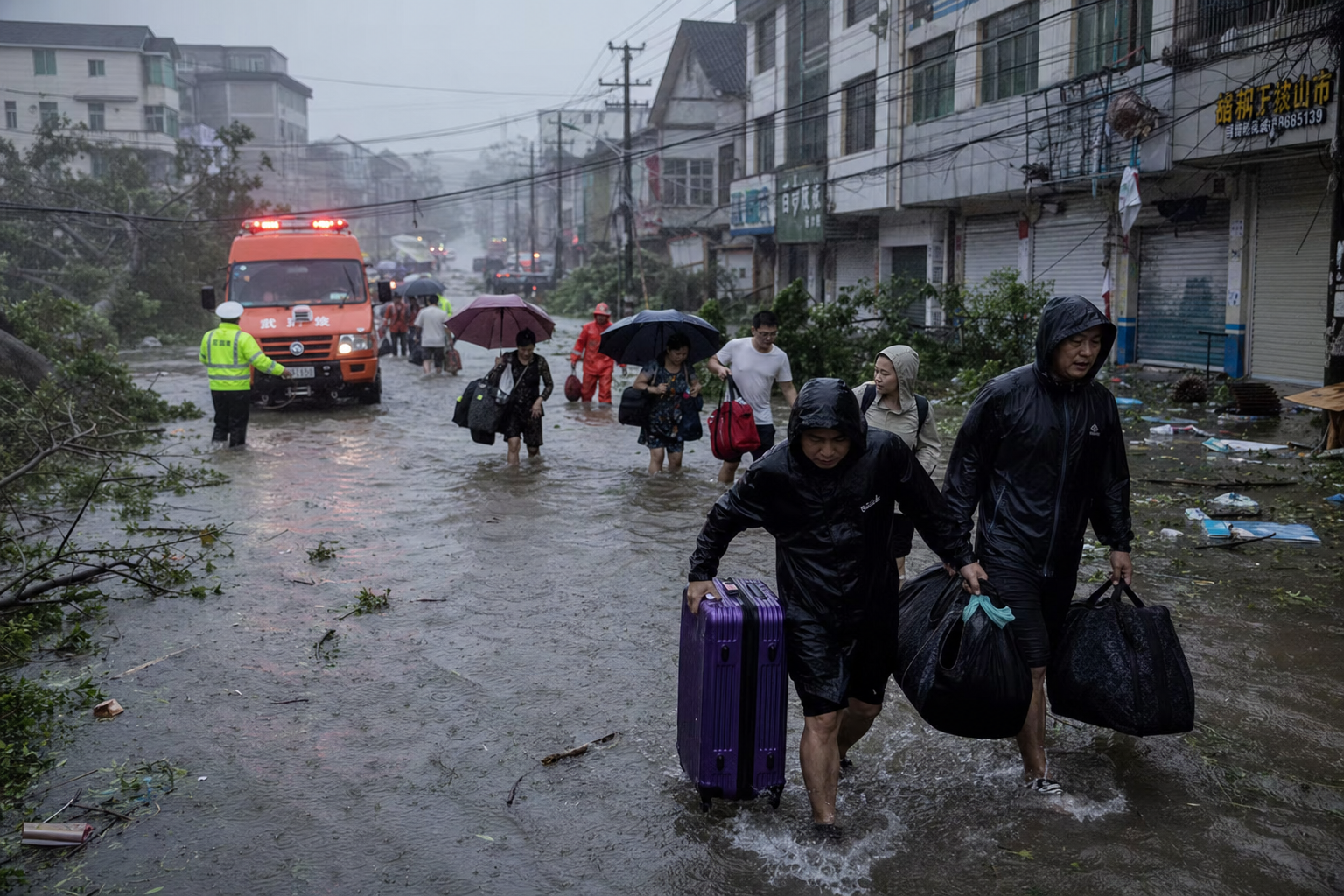
Typhoon Bavi has struck eastern China after moving through parts of the Pacific and East Asia, prompting large-scale evacuations and widespread disruption. The storm made landfall first in Taizhou and later in Wenzhou in Zhejiang province, before moving inland toward Hangzhou and, later, expected to continue northwest toward Anhui and the Yellow Sea. Although Bavi weakened from a super typhoon to a severe tropical storm, officials warned it remained dangerous because of the large amount of moisture in its rain bands. In response, Chinese authorities evacuated more than 1.7 million people in Zhejiang and thousands more in nearby provinces, while Beijing ordered 100,000 people to leave higher-risk areas.
The article highlights major impacts on daily life and infrastructure, including school closures, suspended work and outdoor activities, and the cancellation of about 400 flights and dozens of train services. Wenzhou, a city of around 10 million people, was especially affected, with residents describing strong winds and falling debris. The storm had already caused damage elsewhere: it battered Guam and the Northern Mariana Islands, struck Japan’s Sakishima islands, and brought heavy rain to Taiwan. In the Philippines, landslides triggered by the system killed at least 17 people. The article also places Bavi in the context of another recent storm, Typhoon Maysak, which had already devastated parts of southern China, causing deaths and agricultural losses. Overall, the report emphasizes the scale, mobility, and continuing hazard of the storm across multiple countries and regions.
Entities: Typhoon Bavi, China, Zhejiang province, Taizhou, Wenzhou • Tone: urgent • Sentiment: negative • Intent: inform
13-07-2026
Former super typhoon Bavi weakened into a tropical storm after making landfall in eastern China’s Zhejiang province, but it continued to bring dangerous winds and heavy rain across a broad swath of eastern and northeastern China. The storm moved northwestward into Anhui province, where the National Meteorological Center said strong winds and heavy rain would affect multiple cities on Sunday and Monday, with heavy to torrential rainfall already recorded in parts of the region. Authorities carried out large-scale evacuations in anticipation of the storm’s impact: more than 2.2 million people were moved from vulnerable areas in Zhejiang, over 290,000 people were evacuated from Shanghai, and more than 180,000 were evacuated from Fujian. In Yueqing, Zhejiang, the storm toppled more than 1,300 trees, including at least 700 that were uprooted. Shanghai airports expected to cancel around 653 inbound and outbound flights due to the storm. Bavi also passed north of Taiwan, where at least 134 people were injured by strong winds and hazardous conditions. The article notes that Bavi had earlier been classified as a super typhoon when it struck a U.S. island territory near Guam and later battered the Northern Mariana Islands. Even after weakening, the storm remained large and moisture-laden, with the potential to cause continued disruption along its path.
Entities: Typhoon Bavi, Zhejiang province, Anhui province, Shanghai, Fujian province • Tone: analytical • Sentiment: negative • Intent: inform
13-07-2026
Typhoon Bavi is moving north through northern China, bringing heavy rain, flooding, and widespread disruptions to daily life in parts of Liaoning and Hebei provinces. In Shenyang, the capital of Liaoning, local authorities suspended classes at junior high schools, primary schools and kindergartens for the day, and also halted construction work and outdoor activities. Tourist sites were closed, roads flooded, and some bus routes and subway stations were temporarily shut as emergency response efforts continued.
The storm has also caused severe damage in Chengde, Hebei province, where flooding reportedly washed away several cars and destroyed roads in about nine villages. Some villagers were trapped as heavy rain continued into Sunday night, and video shared by media captured the ordeal. Local authorities in affected areas issued emergency alerts as the typhoon moved through the region, with government workers deployed for rescue and flood relief. The article emphasizes the scale of disruption caused by the storm and the strain on local infrastructure, especially in areas already recovering from earlier weather-related damage.
Entities: Typhoon Bavi, Shenyang, Liaoning province, Hebei province, Chengde • Tone: urgent • Sentiment: negative • Intent: inform