13-07-2026
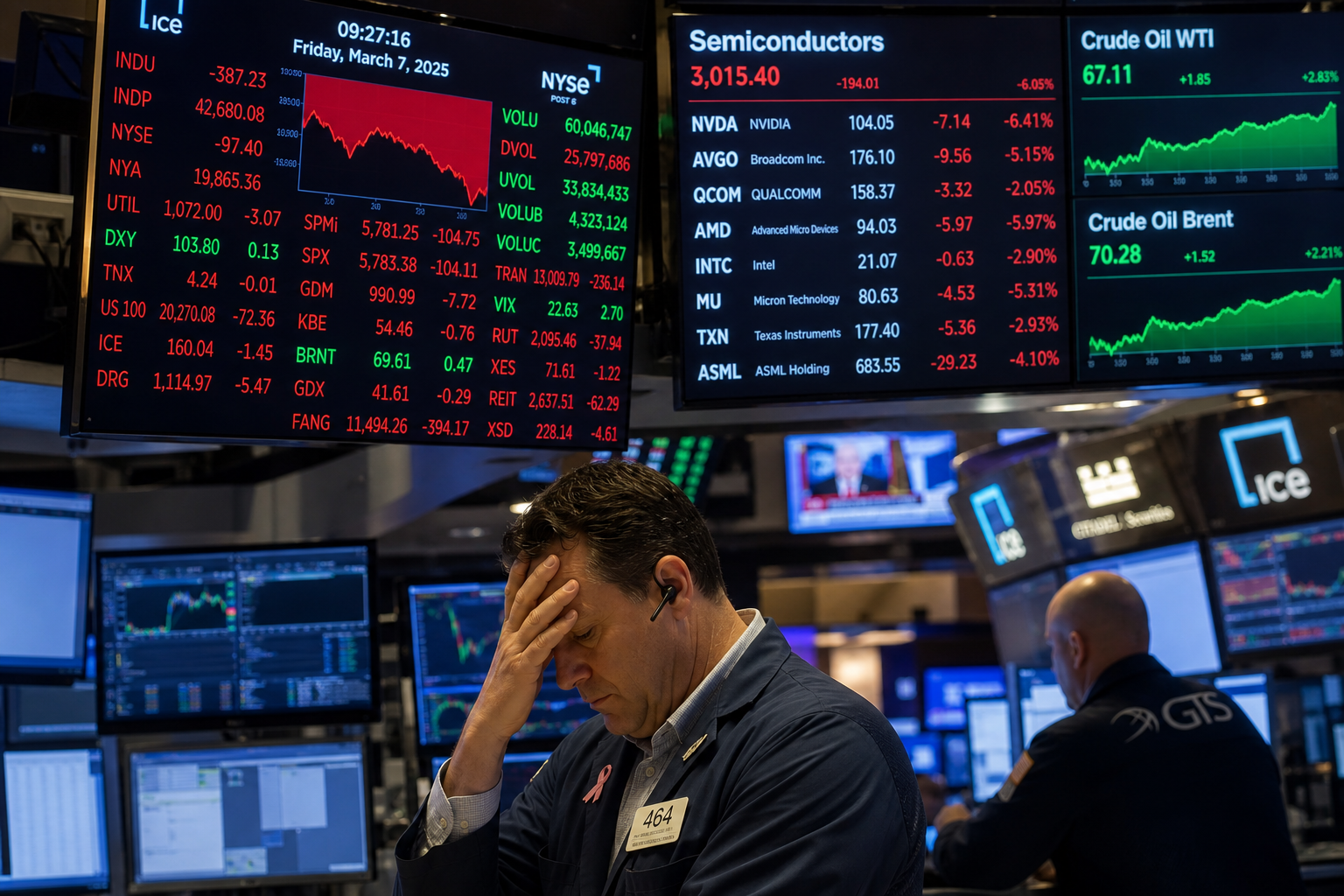
CNBC Daily Open opens the trading week with a sharp focus on weakness in chip stocks, rising geopolitical risk in the Middle East, and the start of a heavy earnings calendar. In Asia, South Korea’s Kospi was hit hard after SK Hynix fell more than 10%, triggering circuit breakers and halting trading. The decline followed a strong Nasdaq debut for SK Hynix’s newly U.S.-listed shares, and CNBC frames the move as a mix of profit-taking, valuation confusion, and broader doubts about the durability of the AI-driven semiconductor trade. Other chip names, including Samsung, also sold off, while U.S. and European futures pointed lower.
The article then turns to oil markets, where prices rose after renewed U.S.-Iran strikes and escalating tension around the Strait of Hormuz. U.S. Central Command retaliated after a container ship was targeted, while Iranian state media claimed strikes on U.S. targets and said the strait had been closed. The piece emphasizes the market impact of the conflict and the uncertainty surrounding the ceasefire.
Finally, the article previews a busy earnings week. In the U.S., JPMorgan, Goldman Sachs, and Netflix are key reports; in Europe, ASML is highlighted; and in Asia, TSMC is the main semiconductor earnings event. FactSet data suggests S&P 500 earnings may have risen 23.3% year over year in the June quarter, which would mark a second straight quarter of profit growth above 20%. The article ends with a separate breaking-news item about Sen. Lindsey Graham, noting his death after a brief illness, but this appears more like a news roundup element than part of the main market analysis.
Entities: SK Hynix, Kospi, Samsung, Strait of Hormuz, U.S. Central Command • Tone: analytical • Sentiment: neutral • Intent: inform
13-07-2026
SK Hynix shares fell sharply in Seoul after the company’s strong Nasdaq debut, as investors took profits and reassessed how to value the memory-chip maker’s U.S.-listed shares relative to its Korean stock. The article explains that the 13% jump in SK Hynix’s Wall Street debut on Friday reflected strong U.S. demand for AI-linked semiconductor names, but the Monday decline in Seoul was driven by profit-taking, valuation uncertainty, and the mechanics of the ADR issuance, which increased stock supply. Analysts quoted in the piece argue that the sell-off is likely temporary rather than a sign of weakening fundamentals. Daniel Yoo of Yuanta Securities says investors are confused about memory-chip demand, fair pricing, and valuation multiples, while also noting that the U.S. listing has created a new benchmark and a more than 20% pricing gap between the U.S. and Korean shares. Phillip Wool of Rayliant Global Advisors similarly characterizes the weakness as risk management and portfolio rebalancing after large gains in South Korean and Taiwanese AI chipmakers, not a decline in enthusiasm for AI hardware. Both analysts maintain that structural artificial intelligence demand remains strong and should continue to support memory suppliers such as SK Hynix over the medium term.
Entities: SK Hynix, Nasdaq, Seoul, South Korea, AI memory chips • Tone: analytical • Sentiment: neutral • Intent: inform
13-07-2026
U.S. and global markets opened the week under heavy pressure as investors reacted to escalating conflict between the United States and Iran and prepared for a dense stretch of economic data and corporate earnings. U.S. stock futures fell sharply, led by Nasdaq-100 futures, while oil prices surged on fears that unrest could threaten flows through the Strait of Hormuz, a critical artery for global energy shipments. Asian markets mostly sold off, with South Korea’s Kospi leading declines, and European stock futures pointed lower as well.
The article frames the market move as a broad risk-off response to geopolitical uncertainty. U.S. and Iranian forces traded airstrikes over the weekend, and the Trump administration disputed Iran’s claim that the Strait of Hormuz had been closed. Traders and strategists said the main near-term concern is whether the conflict escalates enough to disrupt energy supplies and keep pressure on oil prices.
Beyond geopolitics, investors are focused on a major week for earnings and economic indicators. Large U.S. banks including JPMorgan Chase, Goldman Sachs, Morgan Stanley, Bank of America, Citigroup, and Wells Fargo are set to report, along with Netflix, Johnson & Johnson, and UnitedHealth. Analysts expect strong second-quarter profit growth for the S&P 500, but attention is also turning to whether artificial intelligence investment can continue supporting tech-sector earnings. The June CPI report is due Tuesday and is expected to add another layer of market-moving data.
The article also highlights several stock-specific moves in Asia, including pressure on Samsung Electronics and SK Hynix amid weakness in chip stocks, as well as a rally in LG Electronics after a report about its collaboration with Nvidia on AI server racks.
Entities: Iran, United States, Strait of Hormuz, Donald Trump, Dow Jones Industrial Average • Tone: analytical • Sentiment: negative • Intent: inform