11-07-2026
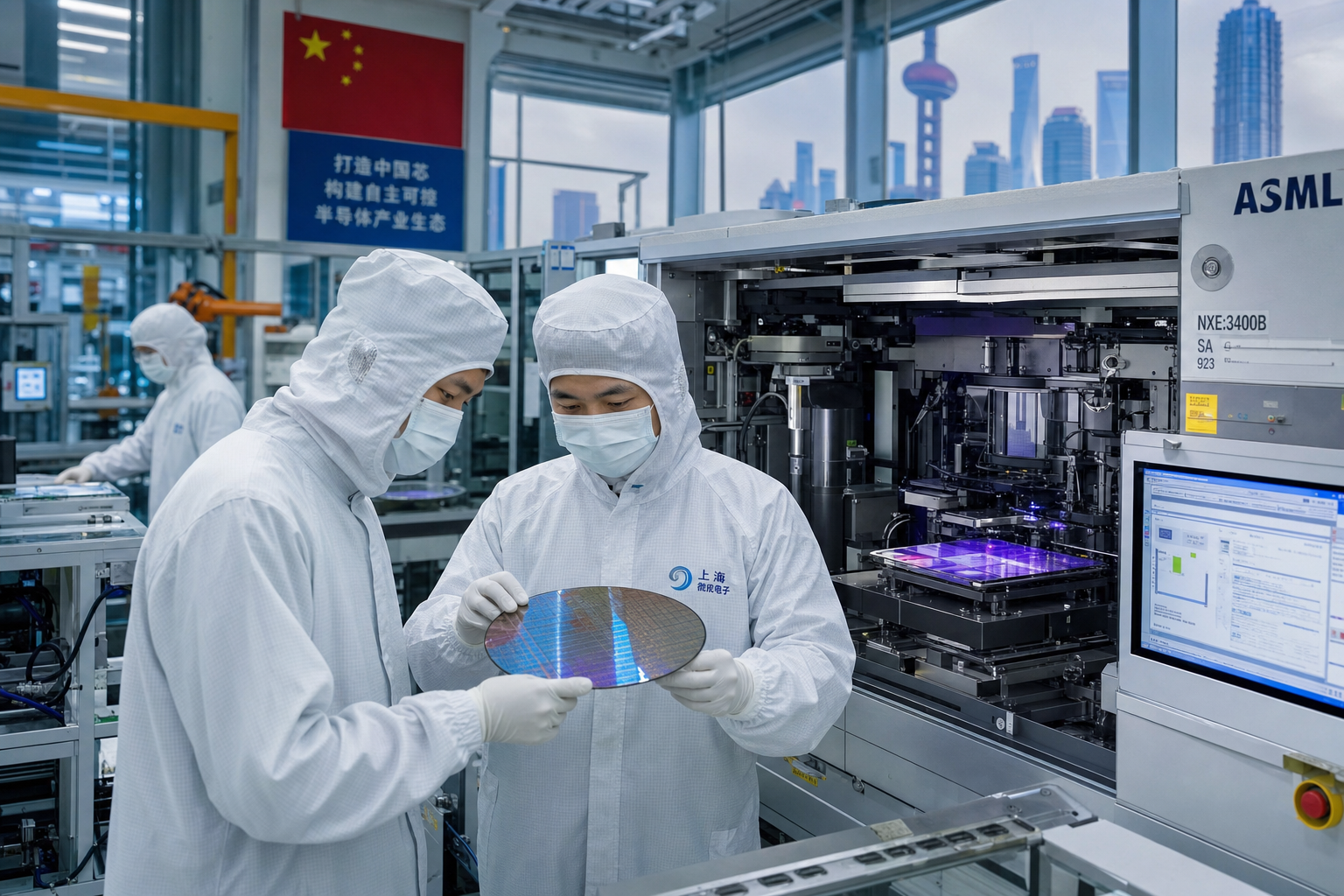
A Chinese chip start-up, Shanghai-based Yuanjiwei, says it has launched what it claims is the world’s first 8-inch production line for two-dimensional (2D) semiconductors, a development it presents as a major step toward China’s goal of semiconductor self-sufficiency. The pilot line is described as covering the full manufacturing chain, from 2D material preparation to chip integration, and is said to support tape-out, the final stage of chip design. Yuanjiwei says it hopes to use the line to develop 5-nanometre-equivalent chips by 2029 without relying on extreme ultraviolet (EUV) lithography, which is a critical tool for producing the most advanced chips.
The article places the announcement in the broader context of escalating US export controls that restrict China’s access to advanced chipmaking equipment. Those curbs have intensified China’s efforts to pursue alternative semiconductor technologies, while the global industry is also searching for new approaches as conventional silicon-based 3D chips approach physical and economic limits. The piece notes that 2D semiconductors are increasingly seen as one of the most promising directions for next-generation chips and are drawing global competition.
The story frames the launch as both a technical milestone and a strategic response to geopolitical pressure, with Chinese officials and the company emphasizing the importance of industrial validation and domestic innovation. At the same time, it reflects the uncertainty around whether 2D chip technology can realistically scale to the performance levels implied by a 5-nanometre equivalent target by 2029.
Entities: Yuanjiwei, Shanghai, Beijing, Ben Jiang, South China Morning Post • Tone: analytical • Sentiment: neutral • Intent: inform
11-07-2026
Demand for grade-A office space in Beijing’s Zhongguancun district rose in the first half of the year as artificial intelligence and semiconductor companies expanded their footprints, making the hi-tech hub the only Beijing submarket to record rent growth, according to Knight Frank. The report says Zhongguancun, already the capital’s densest cluster of technology firms, saw average monthly rent for grade-A offices edge up to 251.40 yuan (US$37) per square metre in the second quarter, a 0.3 per cent increase from the first quarter. That put it second only to Financial Street in Beijing’s office rental ranking.
Knight Frank described Beijing’s office market as moving from "passive adjustment" toward "structural recovery," driven in part by leasing demand from AI-related companies. Virginia Huang, the consultancy’s managing director for north and east China, said the current moment represents the arrival of an "AI super cycle" that has only just begun and could sustain tech-driven leasing demand in Beijing for the next three to five years, with further growth expected. However, she also cautioned that the market is not yet in a full rebound and may not fully recover until late 2029 or early 2030.
The article highlights that several tech firms, including ByteDance, DeepSeek, Moonshot AI, Rank Computing and Sunmmio, added office space in Zhongguancun during the second quarter, reinforcing the district’s status as a magnet for expanding AI and chip companies even as office markets elsewhere in China continue to struggle.
Entities: Beijing, Zhongguancun, Shanghai, Financial Street, Knight Frank • Tone: analytical • Sentiment: neutral • Intent: inform
11-07-2026
The article examines how China’s aggressive push toward automation and high-tech manufacturing is leaving many low-skilled factory workers behind, especially in industrial hubs like Kunshan, once a symbol of mass employment in electronics production. Through the story of Hu Xinbing, a former factory worker now surviving on day labor and security gigs, the piece illustrates how robots, trade tensions, and industrial upgrading are shrinking the stable jobs that once sustained millions of migrant workers.
Kunshan, located near Shanghai, had long depended on labor-intensive electronics assembly for companies like Apple suppliers Pegatron and Inventec. But as manufacturers adopt robots and China shifts investment toward artificial intelligence, flying cars, and other advanced technologies, the demand for low-skilled labor is falling. Workers who previously relied on relatively steady factory contracts are increasingly pushed into precarious gig work, often with lower pay and few protections. The article notes that there are already around 40 million gig workers in China’s manufacturing sector, with some large factories staffed predominantly by temporary labor.
The article also highlights the broader policy dilemma facing China: while the country wants to lead in advanced technologies and maintain global competitiveness, the benefits of that transformation are not being evenly shared. Workers like Hu fear they lack the education or time to retrain for better jobs, and existing legal protections around AI-related layoffs appear to focus more on white-collar workers than factory laborers. The piece presents automation not as a technological triumph alone, but as a force reshaping class, labor, and livelihood in China.
Entities: Hu Xinbing, Kunshan, Shanghai, Henan, Peking University • Tone: analytical • Sentiment: negative • Intent: analyze