11-06-2026
Somali referee Omar Artan, who had been selected as one of the officials for the 2026 World Cup, was denied entry to the United States after border authorities said they found “derogatory information” tied to his alleged association with suspected terror group members. A Trump administration source said the refusal was based on security concerns under immigration law, while Artan told the New York Times he was questioned about possible links to Al Shabab and said he knew nothing about the group. Artan, 34, had arrived at Miami International Airport on a diplomatic passport and valid U.S. visa, but was detained after an 11-hour immigration interview and later flown back via Istanbul. His case is significant because all World Cup referees are based in Florida for training and preparation, making it impossible for him to officiate matches in Canada or Mexico from outside the U.S.
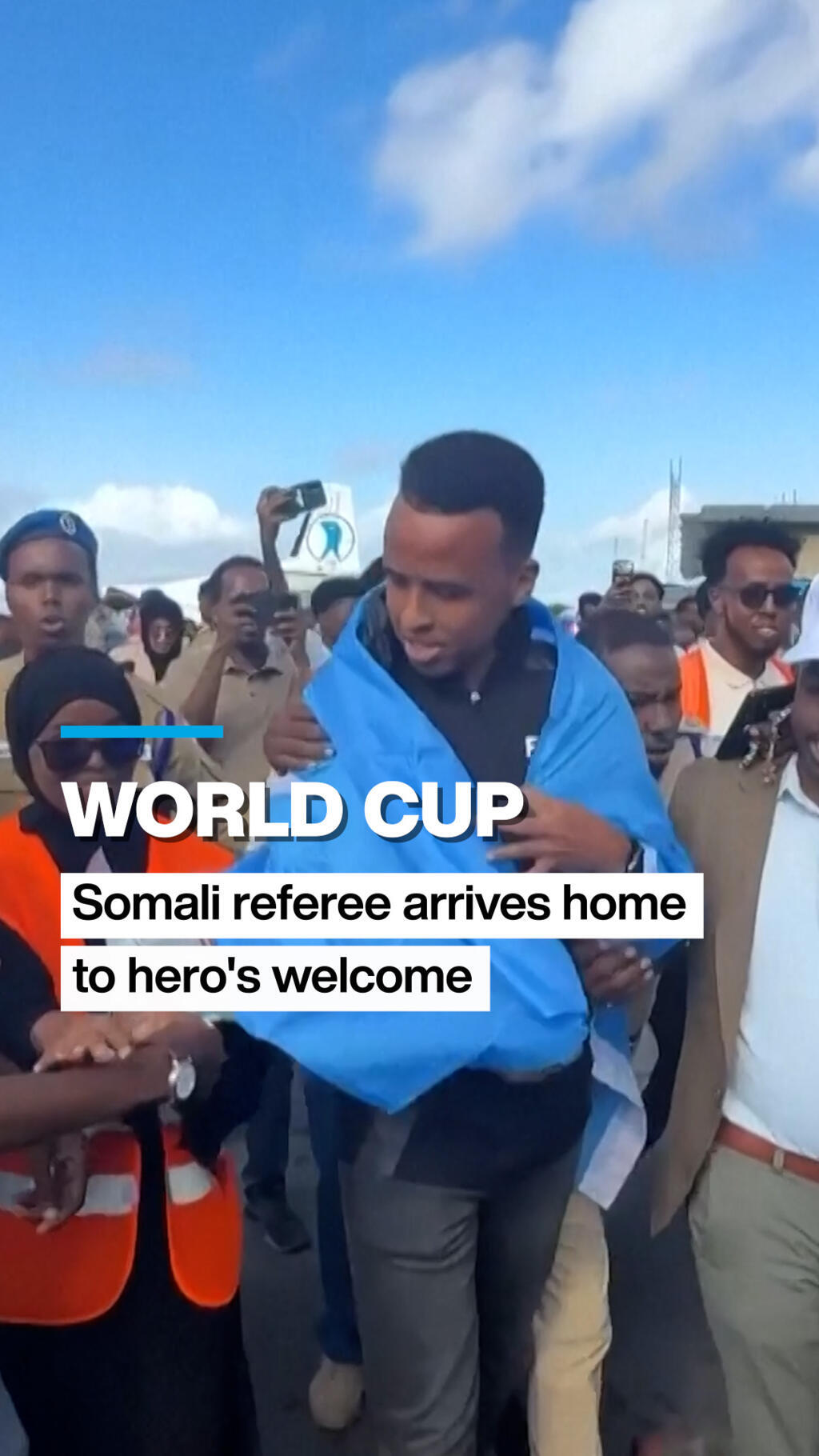
The article places the incident in the broader context of President Donald Trump’s travel ban affecting Somalia and other countries, as well as Trump’s past derogatory remarks about Somalia and Somali immigrants. Upon returning to Mogadishu, Artan was greeted by Somali officials, football representatives, colleagues, and supporters, and later met President Hassan Sheikh Mohamud. In brief remarks, Artan expressed gratitude for the support he received, affirmed his commitment to Somalia, and said he still hoped to officiate at the 2030 World Cup. The story highlights both the personal setback to Artan’s career and the political controversy surrounding U.S. immigration policy and World Cup logistics.
Entities: Omar Artan, Somalia, United States, Miami International Airport, Donald Trump • Tone: analytical • Sentiment: negative • Intent: inform
11-06-2026
The article reports that the U.S. Embassy in Mexico has issued a warning to Americans traveling to the country for World Cup matches, urging them to review State Department travel advisories and take precautions because safety risks vary widely by region. The 2026 World Cup will be co-hosted by the United States, Mexico, and Canada, with 13 matches scheduled in Mexico across Monterrey, Guadalajara, and Mexico City. The embassy’s warning reflects ongoing concerns about crime, terrorism, kidnapping, and other security threats in some areas. Mexico City and Nuevo León are both rated as places where travelers should exercise increased caution, while Tamaulipas carries a much more severe “do not travel” advisory. Jalisco is also flagged as a location where Americans should reconsider travel due to terrorism, crime, and kidnapping risks. The article notes that Mexico’s government says nearly 100,000 troops are being deployed to secure the three host cities, but U.S. officials still advise travelers to remain vigilant, especially in tourist areas, at night, and on certain highways or routes near the U.S. border. Overall, the piece is a security-focused update meant to inform prospective World Cup visitors about regional dangers and the need for careful planning.
Entities: U.S. Embassy in Mexico, U.S. State Department, FIFA, World Cup, Mexico • Tone: urgent • Sentiment: negative • Intent: warn
11-06-2026
With the World Cup about to begin in Mexico City, the article examines who is likely to profit from the influx of tourists and who may be left behind. Economists and local business owners expect the tournament to generate billions of dollars for Mexico, especially in tourism, restaurants, bars, street vendors, and other visitor-facing businesses in Mexico City and resort destinations that will draw day-trippers. In the capital’s main tourist areas, merchants are already selling unofficial merchandise, and restaurants are preparing promotions and decorations to attract fans. Some small businesses expect a substantial boost in sales once matches begin.
But the article also stresses that criminal groups may be among the biggest beneficiaries, particularly through extortion, scams, counterfeit merchandise, fake ticket sales, fraudulent hospitality packages, and malware-laced apps and websites. Security experts and government officials warn that businesses frequented by tourists are vulnerable, even if visitors themselves may be less directly targeted.
At the same time, not everyone is seeing the promised boom. Small kiosks, hotels, rental hosts, and businesses near major fan zones say they may be disrupted by street closures, official event zones, protests, and high costs. Several locals argue that ordinary Mexicans are being priced out by extremely expensive tickets, making the tournament feel like an event for foreign visitors and a small wealthy minority rather than the broader public. The piece presents the World Cup as both an economic opportunity and a source of inequality, insecurity, and uneven gains across Mexico.
Entities: World Cup, Mexico City, Mexico, Michael Rios, FIFA • Tone: analytical • Sentiment: neutral • Intent: analyze
11-06-2026
CNN reports on the controversy surrounding Somali referee Omar Abdulkadir Artan, who was denied entry to the United States just days before the FIFA World Cup because of alleged links to a terrorist group, according to the Trump administration. The decision has drawn attention because Artan was set to become the first Somali to referee at the tournament and had recently been recognized as Africa’s top male referee in 2025. The article highlights the tension between U.S. immigration/security policy and the global sports event, noting that FIFA said it is not responsible for host-country immigration decisions. While the U.S. government is defending the ban, Artan has received a hero’s welcome back home in Somalia, where his achievement and the disappointment over his exclusion have become a source of national pride and public discussion. The piece also situates the story within CNN’s broader coverage, but the core focus is the personal and symbolic impact of the denied entry on Artan and the reaction it prompted in Somalia.
Entities: Omar Abdulkadir Artan, Somalia, United States, Trump administration, FIFA • Tone: analytical • Sentiment: neutral • Intent: inform
11-06-2026
This CNN analysis argues that the 2026 World Cup is arriving under unusually fraught circumstances and badly needs the energy and unity that major tournaments typically generate. The piece contrasts the optimism that surrounded the 2018 decision to award the World Cup to the United States, Mexico, and Canada with the tense political and logistical reality unfolding in 2026. Instead of being defined by celebration, the tournament’s buildup has been dominated by criticism over exorbitant ticket and travel costs, accusations of public transportation price gouging, visa complications, and U.S. immigration policies under President Donald Trump. The article highlights how these issues have affected fans, officials, and even participants, including the denial of entry to Somali referee Omar Abdulkadir Artan and complications faced by the Iranian national team.
Despite the gloomy backdrop, the article argues that the World Cup’s on-field spectacle still has the potential to restore the event’s spirit. With 104 matches spread across North America, the tournament promises broad geographic reach, diverse fan experiences, and the kind of travel memories that often define the World Cup as much as the games themselves. The piece also emphasizes the star power on display, noting that Lionel Messi and Cristiano Ronaldo may be appearing in their final World Cups while a new generation of elite players, including Lamine Yamal, Erling Haaland, Kylian Mbappé, Jude Bellingham, and others, are poised to take center stage. Ultimately, the article presents the tournament as a potential blockbuster event whose success may depend on whether the off-field controversies can be contained long enough for the matches to reclaim the narrative.
Entities: 2026 World Cup, FIFA, Donald Trump, United States, Mexico • Tone: analytical • Sentiment: negative • Intent: analyze
11-06-2026
The article examines how the 2026 World Cup, which opens with unprecedented scale and ambition, is being overshadowed by politics, war, immigration restrictions, and controversy over costs. FIFA president Gianni Infantino has pitched the tournament as the “most inclusive” World Cup ever, but the article argues that the reality is more complicated: the Trump administration’s visa and immigration policies have barred some fans, officials, and even a referee from entering the United States, raising questions about inclusivity. The tournament also unfolds against the backdrop of the U.S. and Israel’s military actions against Iran, which have heightened geopolitical tensions and created concerns for Iran’s team, including visa issues and a relocated training base.
Beyond politics, the piece highlights mounting criticism of FIFA’s ticketing strategy, with prices ranging from hundreds to tens of thousands of dollars and resale prices soaring even higher. Fans have complained of a “monumental betrayal,” while related costs such as parking and transportation have also spiked. The article notes that public excitement in the U.S. appears relatively subdued, and hotel bookings have not met expectations in many host cities.
The article also frames the World Cup as a major logistical and environmental experiment: the first edition spread across three countries, with 48 teams, 104 matches, and significant travel demands. It warns that rising temperatures and extreme heat could affect players, fans, and workers, and that the tournament’s carbon footprint will be substantial. Overall, the piece portrays the World Cup as a spectacular sporting event burdened by war, nationalism, exclusion, commercialization, and climate challenges.
Entities: 2026 World Cup, FIFA, Gianni Infantino, Donald Trump, Trump administration • Tone: analytical • Sentiment: neutral • Intent: analyze