10-05-2026
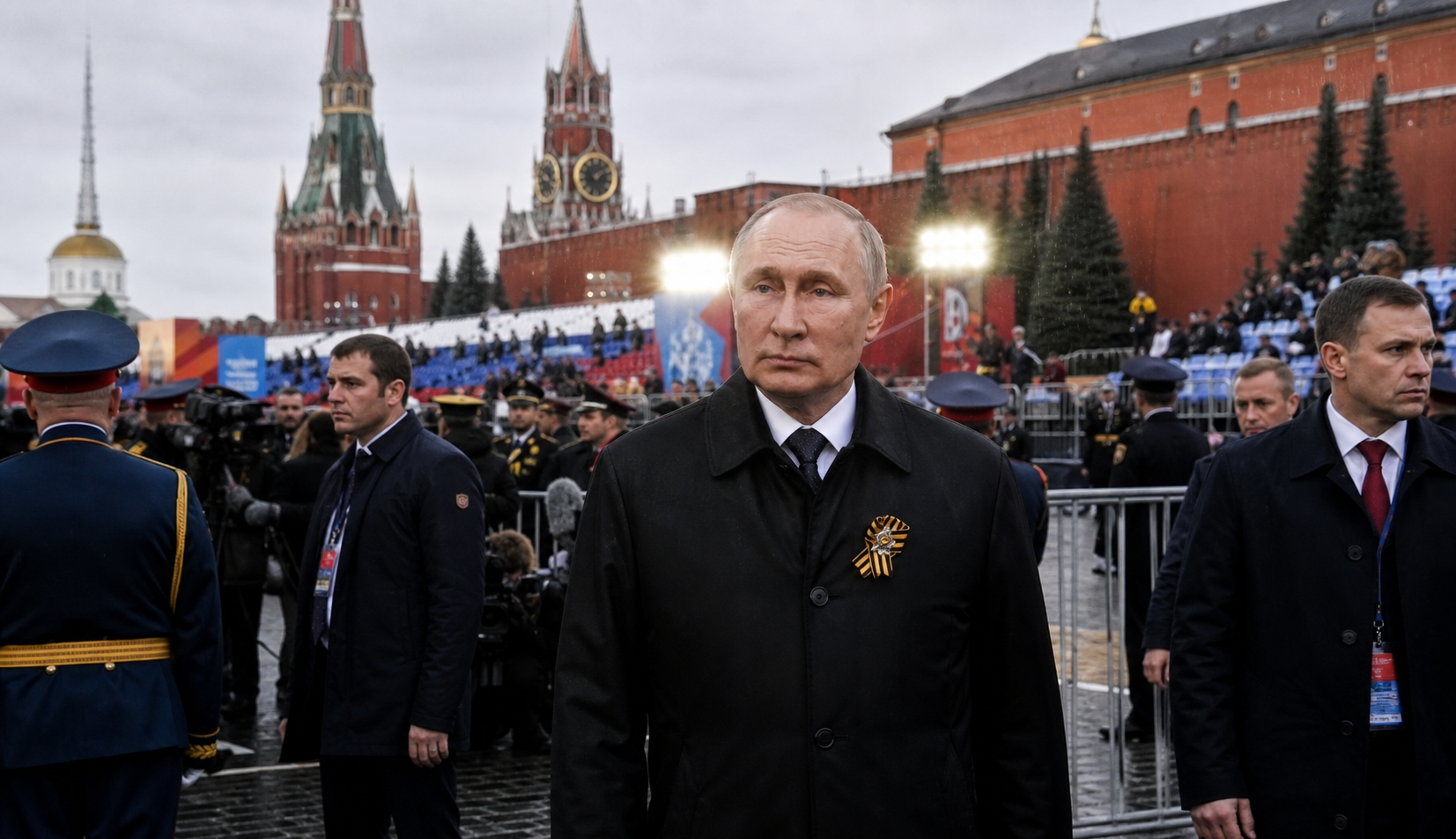
Russian President Vladimir Putin said he believes the war in Ukraine is “coming to an end,” even as he used his Victory Day remarks to defend Russia’s invasion and blame Western governments for prolonging the conflict. Speaking after a scaled-back military parade in Moscow’s Red Square, Putin argued that Russia’s confrontation with Ukraine was nearing completion, but reiterated that any peace settlement would need to be final and lasting before he would meet with Ukrainian President Volodymyr Zelensky. The article places these comments in the context of Russia’s annual Victory Day events, which were visibly reduced this year because of security concerns over possible Ukrainian drone attacks. A last-minute ceasefire, reportedly brokered by U.S. President Donald Trump, helped the parade proceed without incident and coincided with a prisoner exchange agreement between Kyiv and Moscow. Despite this diplomatic opening, the article emphasizes that Putin’s broader stance remained hardline: he described the war as just, called Ukraine an aggressive force supported by NATO, and said he preferred German ex-chancellor Gerhard Schröder as a negotiating partner for future European security talks. The piece also notes that international media access to the event was limited and that the absence of military hardware reflected heightened wartime caution and the Kremlin’s desire to project control while avoiding vulnerability.
Entities: Vladimir Putin, Volodymyr Zelensky, Donald Trump, Gerhard Schröder, António Costa • Tone: analytical • Sentiment: neutral • Intent: inform
10-05-2026
Russian President Vladimir Putin used Moscow’s Victory Day parade to project strength and national unity while insisting the war in Ukraine may be approaching an end, though he framed any peace as dependent on conditions being settled first. The annual May 9 celebration, honoring the Soviet defeat of Nazi Germany, was noticeably scaled back this year: for the first time in nearly two decades, heavy weapons such as tanks and missiles were absent from Red Square, and security was tightened amid fears of Ukrainian attacks. Putin praised Russian forces in Ukraine, cast the war as a struggle against NATO-backed aggression, and emphasized Russia’s sacrifices and wartime heroism.
The article places Putin’s remarks in the context of heightened Russia-Ukraine tensions, including mutual accusations of ceasefire violations, Ukraine’s growing long-range drone capability, and Russian threats of retaliation if celebrations were disrupted. It also notes international dimensions: North Korean troops were featured for the first time in the parade, several foreign leaders attended, and Slovakia’s prime minister Robert Fico drew criticism for visiting Moscow. The article highlights that Russia ordered mobile internet restrictions in Moscow for safety, underscoring both the security climate and the Kremlin’s tightening controls. Overall, the piece frames Victory Day as both a symbolic commemoration of WWII and a platform for modern geopolitical messaging about the war in Ukraine and Russia’s role in the world.
Entities: Vladimir Putin, Volodymyr Zelenskyy, Donald Trump, Dmitry Peskov, Robert Fico • Tone: analytical • Sentiment: neutral • Intent: inform
10-05-2026
President Trump announced that Russia and Ukraine would exchange 1,000 prisoners each under a temporary three-day ceasefire tied to Russia’s Victory Day observance. According to Trump, the ceasefire would pause all kinetic military activity from Saturday through Monday, and he said he requested the arrangement himself. His announcement followed recent, separate ceasefire proposals from both sides on different dates, leaving some ambiguity about the exact timing and scope, though statements from Moscow and Kyiv suggested both governments were willing to accept the terms. The White House framed the pause as a possible step toward ending the war, with Trump expressing hope that it could mark “the beginning of the end” of a conflict he described as long, deadly, and hard fought.
The article notes that Russian aide Yuri Ushakov confirmed Moscow’s acceptance of the prisoner-exchange ceasefire idea, saying Putin had instructed him to acknowledge Trump’s initiative. Ukrainian President Volodymyr Zelenskyy also appeared to agree, saying Ukraine had received Russia’s consent for a “1,000 for 1,000” prisoner swap and that Kyiv should prepare quickly for the exchange. Zelenskyy added that Ukraine believed there should also be a ceasefire on May 9, 10, and 11, and reiterated that Ukraine is working to bring its citizens home from Russian captivity.
The report places the development in the broader context of recent U.S. diplomatic engagement, noting meetings between top American officials and Ukrainian representatives in Miami and a prior phone call between Trump and Putin. Overall, the article presents the ceasefire and prisoner swap as a potentially meaningful but still somewhat unclear diplomatic breakthrough in the ongoing Russia-Ukraine war.
Entities: Donald Trump, Vladimir Putin, Volodymyr Zelenskyy, Russia, Ukraine • Tone: analytical • Sentiment: neutral • Intent: inform
10-05-2026
Russian President Vladimir Putin suggested on Saturday that the war in Ukraine may be nearing an end, saying, “I think that the matter is coming to an end,” according to Reuters. His comments followed a surprise three-day ceasefire announced by Donald Trump, who said the pause was designed to mark Russia’s Victory Day and would also include a major prisoner exchange of 1,000 captives from each side. The ceasefire, which began Saturday and runs through Monday, was presented by Trump as a direct request he made to both Putin and Ukrainian President Volodymyr Zelenskyy.
The article places Putin’s remarks in the context of a war that has now lasted more than four years since Russia’s full-scale invasion of Ukraine in February 2022. Despite Russia’s early expectations of a quick victory, the Kremlin has still not secured control of the entire Donbass region. Putin also indicated he would be willing to speak with Zelenskyy only after a durable peace agreement has been reached, and he said he would prefer to talk with former German Chancellor Gerhard Schroeder when asked about European leaders.
Ukraine confirmed the prisoner swap negotiations on X, with Zelenskyy stating that the exchange was being carried out under American mediation and that Ukraine had agreed to a 1,000-for-1,000 swap. Zelenskyy also said Ukraine wanted a ceasefire on May 9, 10, and 11, and he thanked Trump for his involvement while urging the United States to ensure Moscow honors the agreement. The article frames the ceasefire and prisoner exchange as a rare diplomatic development amid an otherwise prolonged and destructive conflict.
Entities: Vladimir Putin, Donald Trump, Volodymyr Zelenskyy, Reuters, Fox News • Tone: analytical • Sentiment: neutral • Intent: inform