Articles in this Cluster
10-05-2026
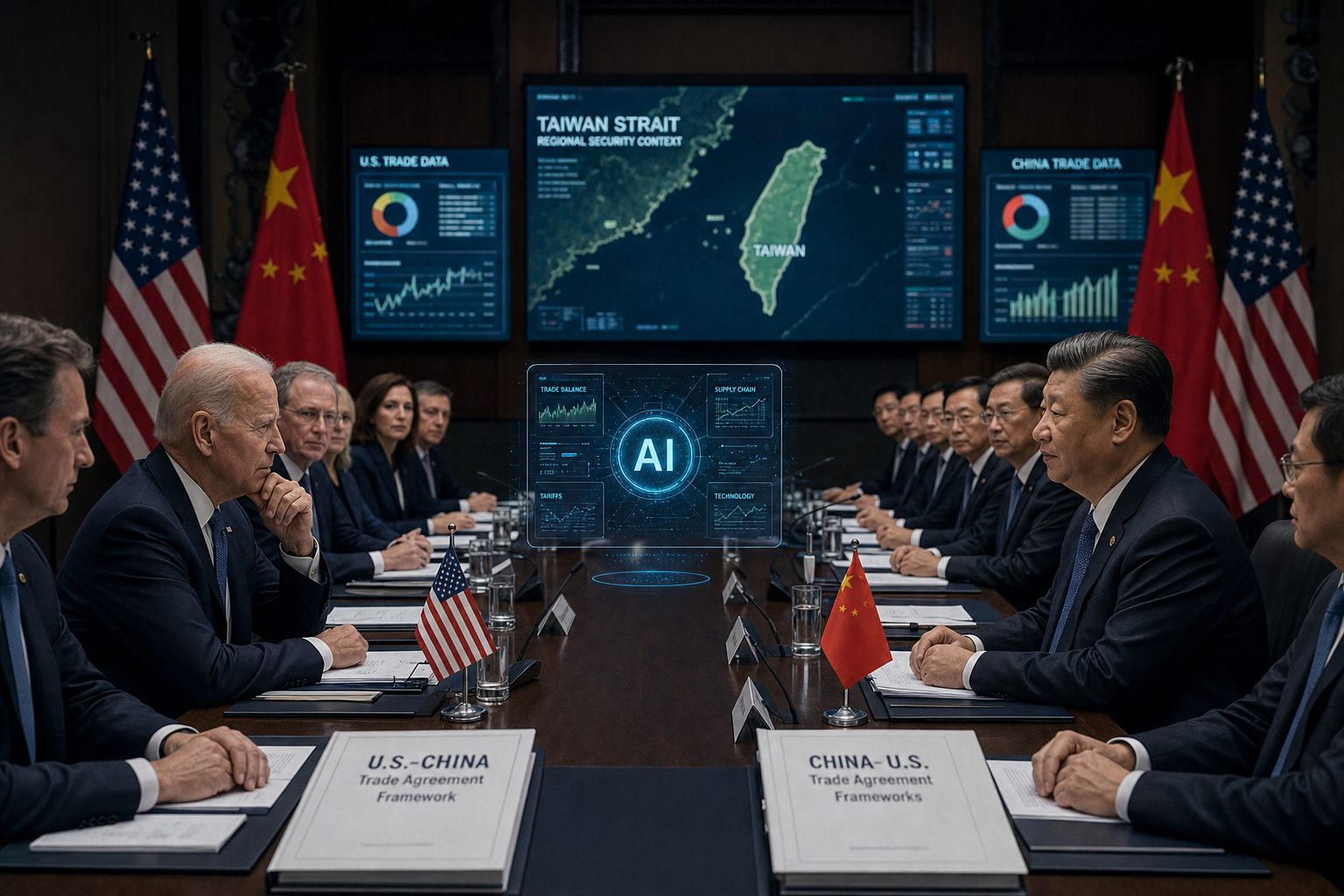
The article argues that artificial intelligence is emerging as a major strategic dilemma for the United States and China, comparable in significance to the nuclear challenge of the Cold War. As Xi Jinping and Donald Trump prepare to meet in Beijing, AI is framed as one of several high-stakes issues likely to shape their discussions, alongside trade, Taiwan, and Middle East conflicts. The core point is that AI has become both a source of national power and a growing security risk. The more advanced AI systems become, the more they can enhance economic productivity, military capability, and geopolitical influence. Yet those same advances also intensify fears about instability, misuse, and unintended consequences. The article suggests that leaders in Beijing and Washington are increasingly anxious about how to balance cooperation and competition in AI development. Rather than treating AI as merely another technology race, the piece presents it as a transformative strategic problem that may define great-power relations. The framing implies that neither side can afford to fall behind, but neither can fully trust the other, creating a tense and potentially unstable relationship reminiscent of nuclear deterrence-era rivalry.
Entities: Artificial intelligence (AI), China, United States, Beijing, Washington • Tone: analytical • Sentiment: neutral • Intent: analyze
10-05-2026
The article examines rising concern in Taipei and Washington that China is pressing Donald Trump to make concessions on Taiwan, potentially reviving a longstanding pattern of U.S.-China bargaining over the island’s status. It opens with historical context from the late 1970s and early 1980s, when Chinese officials sought a U.S. commitment to end arms sales to Taiwan and the Reagan administration responded with a carefully balanced compromise: a communiqué promising to reduce arms sales only if China’s intentions remained peaceful, plus secret reassurances to Taiwan.
This history is used to frame the present-day fear that Trump could again be drawn into a deal that weakens support for Taiwan in exchange for progress with Beijing. The article implies that such a bargain would be especially consequential because Taiwan remains a central flashpoint in U.S.-China relations, and any perceived concession could alarm allies, embolden China, and unsettle the island’s leaders. The tone suggests a broader strategic uncertainty: Washington may see a deal with Beijing as a diplomatic win, while Taipei worries about being traded away or strategically downgraded.
Overall, the piece is less about a single negotiation than about the recurring structure of U.S.-China diplomacy, where symbolic language, private assurances, and power politics intersect. It highlights how Taiwan has repeatedly been used as a bargaining chip in wider geopolitical competition, and why the possibility of Trump conceding ground is causing anxiety in both Taiwan and the United States.
Entities: China, Donald Trump, Taiwan, Taipei, Washington • Tone: analytical • Sentiment: neutral • Intent: analyze
10-05-2026
The article examines how Chinese commentators increasingly view the United States as a declining power, but one that remains dangerous because of its global reach and ability to disrupt China’s rise. In Beijing, a group of scholars issued a sarcastic “thank you” to Donald Trump, arguing that his return to the White House has accelerated trends that benefit China’s narrative: alienating America’s allies, exposing U.S. instability, and forcing China to become more innovative under pressure. The piece suggests that Chinese thinking is not simply celebratory about American decline. Instead, it sees Trump as both a symptom of deeper U.S. weakness and a force that speeds it up. At the same time, the article emphasizes that China still considers America uniquely threatening because of its military power, alliance network, and capacity to impose economic pressure. The core argument is that Beijing’s worldview combines confidence in America’s relative decline with caution about the risks posed by a still-formidable rival.
Entities: China, United States, Donald Trump, Beijing, Chinese scholars • Tone: analytical • Sentiment: neutral • Intent: analyze
10-05-2026
The article argues that expectations for a sweeping economic breakthrough between Donald Trump and Xi Jinping are unrealistic. Despite the long-standing hope among some observers that the two leaders might use a summit to achieve a “grand bargain” that would reset the U.S.-China relationship, the most likely outcome is far more modest: preserving a fragile trade truce and avoiding renewed confrontation. The piece frames the meeting in Beijing on May 14th and 15th as one shaped by deep strategic rivalry rather than mutual trust, making major concessions on trade, market access, Taiwan, or military posture highly unlikely. Instead of a transformative deal, the summit is presented as a test of whether both sides can manage tensions without escalating them.
The article emphasizes that earlier optimistic visions imagined an expansive package involving more balanced trade, genuine openings in China’s market, and even American military retrenchment in East Asia. But those hopes are portrayed as fantasy in the current climate. The realistic benchmark for success is simply maintaining the temporary trade truce already in place. In that sense, the summit is less about producing a historic agreement than about preventing deterioration in an already strained bilateral relationship. The article positions the meeting as part of the broader challenge of U.S.-China competition, where symbolic diplomacy may matter more than substantive breakthroughs, and where avoiding conflict is itself a meaningful achievement.
Entities: Donald Trump, Xi Jinping, Beijing, China, United States • Tone: analytical • Sentiment: neutral • Intent: analyze
10-05-2026
The article examines Taiwan’s fraught political moment ahead of a planned US-China summit, centering on Cheng Li-wun, chair of Taiwan’s opposition Kuomintang (KMT), who argues that Taiwan should avoid choosing sides between Washington and Beijing and instead pursue dialogue with both powers. Speaking shortly after meeting Chinese leader Xi Jinping in Beijing, Cheng says Taiwan can remain friendly with the United States without being hostile to China and warns that Taiwan does not want to become “the next Ukraine.” Her stance contrasts sharply with the expectations of many US officials and security analysts, who have urged Taiwan to strengthen its military and deepen defense cooperation with Washington in response to escalating Chinese pressure.
The article highlights a legislative battle in Taipei over President Lai Ching-te’s proposed $40 billion defense package, which Taiwan’s opposition-controlled legislature partially diluted and cut by about a third. While the package still preserves billions in US arms purchases, it reduces funding for domestic defense initiatives such as drone development. Critics, including former US national security adviser Matt Pottinger, accuse the KMT of undermining urgently needed military modernization, while Cheng insists that the budget is too vague and that the party remains committed to national defense.
Beyond the budget fight, the piece places Cheng’s outreach to Beijing in historical and strategic context. It notes the symbolism of her meeting with Xi, Beijing’s long-standing goal of “reunification,” and Taiwan’s enduring divide over how to balance deterrence, diplomacy, and cross-strait stability. Cheng presents engagement as the only realistic way to avoid war and suggests that if the KMT returns to power, tensions would ease. The article closes by noting speculation that Cheng may become a presidential contender in 2028, underscoring how her rise is reshaping Taiwan’s political landscape.
Entities: Cheng Li-wun, Kuomintang (KMT), Taiwan, Taipei, Beijing • Tone: analytical • Sentiment: neutral • Intent: inform
10-05-2026
Donald Trump’s upcoming summit with Xi Jinping in Beijing is presented as a high-stakes diplomatic test shaped by multiple vulnerabilities for the US president. The article argues that Trump enters the meeting from a weakened position after an attack on Iran has exposed limits in US power and diverted attention from his China strategy. The trip, shortened to two days, comes after years of worsening tensions that include a trade war, pandemic disruption, and growing US concern over China’s military posture, especially around Taiwan.
Despite the tense backdrop, both sides have incentives to find limited economic wins. The 2025 Busan meeting created a temporary trade truce after Trump imposed tariffs as high as 145% on Chinese goods and China retaliated with rare earth export restrictions that disrupted US industry. Now Trump wants visible results before the midterm elections, including possible headline-grabbing deals involving Boeing jets, agricultural purchases, and investment commitments. China, meanwhile, wants to preserve access to US technology, extend the trade truce, and secure relief from export controls.
The summit is further complicated by the war in Iran, which affects global oil flows through the Strait of Hormuz and could harm both China’s economy and the broader global outlook. Washington is pressing Beijing to use its influence with Tehran, even as China seeks to avoid recessionary fallout. Beneath the economic diplomacy lies deep mutual distrust, with trade, military relations, and Taiwan remaining unresolved fault lines. The article portrays the summit as a fragile balancing act in which photo opportunities and symbolic gestures may matter as much as substantive agreements.
Entities: Donald Trump, Xi Jinping, Beijing, China, United States • Tone: analytical • Sentiment: neutral • Intent: analyze