08-09-2026
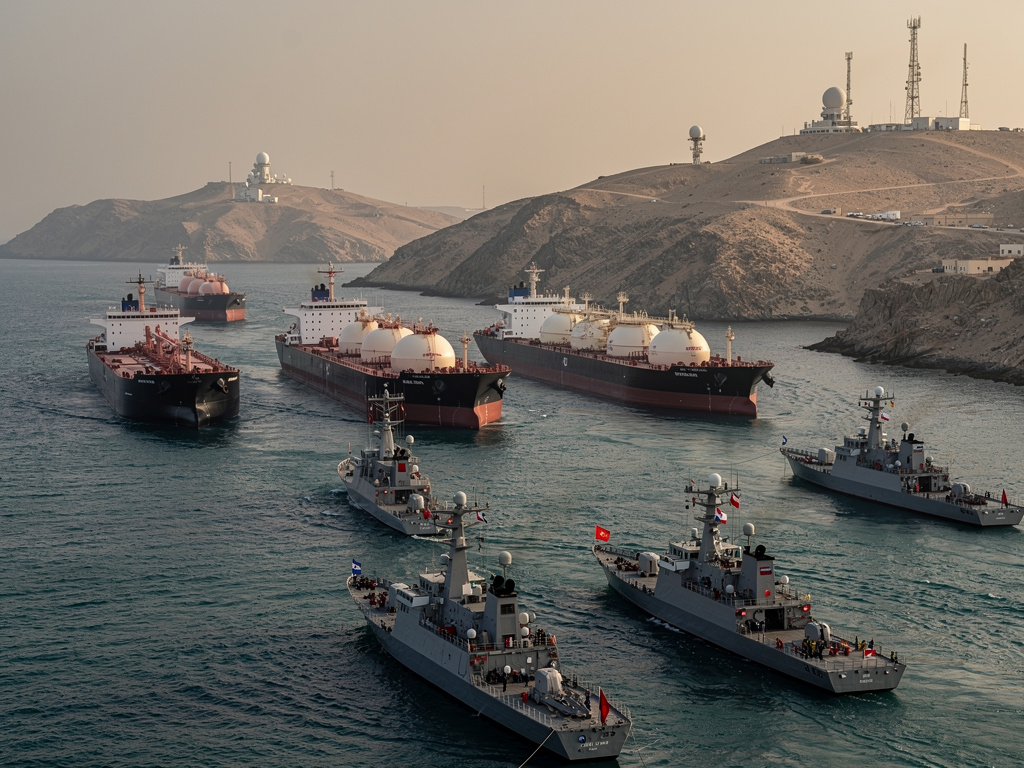
The live news report describes escalating military and economic tensions involving Iran, the United States and several regional actors. Iran’s Supreme National Security Council says Tehran plans to establish a maritime “exclusion zone” outside the Strait of Hormuz and prevent vessels from transiting without Iranian permission. The announcement follows an Iranian threat of a “more intense and more painful” response after U.S. strikes on three Iranian oil tankers in the Persian Gulf and Gulf of Oman.
The conflict is driving global energy prices higher. Brent crude briefly reached $97 per barrel, while West Texas Intermediate traded above $92. U.S. gasoline prices also climbed to approximately $4.15 per gallon, a record level for the Labor Day weekend and nearly a dollar above the previous year. President Trump predicted that oil prices would fall sharply if the United States wins the war, but prices remained elevated as hostilities continued.
The report also details economic pressure inside Iran. The government doubled the gasoline price for consumers exceeding a monthly quota, affecting about 15% of users. The change comes as Iran’s currency and purchasing power deteriorate, while domestic fuel consumption exceeds production capacity.
Military activity has spread across the region. U.S. Central Command says it has redirected 94 commercial ships accused of violating a blockade of Iranian ports, while three ships were disabled and two boarded. In Yemen, Iran-backed Houthis accused Saudi Arabia of airstrikes that reportedly killed seven people at a prison, amid fighting near the Bab al-Mandab Strait. Israel said it struck Hezbollah targets in southern Lebanon after drone launches, despite maintaining its commitment to a ceasefire. Oman’s navy also rescued 16 crew members from a Saudi-flagged tanker attacked by Iran; two people were killed. The supplied article ends mid-sentence during that account.
Entities: Iran, United States, Strait of Hormuz, U.S.-Iran war and maritime escalation, Brent crude oil • Tone: urgent • Sentiment: negative • Intent: inform
08-09-2026
Iran has criticized Canada for supporting U.S.-led efforts to reopen the Strait of Hormuz and for condemning Tehran’s actions in the Middle East. Esmaeil Baghaei, spokesperson for Iran’s Foreign Ministry, accused Ottawa of appeasing Washington and described Canada’s position as “strategic confusion and submission to intimidation.” His comments came after Canadian officials said the country would work with international partners to maintain significant pressure on Iran through sanctions and support for efforts to restore freedom of navigation in the strait, led by the United States, France and the United Kingdom.
Baghaei also linked Canada’s decision to support the U.S. to President Donald Trump’s recent depiction of Canada, Greenland and Iceland as part of U.S. territory. Trump has repeatedly discussed making Canada the 51st U.S. state and annexing Greenland, a semi-autonomous territory of Denmark. Baghaei argued that Canada could not credibly claim to support peace, security, international law and freedom of navigation while backing what Iran called U.S. military aggression and intervention in the region.
The Iranian official further claimed that supporting Washington would not protect Canada from U.S. pressure, citing recent trade tensions between Ottawa and Washington. Trade negotiations collapsed after Prime Minister Mark Carney said U.S. demands were excessive, prompting tariffs on approximately $20 billion of Canadian goods and matching Canadian retaliatory tariffs.
Iran has also warned other U.S. partners, including South Korea, against providing military support for operations in the Persian Gulf and Strait of Hormuz. Seoul has said it is considering options, including military measures to support freedom of navigation. Baghaei warned that countries participating in U.S. operations could face “serious consequences,” escalating tensions surrounding the strategically important waterway.
Entities: Iran, Canada, United States, Strait of Hormuz, Persian Gulf • Tone: analytical • Sentiment: negative • Intent: inform
08-09-2026
Oil prices rose for a third consecutive day on Tuesday, reaching six-week highs as markets reacted to escalating hostilities between the United States and Iran. Brent crude for November delivery gained 0.20% to $97.20 per barrel, while U.S. West Texas Intermediate for October rose 1.07% to $92.56. The latest gains followed weekend exchanges in which the U.S. military struck three Iranian oil tankers after Iran launched ballistic missiles at two U.S. Navy warships. Iran condemned the attacks on commercial vessels as a “war crime” and an act of “economic warfare.”
Market analysts said the strikes represented a significant escalation and raised concerns that diplomatic efforts to prevent Iran from obtaining a nuclear weapon could fail. The confrontation also contributed to record-high gas prices, while Iranian and U.S. officials exchanged threats over further attacks on vessels and military assets.
Goldman Sachs raised its December 2026 price forecasts for Brent and WTI by $5, to $85 and $80 per barrel, respectively. The bank also increased its 2027 forecasts to $80 for Brent and $75 for WTI. Goldman expects disruptions to oil shipping in the Middle East to continue into 2027, with production gradually recovering in the second half of that year. The bank said markets are increasingly pricing in a prolonged conflict, citing tanker rates for shipments from the Persian Gulf to China as evidence that disruptions could persist.
President Trump said oil prices would fall sharply when the United States wins the war with Iran, but the immediate market reaction reflected increased concern over supply and shipping risks in the region.
Entities: Brent crude, West Texas Intermediate (WTI), Oil prices, Strait of Hormuz, United States • Tone: analytical • Sentiment: negative • Intent: inform
08-09-2026
The article reports a sharp escalation in the conflict between Iran and the United States, with Tehran threatening to establish a maritime exclusion zone across parts of the Persian Gulf and around the Strait of Hormuz. Mohsen Rezaei, secretary of Iran’s Supreme National Security Council, said vessels entering the proposed zone would be placed on an Iranian sanctions list. Iran also said it had used the Qassem Basir, an advanced ballistic missile, against US warships. Iranian media described the missile as highly manoeuvrable, resistant to electronic warfare and capable of evading missile-defence systems, while the US military said its ships avoided the reported attacks.
The confrontation has continued through alternating pauses and flare-ups during a six-month-old war that began with US and Israeli strikes on Iran on Feb 28. The United States has reportedly attacked Iranian targets, including three oil tankers, while Iran retains missile and drone capabilities that could threaten commercial shipping and US military installations in Gulf states. Tehran plans to publish maps for a new shipping corridor through the Strait of Hormuz, although the timing and details remain unclear.
The conflict is disrupting a major global energy route. Before the war, approximately one-fifth of global oil and liquefied natural gas shipments passed through the strait; recent shipping data showed only about 10 commodity vessels per day using it. Iran wants sanctions relief and may seek to charge fees to ships using the waterway, while US President Donald Trump has predicted sharply lower oil prices if the war ends in an American victory and said Iran will not obtain a nuclear weapon.
The article also highlights the broader regional consequences. Israeli strikes in southern Lebanon killed at least 12 people, raising fears of renewed conflict with Hezbollah and complicating diplomatic efforts. Iran insists that any lasting agreement with Washington must include an end to Israeli attacks in Lebanon.
Entities: Iran, United States, Persian Gulf, Strait of Hormuz, Qassem Basir missile • Tone: urgent • Sentiment: negative • Intent: inform