07-09-2026
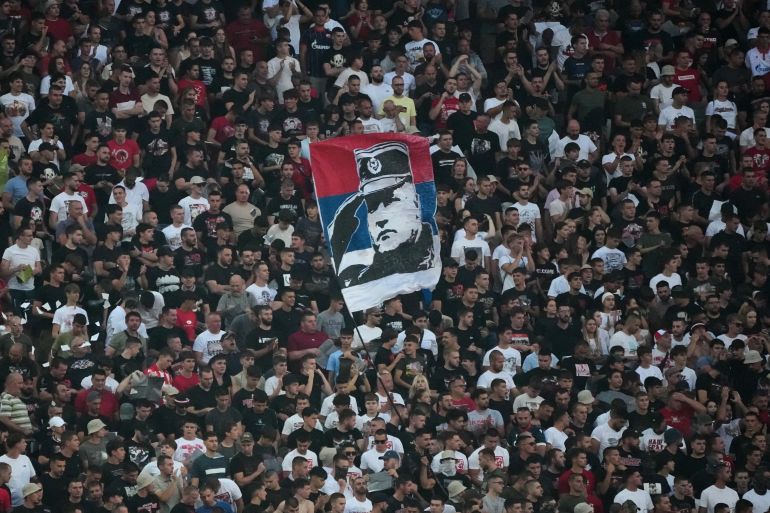
The article examines the public glorification of Ratko Mladic, the former Bosnian Serb general convicted of genocide, war crimes and crimes against humanity, by football supporters in Serbia. During Red Star Belgrade’s match against Partizan, fans displayed a giant image of Mladic, used the slogan “Pravac Potocari” (“Direction Potocari”) and held a minute of silence in his memory. The slogan refers to Mladic’s words when he entered Srebrenica on July 11, 1995, before Bosnian Serb forces carried out the genocide of thousands of Bosniak men and boys.
The tribute followed UEFA’s €98,250 fine against Red Star for an earlier banner praising Mladic, along with a ban on supporters attending two European away matches. Partizan supporters had also recently displayed messages thanking Mladic, indicating that the sentiment extends across the rivalry between Serbia’s two largest clubs.
Serbian journalists and organized-crime analysts quoted in the article argue that the incident reflects a longstanding relationship between football hooliganism, nationalism, criminal networks and political power. They describe stadium terraces as spaces for nationalist mobilization and coded political messaging, and suggest that authorities have historically tolerated or directed fan groups for purposes ranging from wartime recruitment to peacetime intimidation and propaganda. The article connects Red Star’s fan culture to Serbian paramilitary leader Zeljko Raznatovic Arkan and notes that Mladic’s body was returned to Serbia on a government plane and received with military honours.
Experts warn that the most troubling development is the normalization of hate speech and war-criminal glorification. Research cited by the Global Initiative Against Transnational Organized Crime found that Serbia has particularly serious links between violent hooliganism and extreme political or paramilitary structures, though analysts caution against labeling all supporters as terrorists. UEFA’s disciplinary measures are presented as a response to this broader pattern.
Entities: Ratko Mladic, Srebrenica genocide, Potocari, Red Star Belgrade, Partizan Belgrade • Tone: analytical • Sentiment: negative • Intent: analyze
07-09-2026
Serbia has held the funeral of Ratko Mladic, the former Bosnian Serb military commander convicted of genocide against Bosniak Muslims during the conflicts of the 1990s. The ceremony took place in Serbia’s capital and was conducted with state honours, attracting thousands of attendees. Mladic died while serving a life sentence in The Hague, according to the article.
Mladic was one of the most prominent figures associated with the Bosnian Serb forces during the war in Bosnia and Herzegovina. His conviction for genocide made him a central figure in international efforts to prosecute individuals responsible for atrocities committed during the conflict, including crimes against Bosniak Muslim civilians. The article does not provide further details about the funeral’s speakers, the government’s justification for granting state honours, or the reactions of victims’ families and survivors.
The event is significant because the public commemoration of a convicted war criminal can be deeply contentious, particularly in the context of the Srebrenica genocide and the continuing divisions surrounding the legacy of the Bosnian war. The attendance of thousands and the official nature of the ceremony indicate that Mladic remains a powerful and divisive figure for sections of Serbian society. At the same time, the article’s description of his conviction and life sentence underscores the international legal judgment against him.
Published on 7 September 2026, the report presents the funeral as a current news event and focuses on the ceremony, Mladic’s wartime role, his conviction, and the circumstances of his death. It offers a concise factual account rather than an extended analysis of the political or social consequences of the funeral.
Entities: Ratko Mladic, Serbia, Belgrade, The Hague, International Criminal Court (ICC) • Tone: neutral • Sentiment: negative • Intent: inform
07-09-2026
The article reports that supporters of Serbian football club Red Star Belgrade unveiled a large stadium display, or “tifo,” honoring Ratko Mladic during the Belgrade derby against rival club Partizan. Mladic was a Bosnian Serb military commander who was widely known as the “butcher of Bosnia.” He was convicted by an international tribunal of genocide, crimes against humanity, and war crimes related to the conflicts in Bosnia and Herzegovina. The article states that Mladic died while imprisoned in The Hague.
The report places the display within the highly charged atmosphere of the Red Star–Partizan derby, one of Serbia’s most prominent football rivalries. Although the article does not provide extensive details about the design or the circumstances surrounding the tribute, it identifies the tifo as an act of public commemoration by Red Star fans. The incident is significant because it invokes a figure associated with some of the most serious crimes committed during the Balkan wars and reflects the continued presence of contested wartime memory in public life and sporting culture.
Published on September 7, 2026, the short news report focuses on the unveiling itself and on the established legal record concerning Mladic. It does not offer reactions from the club, opposing supporters, Serbian authorities, victims’ organizations, or international institutions. Its central purpose is to inform readers that Red Star supporters publicly honored Mladic at a major football match, while providing brief context about his identity, death, and convictions.
Entities: Serbia, Red Star Belgrade, Ratko Mladic, Partizan, Belgrade derby • Tone: neutral • Sentiment: negative • Intent: inform
07-09-2026
Ratko Mladic, the former Bosnian Serb military commander convicted of genocide and other war crimes, was buried in Belgrade with military honours despite warnings from the European Union against glorifying convicted war criminals. Mladic died aged 84 on August 27 in The Hague, where he had been serving a life sentence imposed in 2017 by the International Criminal Tribunal for the former Yugoslavia.
Thousands of mourners gathered at the Serbian Orthodox Church of St. Luke, where Mladic’s body lay in state. Many Serbs continue to regard him as a hero. His coffin was displayed with a military officer’s cap and sabre, and was guarded by men in military fatigues. Patriarch Porfirije, head of the Serbian Orthodox Church, led the funeral service.
Serbian army soldiers later carried the flag-draped coffin through the cemetery as mourners applauded and a military orchestra played. Pro-government media broadcast the ceremony live, turning the funeral into a prominent public event. Among those attending were Milorad Dodik, a Bosnian Serb nationalist leader, and Alexander Botsan-Kharchenko, Russia’s ambassador to Serbia.
Mladic was convicted of orchestrating the 1995 Srebrenica massacre, in which more than 8,000 Muslim men and boys were killed. He was also found responsible for the prolonged siege of Sarajevo and other crimes, including the establishment of concentration camps for non-Serb civilians and captured soldiers. The funeral’s military honours and public attendance therefore represented a direct challenge to EU concerns about the glorification of war criminals and highlighted the continuing divisions over Mladic’s legacy in Serbia and the wider Balkans.
Entities: Ratko Mladic, Serbia, European Union, Belgrade, Bosnian Serb forces • Tone: analytical • Sentiment: negative • Intent: inform
07-09-2026
Former Bosnian Serb army commander Ratko Mladic, convicted of genocide and other war crimes, was buried at Topcider Cemetery in Belgrade with military honors. Several thousand people attended or lined the funeral procession, while Serbian Patriarch Porfirije officiated the service. Mladic died while serving a life sentence in The Hague for crimes committed during the 1990s breakup of Yugoslavia, including the 1995 Srebrenica massacre, in which approximately 8,000 Bosniak civilians and prisoners were killed. He was buried beside his daughter, who died by suicide in 1994.
President Aleksandar Vucic did not attend, citing a scheduled visit by Uzbekistan’s president, but defended the decision to provide a dignified burial and military honors. He dismissed criticism from the European Union, including remarks by EU Enlargement Commissioner Marta Kos, while an EU spokesman condemned the glorification of war criminals, genocide denial and historical revisionism.
The funeral comes at a politically sensitive moment for Vucic, who may call snap parliamentary elections as early as this week. His governing Serbian Progressive Party could face a serious challenge from a student-led movement that has organized anti-government protests for nearly two years. Analysts Dejan Bursac and Tanja Topic argue that Mladic’s funeral and the nationalism surrounding it could help Vucic portray himself as a patriot and his opponents as traitors. They also warn that patriotic emotion can distract voters from economic and political difficulties.
The student movement has largely avoided discussing Mladic, focusing instead on the rule of law, democracy and corruption. It emerged after the November 2024 collapse of a canopy at a renovated railway station in Novi Sad killed 16 people. With Serbia’s media landscape largely controlled by the government or its allies, pro-Vucic outlets have attacked critics of Mladic as anti-Serb. However, the article concludes that the funeral is unlikely to sustain Vucic’s electoral momentum until voting expected in October.
Entities: Ratko Mladic, Aleksandar Vucic, Serbian Patriarch Porfirije, Marta Kos, Dejan Bursac • Tone: analytical • Sentiment: negative • Intent: analyze