06-11-2026
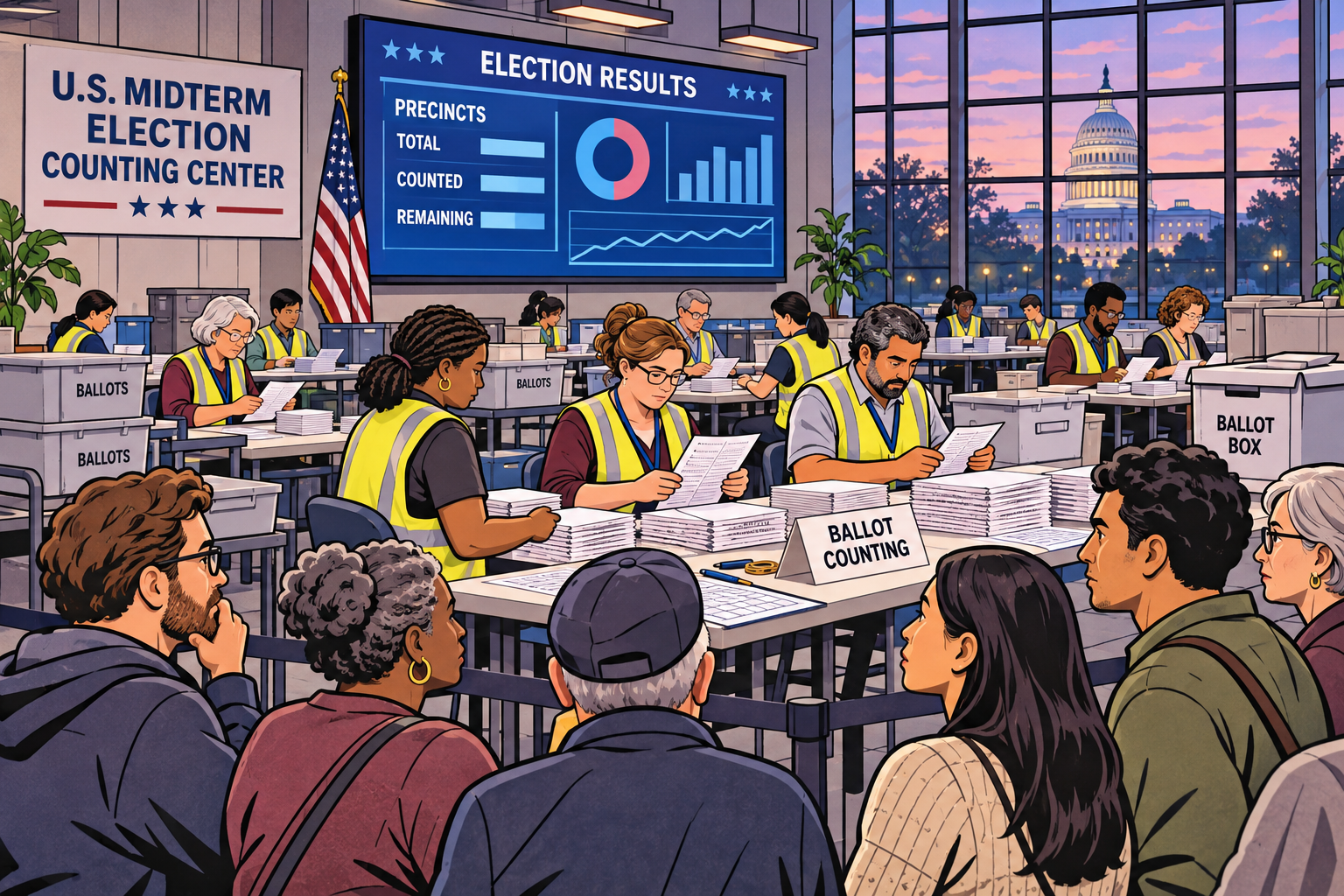
The supplied excerpt describes a major midterm defeat for President Donald Trump’s Republicans. Democrats reportedly won a large House majority and control of the Senate, making substantial gains even in traditionally Republican strongholds. The excerpt characterizes the outcome as the party’s worst loss in roughly 50 years.
Several factors are identified as contributing to the Republican setback: Trump’s war in Iran, rising gasoline prices, corruption claims, and voters’ dissatisfaction with unmet promises on costs and wars. The campaign was also weakened by Republican infighting, poor candidate choices, and delayed spending. By contrast, Democrats benefited from redistricting and strong candidates who helped them broaden their electoral map.
The article’s opening scene shifts to the final days before the election. Six days before voters went to the polls, more than two dozen of Trump’s senior strategists joined a private video call. The mood was described as grim, and the discussion reportedly opened with talk of cyanide. This detail sets a stark, dramatic tone and signals the campaign team’s perception of the crisis.
The supplied material is only a short excerpt and does not provide the full account promised by the headline. It establishes the scale of the reported electoral collapse and names political, economic, and organizational explanations, but offers little detail about the strategists’ discussion or how the campaign reached its final position. The analysis therefore reflects only the information included in the provided text.
Entities: Donald Trump, Shane Goldmacher, Jonathan Swan, Maggie Haberman, Democratic Party • Tone: analytical • Sentiment: negative • Intent: analyze
06-11-2026
The article reports that baseless claims of voter fraud largely faded after Democrats won both chambers of Congress in the 2026 US midterm elections, a result described as a decisive “blue tsunami.” Although observers had expected election deniers to challenge results or for Donald Trump to try to influence the outcome, neither happened. Trump accepted the defeat, and many of his supporters followed his lead. The University of Washington’s Center for an Informed Public said election denialism did not become a central explanation for the Democratic victories, noting that such claims lacked a political elite to organize and amplify them.
Analysts offered several possible explanations. The scale of the Democratic win may have made challenges less likely, though David Becker of the Center for Election Innovation and Research argued that large margins had not stopped fraud claims in the past. He suggested political incentives may have changed. Many election-denying candidates also lost and did not contest their results. Andy Biggs, who had challenged the 2020 election, conceded his Arizona gubernatorial race to Katie Hobbs and blamed inadequate turnout rather than fraud.
Some conservative influencers who had previously promoted election skepticism were also subdued. Rogan O’Handley said Republicans lost because they failed to address voters’ concerns, including prices and the Iran war, not because of election fraud. However, Media Matters for America’s John Knefel warned against assuming election denialism has permanently weakened, saying rejection of Democratic victories remains foundational to Trump’s movement. Other experts expressed cautious optimism: voters may be tiring of unsupported claims, and polling suggests election fraud is not a major factor in how most people decide their votes. The article concludes that the movement may persist even as its claims receive less traction in this election.
Entities: Donald Trump, Democratic Party, Republican Party, 2026 US midterm elections, Blue tsunami • Tone: analytical • Sentiment: neutral • Intent: analyze
06-11-2026
France 24 interviews political scientist Ian Bremmer about what he sees as a sharp decline in Donald Trump’s ability to shape US politics and international affairs. Bremmer argues that although Trump retains the formal powers of the presidency and considerable public visibility, his practical political influence is increasingly limited. He points to a major electoral setback for the governing party, congressional opposition, Republican discontent, unpopular foreign-policy decisions, economic disappointment and unfulfilled campaign promises as factors weakening the coalition that brought Trump back to office.
Bremmer describes the political reversal as historically striking: Trump made what he calls the biggest political comeback in US history in 2024, only to face the largest loss for a governing party in more than 50 years two years later. He characterizes the current period as “peak Trump” having passed—not because the president has become powerless, but because he is less able to turn presidential authority into political outcomes.
The effects may reach beyond Washington. In relation to the war in Iran, the conflict in Ukraine and transatlantic relations, Bremmer says foreign governments are beginning to account for the possibility of a post-Trump administration. Some leaders may increasingly engage with the United States they expect to deal with after Trump leaves office. He also questions whether the president’s attention to monumental projects and personal legacy is compatible with the demands of governing.
Bremmer’s central conclusion is that Trump has two years remaining but is unlikely to cause disruption on the global scale he did at the start of his term. The interview frames this as a broader question about whether a president can retain the constitutional authority of the office while losing the political influence needed to direct the country’s future; Bremmer believes that process is already underway.
Entities: Donald Trump, Ian Bremmer, France 24, Eurasia Group, GZERO Media • Tone: analytical • Sentiment: neutral • Intent: analyze