06-11-2026
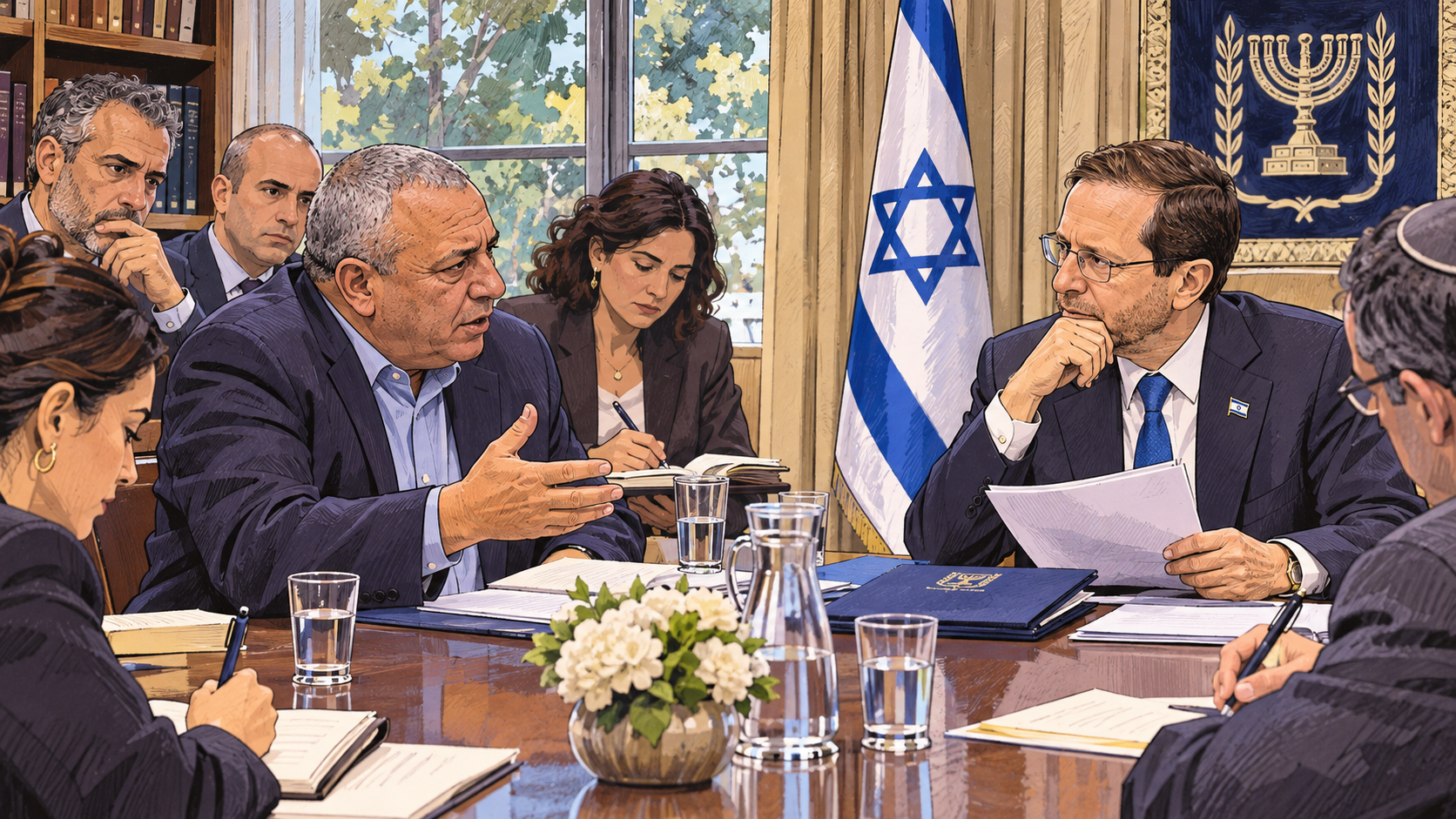
Israeli President Isaac Herzog is expected to announce on Sunday which lawmaker he will ask to form a government following the October 27 election. Opposition leader Gadi Eisenkot received 67 recommendations from members of parliament, compared with 46 for Prime Minister Benjamin Netanyahu; seven lawmakers abstained. Although the customary choice is the person with the most recommendations, Herzog said the result does not settle who can actually assemble a governing coalition, given vetoes within and between political blocs. He plans to consult party leaders directly before deciding.
Two Arab-majority lists, which won a historic combined 19 seats, endorsed Eisenkot. Their support could make them pivotal, but Israel Beiteinu, an Eisenkot-aligned right-wing party led by Avigdor Liberman, has repeatedly ruled out joining a government dependent on Arab parties. Liberman pointed to the lists’ refusal to explicitly label Hamas a terrorist group, despite their condemnation of Hamas’s October 7, 2023 attack on Israel.
The ultra-Orthodox United Torah Judaism party declined to recommend either candidate. Along with Shas, it wants to preserve exemptions from military service for religious students. The issue has become contentious as reservists serve repeated tours amid wars in Gaza, Lebanon and Iran. Eisenkot has pledged to end the exemptions, while some allies criticize the ultra-Orthodox community’s exemption from service. Observers suggest United Torah Judaism’s position may be intended to pressure Netanyahu, rather than rule out joining a government he forms.
Netanyahu’s bloc has 53 seats and Eisenkot’s has 48, leaving coalition-building uncertain despite Eisenkot’s lead in recommendations. The lawmaker given the mandate would have 28 days to form a government, with a possible 14-day extension; if unsuccessful, Herzog can turn to someone else. Arab parties’ gains reflected anger at Netanyahu’s hard-right government and longstanding complaints of racism and discriminatory treatment. Netanyahu has attacked the prospect of an opposition alliance with Arab lawmakers and questioned Arab citizens’ loyalty, alleging without substantiation that foreign powers may have funded the election.
Entities: Isaac Herzog, Gadi Eisenkot, Benjamin Netanyahu, Yashar, Israel Beiteinu • Tone: analytical • Sentiment: neutral • Intent: inform
06-11-2026
The France 24 video report focuses on Gadi Eisenkot’s emergence as the leading candidate to be asked to form Israel’s next government. According to the article description, Eisenkot became the frontrunner on Thursday, November 5, after one of the two main parties representing ultra-Orthodox Jewish voters declined to recommend any candidate. That party had been a longtime ally of Prime Minister Benjamin Netanyahu’s governing coalition, making its decision significant in the political calculations around forming a government.
The report raises the question of whether Eisenkot could replace Netanyahu, but the supplied text does not say that he has been selected to form a government or that a new government has been formed. Instead, it describes him as a frontrunner at this stage of the process. A related France 24 headline says Israel’s president would announce on Sunday who would be tasked with forming a government, indicating that the decision remained pending when the report was published.
The video is reported by France 24 correspondent Noga Tarnopolsky in Jerusalem. The supplied page content contains only a short description rather than a full transcript, so it does not provide further details about Eisenkot’s political support, the parties involved, or the likely composition of a coalition. The report’s central focus is the effect of the ultra-Orthodox party’s decision on the contest to form a government and on Netanyahu’s political position.
Entities: Gadi Eisenkot, Benjamin Netanyahu, Noga Tarnopolsky, Israel, Jerusalem • Tone: analytical • Sentiment: neutral • Intent: inform
06-11-2026
Israeli President Isaac Herzog said he will announce on Sunday, November 8, which political leader he will ask to try to form Israel’s next government. The announcement follows post-election consultations with the leaders of the country’s political parties. Those consultations produced a clear difference in the recommendations reported: 46 members of parliament backed incumbent Prime Minister Benjamin Netanyahu, while 67 supported his rival, Gadi Eisenkot. Seven lawmakers abstained. The figures show that Eisenkot received more recommendations than Netanyahu in this stage of the process, but the article does not say that Herzog has already selected him or that a government has been formed. Rather, the president is expected to identify whom he will task with attempting to assemble a government after hearing from the party leaders. The report therefore concerns the next procedural step following an election whose outcome, according to related coverage listed on the page, had not produced a clear winner. The article provides no further details about the parties’ positions, the negotiations, or the prospects of either candidate successfully forming a coalition. Its central news is the timing of Herzog’s forthcoming decision and the distribution of lawmakers’ recommendations: Eisenkot received 67, Netanyahu 46, and seven abstained. The report is presented as a short France 24 video item, credited to Simon Moritz and Eliza Herbert, and identifies Israel’s elections and the Middle East as its topics.
Entities: Isaac Herzog, Benjamin Netanyahu, Gadi Eisenkot, Israel, France 24 • Tone: neutral • Sentiment: neutral • Intent: inform
06-11-2026
Israel’s President Isaac Herzog is expected to announce on Sunday which politician will receive the first opportunity to form a government after last month’s election produced no clear governing majority. Gadi Eisenkot, who received recommendations from 67 of the Knesset’s 120 members during consultations, is widely expected to be chosen, though Herzog has discretion and the decision could shape the country’s political future. The article describes the task as unusually consequential amid deep divisions and high stakes.
Eisenkot would face difficult coalition choices. To secure a majority, opposition parties may have to reverse campaign pledges, particularly on whether to work with the ultra-Orthodox United Torah Judaism party despite disputes over military-service exemptions and public funding. They must also decide whether to cooperate with Arab parties, whose alliance won 19 seats after high turnout. Critics have stigmatized Arab politicians, while Netanyahu supporters have promoted an unsubstantiated claim that the election was stolen through a foreign-funded effort to increase Arab turnout. Israel’s Central Elections Committee has affirmed the result’s validity.
If Herzog gives Eisenkot the mandate, he will have 28 days to assemble a coalition, with a possible 14-day extension. Benjamin Netanyahu would remain caretaker prime minister and could work to undermine the effort. The article notes concern that he might manufacture or exploit a security crisis, with tensions with Iran still high. If the first attempt fails, Herzog can give another candidate 28 days without an extension, consult further with Knesset factions, or set in motion a further process in which at least 61 lawmakers can nominate a willing candidate. That candidate would have 14 days. Failure to form a government ultimately leads to new elections.
Entities: Isaac Herzog, Gadi Eisenkot, Benjamin Netanyahu, Yousef Jabareen, Israel • Tone: analytical • Sentiment: negative • Intent: inform
06-11-2026
Gadi Eisenkot, leader of Israel’s Yashar party, received recommendations from 67 Knesset lawmakers during consultations with President Isaac Herzog, giving him a clear lead over Prime Minister Benjamin Netanyahu, who received 46 recommendations. Eisenkot’s total exceeds the 61 lawmakers needed for a parliamentary majority, and the support of the Arab-led Joint List proved decisive. The party, which had considered abstaining, backed Eisenkot to prevent Netanyahu and his Kahanist allies from returning to power. Eisenkot says he wants to form a “national emergency government” to restore political stability, but stressed that negotiations are far from over.
The recommendations do not guarantee a viable governing coalition. Only 48 of Eisenkot’s 67 recommenders are currently willing to work together without conditions, while the Joint List has ruled out formally joining his government and has significant policy differences with some of the Jewish-led opposition. It may instead support the government from outside. Yisrael Beiteinu leader Avigdor Liberman has rejected a government dependent on Arab-party support, further narrowing Eisenkot’s options. The ultra-Orthodox United Torah Judaism party, which declined to recommend either candidate, could potentially matter in coalition negotiations, but its demands regarding military-service exemptions for Haredi men conflict with positions held by parties in Eisenkot’s camp.
Netanyahu’s tally fell below the 53 seats previously expected after United Torah Judaism withheld its recommendation. His allies may also seek to weaken Eisenkot by challenging the legitimacy of a government that relies on Arab parties. Eisenkot has political momentum, but he has less experience in coalition bargaining than Netanyahu, who has a long record of navigating such negotiations.
Herzog has not yet formally given Eisenkot the mandate to form a government. He plans further consultations with political parties before deciding on Sunday whom to task. Herzog also explored the possibility of a national unity arrangement, but Eisenkot’s camp indicated it would not share power with Netanyahu.
Entities: Gadi Eisenkot, Benjamin Netanyahu, Isaac Herzog, Yashar, Knesset • Tone: analytical • Sentiment: neutral • Intent: analyze