06-09-2026
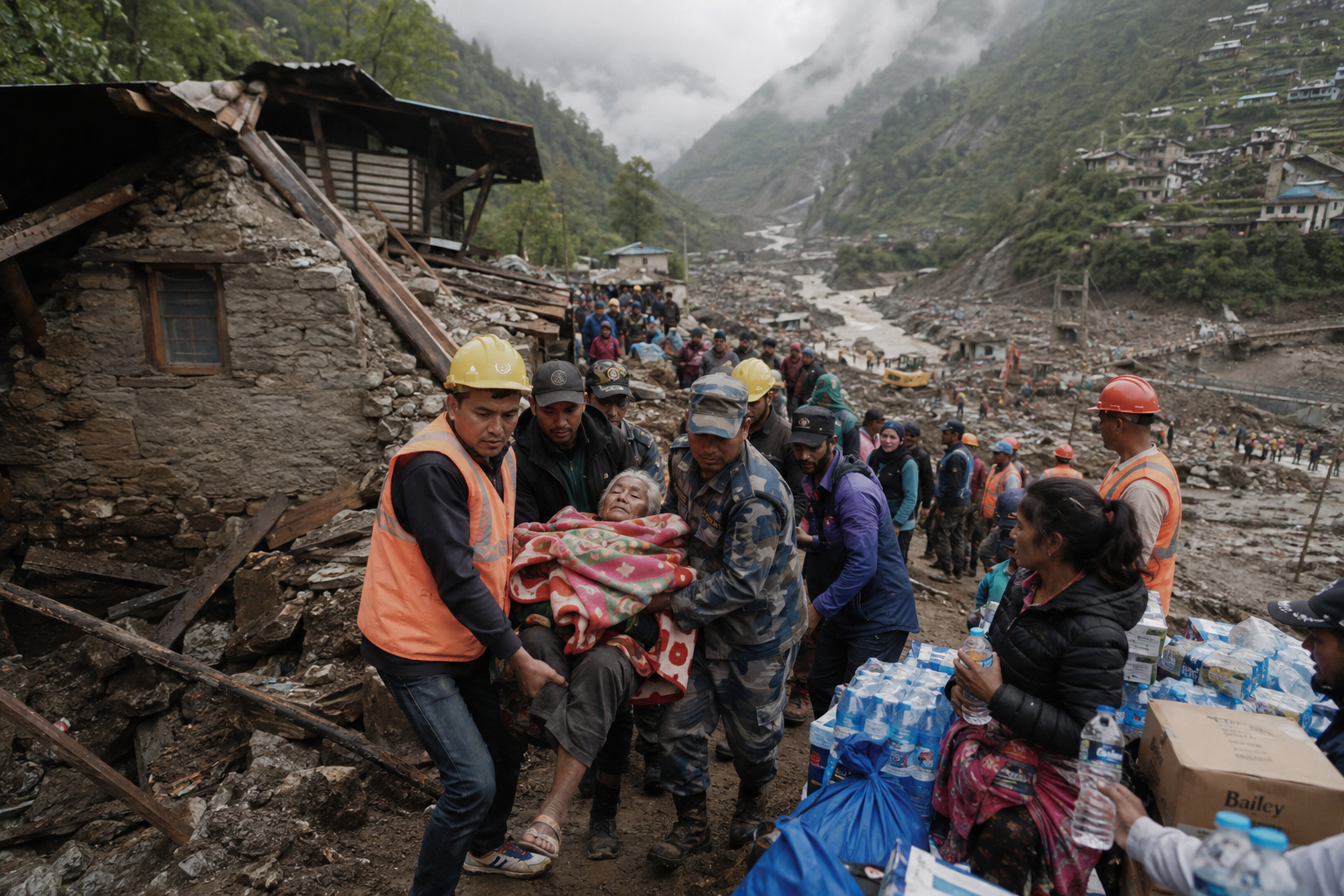
The article reports the rescue of Chandika Shrestha, a 64-year-old woman who was found alive after a devastating flow of ice, rock and mud struck a Himalayan valley in Nepal. More than 10 days after the disaster, rescuers were still searching damaged and partially buried homes and continued to discover survivors. Shrestha was located on the fourth floor of her house in Nepal’s Nuwakot district, despite the building being partly buried by the debris. Members of Nepal’s Armed Police Force found her on 5 September, according to Reuters. Following her rescue, she was airlifted to a hospital in Kathmandu for medical treatment. The report highlights both the destructive scale of the disaster and the continuing emergency response in the affected region. Shrestha’s survival and recovery after being trapped in a mud-buried home provide a hopeful element amid the wider devastation. The article is presented as a short news video report, with the rescue moment serving as its central focus. It provides limited information about the original event, including the precise cause of the ice, rock and mud flow, the number of people affected, or Shrestha’s medical condition after reaching the hospital. Its primary emphasis is on the ongoing rescue operation and the remarkable discovery of a survivor more than a week after the disaster.
Entities: Chandika Shrestha, Nepal, Nuwakot district, Kathmandu, Nepal’s Armed Police Force • Tone: urgent • Sentiment: positive • Intent: inform
06-09-2026
Two survivors were rescued in separate operations in Nepal, 10 days after devastating floods and mudslides killed at least 1,300 people and left more than 5,000 missing. A man was pulled alive from a 738-foot tunnel at the Trishuli 3A hydropower project by a joint team of Nepalese military personnel and South Korean disaster experts. He was evacuated by helicopter, taken to a hospital and reported to be in stable condition. His rescue brought the number of workers recovered alive from the hydropower project to three, after two Nepalese workers were rescued the previous day. The man told rescuers that he repeatedly shouted when he saw the lights of rescue crews but could not be heard. Separately, Nepalese army rescuers found a woman alive and covered in mud inside a house in the flood-hit town of Nuwakot. She was given water, wrapped in a blanket and airlifted to Kathmandu. Rescue efforts are now focused on 12 hydropower projects across Nepal, where approximately 900 workers are missing and about 500 are believed to be trapped in tunnels. Teams from Nepal, India, China, South Korea and the United States are searching through debris, damaged structures and tunnels for survivors. Authorities believe the Aug. 26 floods were likely caused by a glacier collapse. The continuing rescue operations offer signs of hope, but the scale of the disaster remains severe, with thousands still unaccounted for and widespread damage across the country.
Entities: Nepal, Trishuli 3A hydropower project, Nuwakot, Nepal Army, Nepalese military • Tone: urgent • Sentiment: negative • Intent: inform
06-09-2026
Flash floods and mudslides that struck Nepal on August 26 have killed more than 1,300 people and left tens of thousands isolated from roads, bridges, medical care and other infrastructure. A glacial collapse sent ice and boulders downriver across Nepal and Tibet, reportedly leaving more than 5,300 people missing. Entire villages and towns were inundated by mud, while some buildings lost walls several storeys above ground level. Families have been separated by destroyed bridges and, in some cases, cannot determine whether relatives survived.
As official rescue efforts continue, Nepali entrepreneurs, philanthropists and aid workers are organizing volunteer missions to reach remote communities. They are trekking through thick mud, using helicopters and crossing rivers by zipline to deliver blankets, clothing, food, medicine, tents and sanitary products. The Nepal Army has installed ziplines to move supplies, injured people and residents across swollen rivers, while police are using drones to search for survivors. Two people were also rescued from a tunnel near the Trishuli Hydropower project.
Shree Lamichhane, a Nepali-US businessman with businesses in Dubai, returned to flood-hit areas including Trishuli Bazaar, Devighat and Nuwakot district soon after the disaster. He traveled with friends from Nepal, Belgium, India and the United States, distributing supplies to people sheltering in schools. He said many survivors had lost their homes, vehicles and businesses and would have to begin again from nothing. He plans to continue taking aid to communities that have received little assistance.
Rajani Thapa, a Kathmandu-based aid worker and vice president of Junior Chamber International, is also helping teams reach locations without road access. She described severe shortages of food and drinking water, widespread injuries and the need for long-term shelter and support. The article emphasizes both the immediate humanitarian emergency and the prolonged recovery Nepal will face as families search for missing relatives and survivors rebuild their lives.
Entities: Shree Lamichhane, Rajani Thapa, Nepal, Tibet, Nuwakot district • Tone: emotional • Sentiment: negative • Intent: inform