05-11-2026
The live-update article reports on reactions to the 2026 U.S. midterm elections and the ongoing U.S.-Iran war. Iran’s chief negotiator, Mohammad Bagher Ghalibaf, said the election results showed Americans rejected the war and warned of a “Nightmare” if President Donald Trump ignored voters’ message. Trump acknowledged the conflict may have contributed to Republican losses, partly by raising gasoline prices, but said he did not regret the military campaign and would make the same decision again, arguing Iran must not obtain a nuclear weapon.
Democratic leaders said the war should end and indicated that the party’s incoming congressional majority could use war powers resolutions and control of government funding to pressure the administration. Senator Chuck Schumer criticized the lack of a clear rationale for the conflict, while Representative Jason Crow said Congress should continue voting on war powers and be prepared to use appropriations. Crow also called for Defense Secretary Pete Hegseth to leave office.
Iranian security official Mohsen Rezaei portrayed the election outcome as a political defeat for Trump and said Americans were bearing the cost of the war. The article notes that Vice President JD Vance had reportedly contacted Rezaei about ceasefire conditions and negotiations, though the effect of the election on talks remained uncertain.
Other updates describe continuing regional and economic consequences. Iran’s Revolutionary Guard said four oil tankers caught fire after striking mines in the Strait of Hormuz, despite signs of a diplomatic push. The U.S. announced sanctions against two Indian nationals and companies it accused of helping Iran’s oil-tanker shadow fleet evade restrictions through false flags and fake certifications. Separately, the International Committee of the Red Cross delivered medical supplies to Taiz, Yemen, for the first time in weeks amid intensified fighting between Houthi forces and the Saudi-backed Yemeni army.
Entities: Donald Trump, Mohammad Bagher Ghalibaf, Jason Crow, Chuck Schumer, Mohsen Rezaei • Tone: analytical • Sentiment: neutral • Intent: inform
05-11-2026
Brookings Institution senior fellow Robert Kagan warned that Russia and China could act more aggressively over the next two years if they believe President Donald Trump is politically weakened or nearing the end of his time in office. His comments follow Democrats winning control of both chambers of Congress. Speaking to CNBC, Kagan argued that the war with Iran has exposed limits in U.S. military capacity, including depleted stocks of missile-defense interceptors and missiles that could be important in an Asian conflict. Congressional Budget Office reports have estimated that as much as two-thirds of U.S. missile-defense interceptors were used in the conflict since June 2025, particularly in defending Israel from Iranian attacks, potentially leaving inventories constrained for years.
Kagan also said that sending three U.S. aircraft carriers to the Middle East reduces the naval forces available in Asia. He believes China may see an opportunity to adopt a more assertive regional posture, especially if it concludes that Trump is chiefly interested in economic agreements rather than confronting Beijing. The article notes that Trump approved an $11 billion arms package for Taiwan in December but later held back a second package worth about $14 billion, describing it as a bargaining chip in talks with China. China claims Taiwan, while U.S. law requires Washington to provide the island with means to defend itself, despite the absence of a mutual-defense treaty. Former CIA Director William Burns said Xi Jinping had directed China’s military to be ready to invade Taiwan by 2027, while clarifying that this did not mean Xi had decided to invade.
The warning comes amid discussions of a possible Trump–Xi–Putin summit at the APEC Leaders’ meeting in Shenzhen. China confirmed it was communicating with relevant parties about a meeting, but no agenda had been announced. Putin had reportedly proposed a trilateral meeting in October to discuss ending the war in Ukraine, without Ukrainian President Volodymyr Zelenskyy. Kagan cautioned that Russia and China may see the next two years as a moment to act if they perceive a U.S. political transition, though he qualified the prospect of a return to normality.
Entities: Robert Kagan, Brookings Institution, Donald Trump, Xi Jinping, Vladimir Putin • Tone: analytical • Sentiment: negative • Intent: analyze
05-11-2026
Canada’s government is presenting a budget intended to make the country less dependent on the United States by diversifying trade and changing its growth model. Prime Minister Mark Carney says relations with the US have been permanently altered and that a return to the pre-tariff relationship is unlikely. Finance Minister Francois-Philippe Champagne says the plan will encourage domestic commerce and make Canada more resilient and independent.
The budget is expected to fund major projects that Carney considers important to economic sovereignty, including energy-production infrastructure and critical-mineral mining. It will also offer support to workers affected by US tariffs in industries such as autos and steel. The opposition is expected to criticize deficit spending, although the projected shortfall is anticipated to be below the C$78.3 billion forecast in Carney’s 2025 budget.
The outlook for US trade policy is uncertain. After Republicans suffered a major midterm defeat, Democrats are set to control both chambers of Congress in 2027. Democratic Congressman Jamie Raskin said his party would seek to end tariffs and repair relations with Canada. However, Canada’s minister responsible for US trade, Dominic LeBlanc, emphasized that tariff negotiations must take place with President Donald Trump’s White House, not Congress. Although Trump and Carney have recently expressed optimism about a trade deal, similar expectations preceded talks that collapsed in August.
The budget’s implementation and its economic effects will depend partly on how tariffs affect employment. The Bank of Canada recently raised interest rates for the first time in three years to address inflation linked to rising energy prices during the Iran war. Canadian budget bills are confidence votes; Carney’s government needed opposition support in 2025, but the Liberals have since won a parliamentary majority.
Entities: Mark Carney, Donald Trump, Francois-Philippe Champagne, Dominic LeBlanc, Jamie Raskin • Tone: analytical • Sentiment: neutral • Intent: inform
05-11-2026
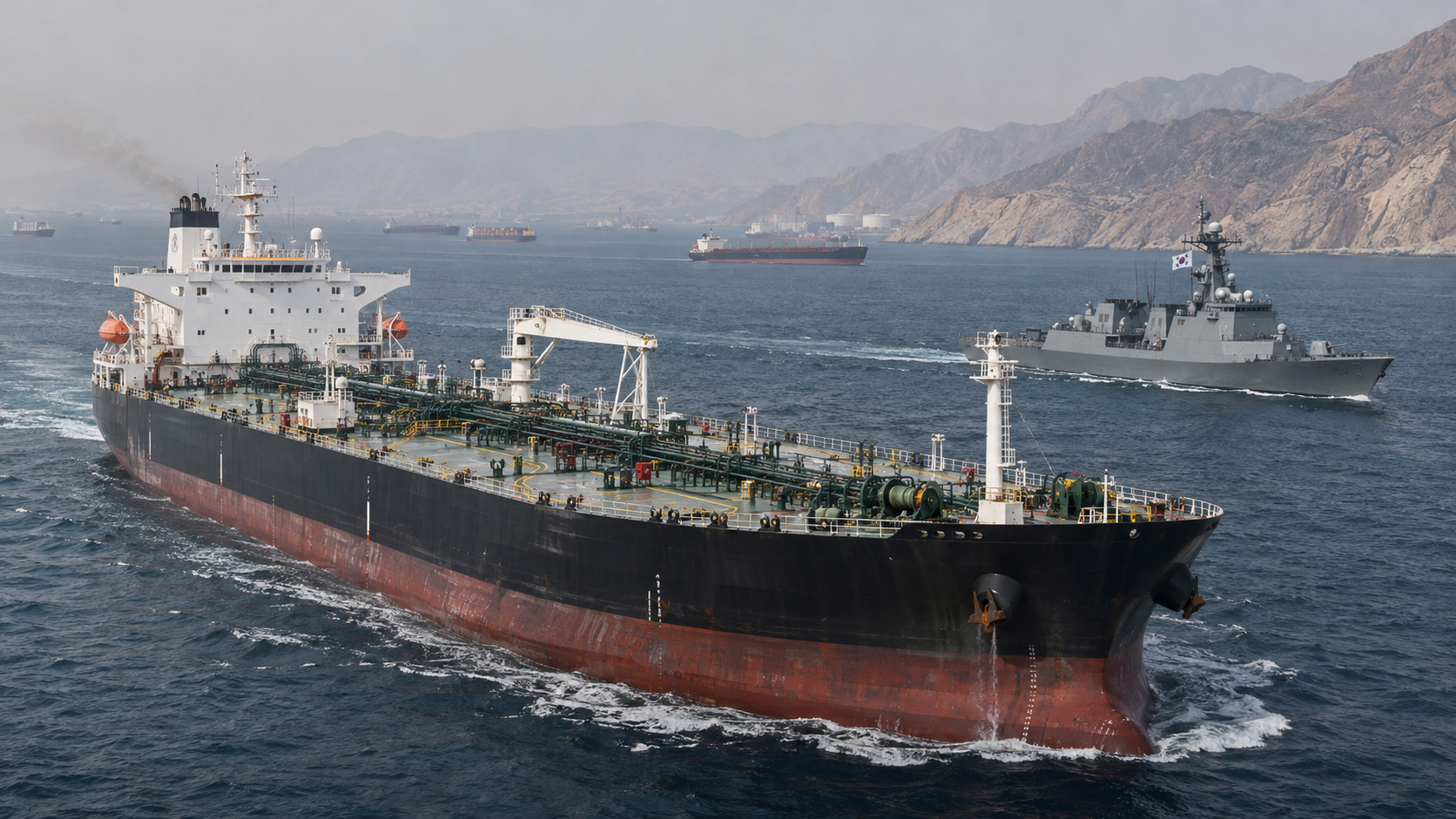
South Korea plans to expand the operating area of its Cheonghae anti-piracy unit toward the Strait of Hormuz, following pressure from US President Donald Trump for Seoul to support the US war in Iran. The government intends to ask parliament to approve operations near Duqm, Oman, about 650km from the strait. The proposal also requires approval from President Lee Jae Myung and the cabinet, and would extend the unit’s Middle East deployment, currently due to expire at the end of 2026.
South Korean officials stress that the expansion is intended to protect citizens and economic interests, not to support combat operations. The unit would act independently of allied forces, patrol only open waters south of Oman, and refrain from targeting or monitoring Iranian territory, territorial waters, or the interior of the strait. Seoul has previously said it would not deploy military assets in a way that could pull the country into conflict, while considering a greater role in protecting maritime navigation.
The planned expansion comes amid dangerous incidents in the strait. Iran’s Revolutionary Guard reported that two oil tankers and a tugboat caught fire in separate incidents after attempting to use unauthorized routes. One tanker reportedly struck a mine; a second supertanker caught fire, as did a tugboat that came to assist it.
Based in the Gulf of Aden since 2009, the Cheonghae unit currently includes a destroyer, helicopter, up to three rigid-hull inflatable boats, and about 300 personnel. Reports say South Korea may also send a P-8A maritime patrol aircraft and add 75 personnel. The move has broader economic significance: South Korea relies heavily on imported oil and obtained 70% of its supplies from the Middle East in 2025, most of it shipped through the Strait of Hormuz. Trump has criticized Seoul’s support for the Iran war and previously reduced major joint military drills, unsettling the US ally.
Entities: South Korea, Cheonghae unit, Strait of Hormuz, Donald Trump, Lee Jae Myung • Tone: analytical • Sentiment: neutral • Intent: inform
05-11-2026
The National’s “Trending Middle East” podcast roundup for November 5, 2026, covers several developments affecting the region and its international relationships. In the United States, Vice President JD Vance attributes the Republican Party’s heavy defeat in the midterm elections to the war against Iran, repeating an explanation previously offered by President Donald Trump. The roundup also reports that Syria and Saudi Arabia have signed a defence agreement. The agreement was concluded during Syrian President Ahmad Al Shara’s meeting with Saudi Crown Prince Mohammed bin Salman in Riyadh; it was Al Shara’s second visit to the Saudi capital in a month.
The segment turns to the effects of disruption in the Strait of Hormuz on energy supply. India has diversified its oil-import sources to around 43 countries, with the UAE becoming a major supplier. In aviation, British Airways has resumed its flights between Heathrow and Dubai after an eight-month suspension attributed to the Iran war. The airline’s services to Abu Dhabi, however, are expected to remain suspended until at least late 2027. The roundup also notes that a minor earthquake measuring 2.3 in magnitude was recorded off the coast of Fujairah on Wednesday evening.
The article presents these items as a concise morning briefing rather than an extended analysis. It identifies the podcast as AI-assisted, while stating that it draws on original reporting published by The National and is curated and edited by human staff.
Entities: JD Vance, Donald Trump, Ahmad Al Shara, Mohammed bin Salman, The National • Tone: neutral • Sentiment: neutral • Intent: inform
05-11-2026
Oil prices fell sharply below $100 a barrel as markets reacted to the Republican Party’s losses in the US midterm elections and the possibility that the United States could seek an end to its war with Iran. Brent crude traded at $94.12 and WTI at $87.51 on Thursday. The declines followed an even steeper sell-off on Wednesday, when Brent fell 8.7% to $94.62 and WTI dropped 8.3% to $88.12, their lowest closing prices since August 31.
The election results, with Democrats taking control of both the House and Senate, could constrain President Donald Trump’s ability to pursue further military action. Sources close to Gulf government circles told Reuters that his weakened political position may increase the incentive to negotiate, though analysts cautioned that a deal perceived as a clear Iranian victory could prompt further recklessness rather than restraint. Trump said the US had no immediate plans to strike Iran and later acknowledged that the war contributed to his party’s electoral defeat. Vice President JD Vance also criticized the decision to enter the conflict. Iran’s Supreme Leader Ayatollah Mojtaba Khamenei said US hostility would persist regardless of which party controlled Washington.
Regional tensions remain: Yemen’s Houthis claimed to have targeted Riyadh’s King Khalid International Airport, and Qatar has increased mediation efforts, although an immediate agreement appears uncertain. Energy flows are also disrupted, prompting the UAE to consider a third oil pipeline to reduce reliance on the Strait of Hormuz. Separately, US crude inventories fell by 865,000 barrels to 409.8 million barrels, contrary to analysts’ expectations of an increase.
Entities: Brent crude, West Texas Intermediate (WTI), Donald Trump, JD Vance, Ayatollah Mojtaba Khamenei • Tone: analytical • Sentiment: negative • Intent: inform
05-11-2026
South Korea plans to expand the mission of its Cheonghae anti-piracy naval unit to waters near the Strait of Hormuz, deploying maritime and underwater capabilities to help protect commercial shipping and energy supplies. The Defence Ministry said the mission would include a destroyer, a P-8 maritime patrol aircraft, an explosive ordnance disposal team, unmanned surface and underwater vessels, and remotely operated vehicles. The move comes amid disruption to shipping caused by the US-Iran war, which began on February 28. The Strait of Hormuz is a major global energy chokepoint and normally carries about one-fifth of the world’s oil.
Seoul maintains that the deployment would not constitute military intervention in the war. A Defence Ministry official said the mission is intended to protect South Korean citizens and economic interests, would be limited to non-combat purposes, and would operate independently of allied forces. Operations would be confined to open waters south of Oman. The patrol aircraft would not target or monitor Iranian territory, Iranian territorial waters, or the interior of the Strait of Hormuz.
The Cheonghae unit currently operates in the Gulf of Aden off Somalia, and its mandate is authorised only through the end of the year. Extending that authorisation would require approval from South Korea’s parliament, according to Yonhap News Agency. President Lee Jae Myung reiterated in September that South Korea would maintain its policy of non-involvement and non-intervention in the war. Tehran has warned Seoul against a deployment after South Korea said it was considering contributing to the waterway’s security.
Entities: South Korea, Seoul, Strait of Hormuz, US-Iran war, Cheonghae anti-piracy naval unit • Tone: neutral • Sentiment: neutral • Intent: inform