02-09-2026
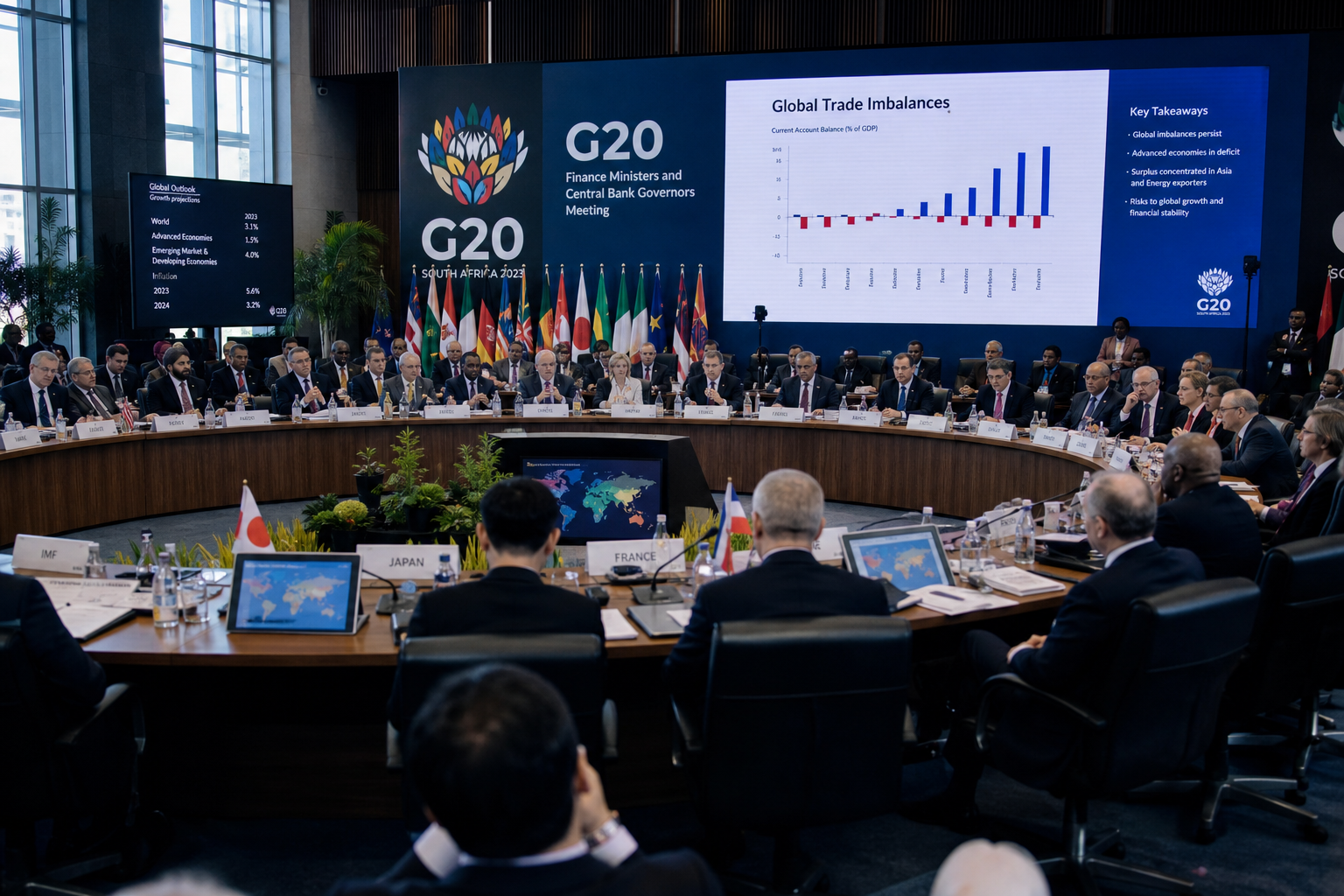
Treasury Secretary Scott Bessent said China was the only G20 member to dissent from a joint statement criticizing non-market economies for generating persistent trade imbalances through large volumes of inexpensive exports. The statement, issued after finance ministers and central bankers met in Asheville, North Carolina, said countries should eliminate non-market policies that worsen imbalances, particularly policies that suppress domestic consumption and encourage excessive reliance on exports. It also called on countries with persistent external surpluses to address those distortions.
Bessent identified China as the country with the world’s largest and “unsustainable” current-account surplus. He said the other 19 G20 members could take action in the coming days, weeks or months to address what he described as an unsustainable global economic equilibrium. The Treasury Department’s statement included a footnote documenting China’s objections. Beijing also opposed language concerning shipping disruptions in the Strait of Hormuz, which Iran has effectively blocked amid its war with the United States, as well as paragraphs supporting International Monetary Fund monitoring of global imbalances and identifying countries whose external debt is significantly owed to G20 members.
The disagreement comes as the Trump administration pressures Iran economically through secondary sanctions under “Operation Economic Outcast.” The policy has raised questions about whether Washington could target China, Iran’s largest trading partner and oil buyer. Bessent said the United States and China share important positions on Iran, including opposition to an Iranian nuclear weapon and support for free maritime trade in the Strait of Hormuz. He also noted that China obtains half of its energy from the Gulf and argued that Beijing should help find a solution. The dispute occurs ahead of long-term U.S.-China trade talks and Chinese President Xi Jinping’s planned visit to the United States in late September.
Entities: China, Scott Bessent, Group of 20 (G20), U.S. Treasury Department, Asheville, North Carolina • Tone: analytical • Sentiment: negative • Intent: inform
02-09-2026
G20 finance leaders concluded two days of meetings in Asheville, North Carolina, with broad support for a final statement despite disagreements over Russia’s participation and China’s objections to parts of the text. US Treasury Secretary Scott Bessent said the attendance of Russian Finance Minister Anton Siluanov had not disrupted discussions and argued that engagement remained important because Siluanov was not under sanctions. European officials, however, criticized Russia’s inclusion while Moscow continues its war in Ukraine. Siluanov was excluded from the G20’s traditional group photograph, and EU officials said they had received little warning that he would attend. EU economy chief Valdis Dombrovskis said it was inappropriate to normalize Russia’s presence while it is conducting an aggressive war and killing civilians. The dispute occurred as Germany accused Russia of an attempted hybrid attack involving a drone at a strategic airport. The statement also addressed the war involving Iran and Israel, calling for free and predictable navigation through the Strait of Hormuz, although China opposed that section. Washington sought support for sanctions on Iran and for reducing global trade imbalances. China also objected to language warning that excessive and persistent economic imbalances could cause distortions, a reference to criticism of its industrial overcapacity and export competition. The meeting included discussions of continued support for Ukraine, including separate talks among G7 finance ministers. German Finance Minister Lars Klingbeil condemned intensified Russian attacks on Kyiv’s civilian population and said European ministers had clearly stated their position. The Asheville meeting will help prepare for a G20 leaders’ summit that President Donald Trump is scheduled to host in Miami in December.
Entities: G20, Scott Bessent, Anton Siluanov, Donald Trump, Valdis Dombrovskis • Tone: analytical • Sentiment: negative • Intent: inform
02-09-2026
US Treasury Secretary Scott Bessent said China prevented the Group of 20 from issuing a joint communique after finance ministers and central bank governors met in Asheville, North Carolina. The dispute centered on China’s large current-account and trade surplus, which Bessent described as “unsustainable” and damaging to global, regional and domestic markets. Instead of a consensus communique, the United States released a statement in the chair’s voice, saying that countries with persistent external surpluses should reduce policies that suppress domestic consumption and encourage excessive reliance on exports. Bessent said 19 G-20 members supported the statement, while China objected to sections concerning the Strait of Hormuz, a proposed task force on trade imbalances, International Monetary Fund monitoring powers and debt restructuring.
The article reports that China recorded a US$1.2 trillion trade surplus in 2025, while the United States ran an approximately US$200 billion trade deficit with China. Bessent made the issue a central priority during the summit. He also said he had limited discussions with Chinese officials about artificial intelligence because Vice-Premier He Lifeng was absent. Bessent expects AI investment to increase productivity and lower inflation, with benefits potentially becoming visible within six months. He said AI-related capital spending could become “extremely disinflationary.”
The article also covers US efforts to increase economic pressure on Iran. Bessent said he discussed possible sanctions and other measures with US allies, Russia and China, noting that China buys about 90 per cent of Iran’s oil. He said Washington and Beijing agree that the Strait of Hormuz should remain open. His comments came after the United States and Iran exchanged strikes on August 31 and September 1. Bessent warned that Iran could respond with further military action but suggested that Tehran might still be prepared to negotiate.
Entities: Scott Bessent, Donald Trump, Xi Jinping, He Lifeng, Group of 20 (G-20) • Tone: analytical • Sentiment: negative • Intent: inform