01-11-2026
Israel’s October 27, 2026 legislative election left the country without a clear governing majority. Prime Minister Benjamin Netanyahu’s coalition won 53 seats, while the Jewish parties opposing him secured 48 and Arab-led parties won 19. None of the blocs reaches the 61 seats required for a majority in the 120-member Knesset, making negotiations among parties necessary and raising the possibility of another election.
The next steps are governed by a timetable: results must be certified and delivered to President Isaac Herzog by November 4, the new Knesset is due to convene on November 10, and Herzog must select a candidate to attempt to form a government by November 11. The candidate has 28 days, with a possible 14-day extension. Netanyahu and former military chief Gadi Eisenkot are considered the likeliest first choices; Eisenkot may have an advantage if Arab-led parties endorse him. Herzog has urged politicians to find creative solutions, including a possible unity government between rivals.
Whether opposition parties will cooperate with Arab-led parties remains uncertain. Some opposition leaders have rejected such a partnership, while Ra’am leader Mansour Abbas and Joint List representative Yousef Jabareen have expressed openness to cooperation aimed at replacing Netanyahu’s government. Arab-led parties might also support a government from outside a formal coalition. Activist Raluca Ganea describes Jewish-Arab partnership as essential for Israeli democracy.
If the first nominee fails, Herzog can appoint another Knesset member, and lawmakers may then propose a third candidate under the process described in the article. Other possibilities include a minority government reliant on outside support or a power-sharing arrangement with alternating prime ministers. If all efforts fail, the Knesset would be dissolved and elections held within 90 days. Netanyahu remains caretaker prime minister until a new government is formed, potentially staying in office for months even if he is excluded from the eventual coalition.
Entities: Benjamin Netanyahu, Isaac Herzog, Gadi Eisenkot, Ehud Barak, Mansour Abbas • Tone: analytical • Sentiment: neutral • Intent: inform
01-11-2026
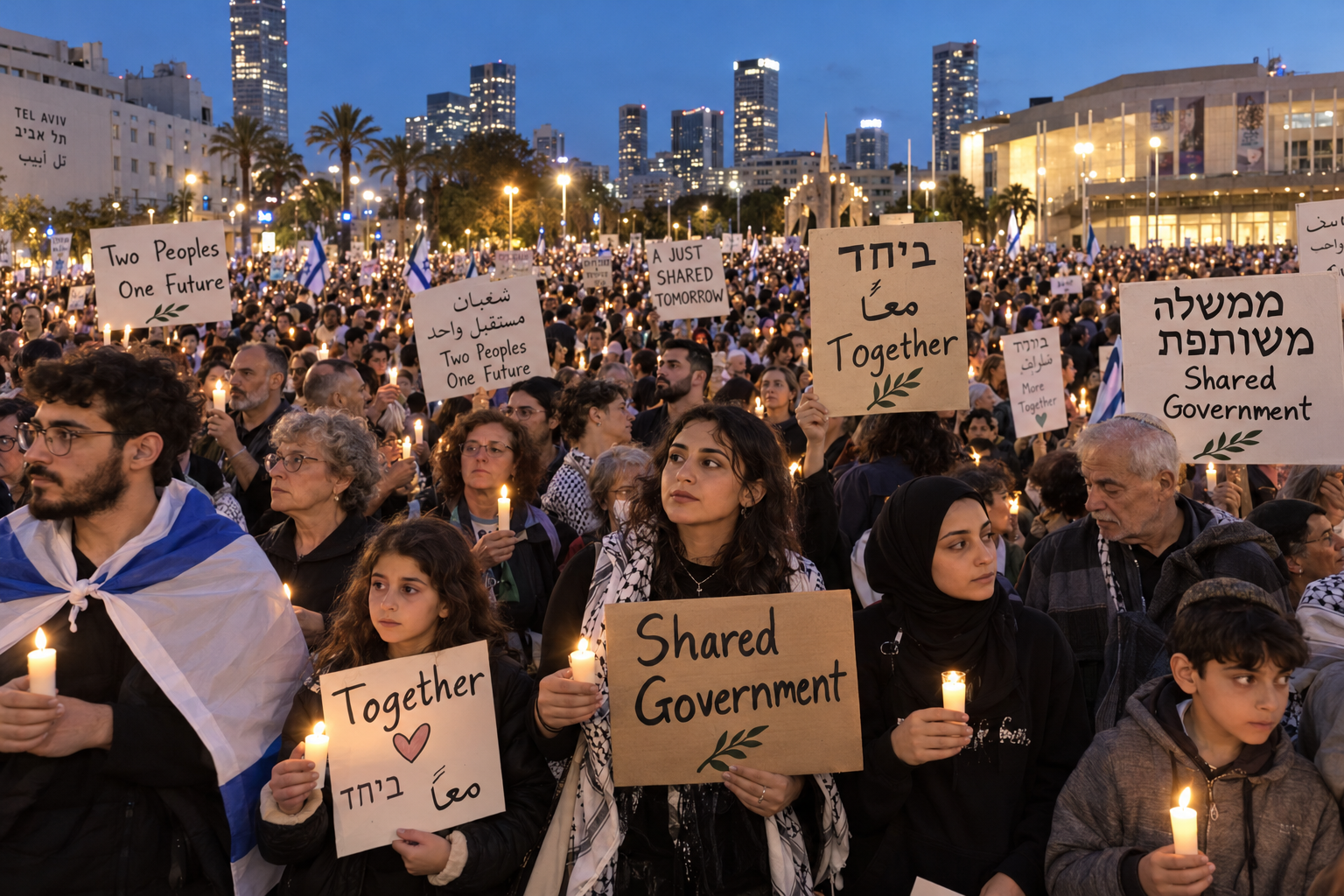
Thousands of people gathered at Tel Aviv’s Habima Square on October 31 to urge Israel’s opposition parties to form a coalition with Arab parties and remove Prime Minister Benjamin Netanyahu. Protesters described the election as a potential “last chance for real change” and called on opposition leaders to respond to voters’ wishes. The rally followed Tuesday’s general election, which left neither major bloc with enough seats to govern independently.
Opposition leader Gadi Eisenkot has previously ruled out a coalition with Arab parties. However, his bloc won 48 seats in the 120-seat parliament, compared with 53 for Netanyahu’s bloc, while Israel’s three Arab-led parties won 19. A partnership between Eisenkot and those parties could produce a 67-seat majority. Nearly 840,000 people voted for Ra’am and the Joint List, a 64 percent increase from the 2022 election, according to the Central Election Committee.
The possibility of a Jewish-Arab coalition remains politically divisive. Netanyahu supporters attended the demonstration to oppose such an arrangement, with some calling Arab parties “so-called terrorists.” Netanyahu has also accused Palestinian-Israeli parties of “stealing” the election and accepting funding from Qatar; Qatar rejected the allegations as a disinformation campaign.
Al Jazeera correspondent Nour Odeh said right-wing circles had likened the high turnout among Palestinian Israelis to “electoral terrorism,” invoking the Hamas-led October 7 attack on southern Israel. Odeh said Palestinian-Israeli voters and their voices were under attack because their electoral strength could determine whether Eisenkot forms a government. The article presents the election deadlock, the increased Arab-party vote and the public dispute over a possible coalition as central factors in Israel’s government-formation debate.
Entities: Benjamin Netanyahu, Gadi Eisenkot, Nour Odeh, Tel Aviv, Ramallah • Tone: analytical • Sentiment: neutral • Intent: inform
01-11-2026
The Arab Joint List says it is willing to support an opposition-led government aimed at replacing Benjamin Netanyahu’s outgoing coalition, but it will not join the cabinet. Senior leader Ahmad Tibi urged opposition leader Gadi Eisenkot to consider the precedent of Yitzhak Rabin, who relied on Arab lawmakers’ support in parliament. Tibi argued that Arab parties are necessary for political change and said the Joint List seeks no ministerial posts.
The election left Netanyahu’s bloc with 53 seats and the opposition with 67 in the 120-seat Knesset. The opposition total includes 48 seats held by Zionist parties and 19 held by Arab factions: 11 for the Joint List and eight for Ra’am. Several Jewish-led opposition parties, however, have ruled out a coalition with Arab parties, making it harder to form a government. Joint List chairman Yousef Jabareen said informal contacts had begun with several opposition figures, but formal negotiations had not started.
The Joint List’s conditions for support include progress toward a Palestinian state, a funded plan to address violent crime in Arab municipalities, and an end to home demolitions. These demands could conflict with opposition parties’ stated opposition to Palestinian statehood. The party also rejected allegations of secret Qatari funding to boost Arab voter turnout. Israel’s Shin Bet has opened a limited investigation into suspected foreign interference, but the claims remain unsubstantiated and authorities say the inquiry will not affect the election results.
Jabareen declined to call Hamas a terrorist organisation, despite Eisenkot identifying that declaration as a requirement for potential coalition partners. He said the Joint List had condemned the October 7, 2023, Hamas-led massacre. President Isaac Herzog urged leaders to accept the results and avoid another election. He is due to receive the certified results on November 4 and then consult party representatives; the new Knesset is scheduled to convene on November 10. Eisenkot says he hopes to form a “Zionist and statesmanlike government,” but the refusal of some Zionist parties to partner with Arab factions remains a major obstacle.
Entities: Ahmad Tibi, Yousef Jabareen, Gadi Eisenkot, Benjamin Netanyahu, Isaac Herzog • Tone: analytical • Sentiment: neutral • Intent: inform