23-09-2026
The liveblog reports diplomatic, political and humanitarian developments related to the US-Israel war on Iran and the wider conflict involving Palestinians. US President Donald Trump said American officials had a “very good” meeting with an Iranian delegation on the sidelines of the UN General Assembly. Earlier, he told the assembly Iran must choose between a deal and further military action, while predicting that an agreement could come after the US midterm elections. US Special Envoy Steve Witkoff also described lengthy talks with the Iranian delegation. Iran said it had conveyed conditions for ending the war on all fronts through Qatari mediation.
French President Emmanuel Macron said France was ready to become more engaged to help ensure transit through the Strait of Hormuz, a vital route amid an escalating energy crisis. He criticized the US decision to start the war and argued that regime change through bombing is not feasible. Oil prices edged lower, with Brent crude reported at $99.18 a barrel.
The liveblog also covered international support for a two-state solution. Canadian Prime Minister Mark Carney announced 100 million Canadian dollars in assistance for Palestinians, mostly for humanitarian aid, with some funding for peace and security initiatives, including training Palestinian police. The UK, France, Canada and Saudi Arabia were among those engaging at the UN on conditions for lasting peace. Angola’s president condemned violence, displacement and settlement expansion affecting Palestinians.
On the ground in the occupied West Bank, Israeli forces raided villages near Jerusalem and Ramallah and made arrests, while settlers reportedly vandalized property and burned a vehicle. The roundup also included criticism of Israeli Prime Minister Benjamin Netanyahu by US Senator Chris Van Hollen, who cited an arrest warrant related to alleged crimes in Gaza, and Senator Bernie Sanders’s condemnation of Trump’s threat to “annihilate” Iran. Sanders called the conflict illegal and unconstitutional and urged Congress to act to end it.
Entities: Donald Trump, Emmanuel Macron, Chris Van Hollen, Bernie Sanders, Mark Carney • Tone: analytical • Sentiment: neutral • Intent: inform
23-09-2026
The Al Jazeera report covers the opening day of the 81st United Nations General Assembly, held on September 22, 2026. It describes a sharp contrast between public rhetoric and diplomatic contact: US President Donald Trump threatened to “annihilate” Iran, yet US and Iranian officials met for three hours on the sidelines of the assembly. The meeting took place despite the threat, making the continued engagement the central development highlighted in the report.
Al Jazeera identifies James Bays, its Diplomatic Editor, as the reporter. The supplied article text does not provide details about who attended the meeting, what was discussed, whether the talks produced any agreement, or how either government characterized them. It also does not elaborate on the context or consequences of Trump’s threat. Accordingly, the report’s main point is limited but notable: a severe public warning against Iran coincided with a lengthy meeting between officials from the two countries during the UN gathering. The article frames this as a day-one diplomatic development rather than explaining the negotiations or assessing their prospects. Its headline emphasizes the apparent tension between Trump’s threat and the decision by US and Iranian representatives to hold talks.
Entities: Donald Trump, James Bays, United States, Iran, United Nations General Assembly • Tone: neutral • Sentiment: neutral • Intent: inform
23-09-2026
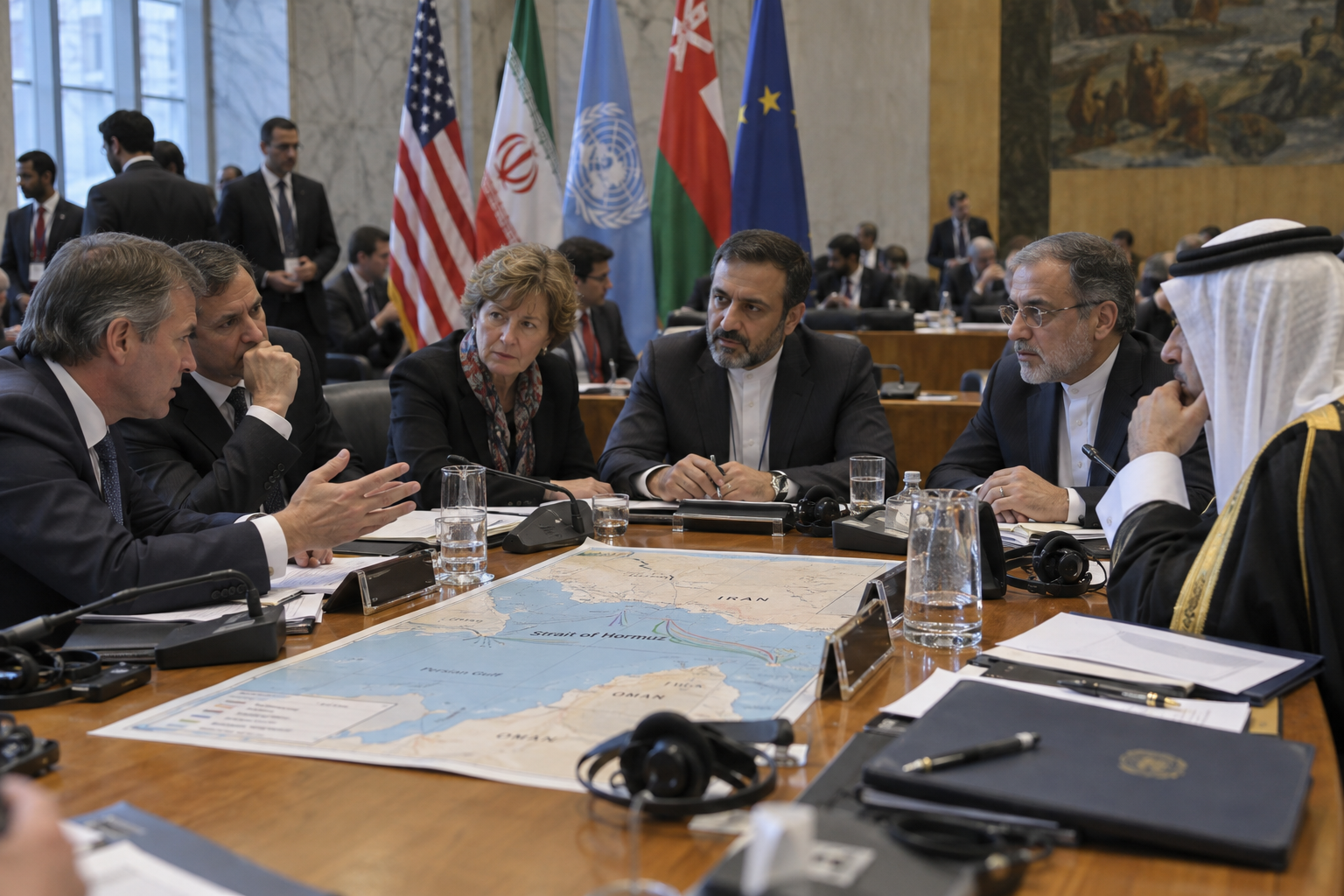
The United States and Iran held hours of indirect talks on the sidelines of the United Nations General Assembly in New York, with mediators relaying messages between the delegations. Accounts differed over whether the sides met directly. US envoy Steve Witkoff described discussions conducted through mediators, while President Donald Trump said Witkoff and Jared Kushner had met Iranian officials for three hours. The White House later clarified that Trump was not present. Iranian state media confirmed a meeting between Foreign Minister Abbas Araghchi and Witkoff, reportedly requested by Washington and focused particularly on reopening the Strait of Hormuz.
Iran’s stated conditions include lifting the US naval blockade, releasing frozen Iranian assets and ending the war on fronts Tehran associates with the “resistance.” An Iranian official said the delegation had authority to negotiate and that Iran had sent a proposal through mediators on September 16. The official said Hormuz could reopen within seven days if the United States reduced military pressure and lifted its blockade of Iranian ports. An Iranian security source suggested further engagement was possible if Washington met Iran’s conditions and commitments.
The talks are part of a wider regional diplomatic push. Qatar said it was working with Pakistan to ease tensions, protect navigation and promote stability; Qatar’s prime minister also met Araghchi. Oman has pursued maritime discussions with Tehran, while Trump met officials from Gulf states, Türkiye, Jordan, Syria and Iraq. A proposed regional security framework involving Iran and Gulf countries was reportedly under consideration.
The diplomatic contacts followed Trump’s UN address, in which he presented a choice between an agreement and military escalation, including a threat to “annihilate” Iran. Iranian military bodies denounced the threats and warned of a forceful response to further attacks. Although US officials have previously described progress toward an agreement, major differences remain, particularly over the blockade and Hormuz. Mediators said their work would continue.
Entities: Donald Trump, Steve Witkoff, Jared Kushner, Abbas Araghchi, United States • Tone: analytical • Sentiment: neutral • Intent: inform
23-09-2026
At the United Nations General Assembly in New York, President Donald Trump said he faced a “big decision” over whether to resume strikes on Iran or pursue a peace deal. He warned that he could “annihilate” the Islamic Republic if the conflict remained unresolved, while arguing that US and Israeli military action had stopped Tehran from obtaining a nuclear weapon. The war, launched in February, has driven up global oil prices and contributed to falling approval ratings for Trump. He predicted a deal might follow November’s US midterm elections.
Despite the threatening rhetoric, US and Iranian representatives held discussions on the sidelines of the assembly. Trump described a three-hour meeting as “very productive.” Iran confirmed that Foreign Minister Abbas Araghchi met US envoy Steve Witkoff, with Qatar mediating. Tehran’s conditions reportedly included an end to the war on all fronts and to US “acts of aggression.” Witkoff said the sides had completed a round of discussions and that mediators would continue their work.
Trump also said he expected to bring Russia’s war in Ukraine to an end, although fighting and strikes continued. Secretary of State Marco Rubio was scheduled to meet Russian Foreign Minister Sergei Lavrov. On artificial intelligence, Trump dismissed concerns he said could undermine US competition with China and proposed calling the technology “super intelligence.” He also signed an agreement with Denmark and Greenland that reaffirms Greenland’s sovereignty while granting the US broad access and strengthening its military presence there.
The speech contrasted with UN Secretary-General António Guterres’s warning about deepening global divisions and the need for international interdependence. Trump criticised the UN and other international institutions, rejected the idea of global government, stressed US sovereignty and military strength, and warned against threats in the Western Hemisphere. He also attacked Cuba’s government; the Cuban delegation appeared to leave the chamber during his remarks. Alongside the speech, Trump met a range of world leaders, including Ukrainian President Volodymyr Zelensky and leaders from the UK, South Korea and Gulf states.
Entities: Donald Trump, António Guterres, Abbas Araghchi, Steve Witkoff, Esmail Baghaei • Tone: analytical • Sentiment: neutral • Intent: inform
23-09-2026
President Donald Trump used a roughly 35-minute address to the United Nations General Assembly to defend his foreign policy record and portray his administration as willing to use American power where previous leaders had failed to resolve conflicts. On Iran, he justified starting the war as an effort to prevent Tehran from obtaining a nuclear weapon, described a choice between reaching a deal and destroying the Islamic Republic, and predicted an agreement after the U.S. midterm elections. He also said that his son-in-law Jared Kushner and envoy Steve Witkoff had held a productive meeting with Iranian representatives. Trump rejected concerns about depleted U.S. munitions, although the Pentagon inspector general had recently reported strategic inventory shortfalls linked to the war.
The president said he had delivered peace and confronted threats, while highlighting U.S. intervention in Venezuela and the acquisition of Venezuelan oil as demonstrations of American influence in the Western Hemisphere. He also promoted a new security agreement with Greenland and Denmark that would allow additional U.S. defense areas on the island. The article notes that Trump’s positions on Greenland, trade, defense spending and NATO involvement in the Iran war have caused friction with Canada and European countries.
Trump criticized warnings about artificial intelligence, proposed calling it “superintelligence” or “SI,” and said he would not limit the technology’s growth. The article also previews his meetings with foreign leaders, including the British and Japanese prime ministers, and his planned White House state visit with Chinese President Xi Jinping. U.S.-China relations remain strained by trade disputes and concerns about China’s ties to Iran and purchases of Russian oil. Finally, the article describes reduced press access to Trump’s U.N. meetings after major news organizations lost White House access and suspended presidential pool coverage; several outlets are suing, citing First Amendment concerns.
Entities: Donald Trump, United Nations General Assembly (UNGA), Iran war, Jared Kushner, Steve Witkoff • Tone: analytical • Sentiment: neutral • Intent: inform
23-09-2026
The live update reports on diplomacy and escalating tensions between the United States and Iran during the U.N. General Assembly. President Donald Trump said he faced a major choice between reaching a deal and inflicting catastrophic consequences on Iran, while also saying U.S. and Iranian officials had held talks and that he believed an agreement could be reached. U.S. envoy Steve Witkoff described the indirect discussions, conducted through mediators, as lengthy and said the round had concluded successfully, though neither side disclosed its substance. Jared Kushner also took part in the U.S. delegation. Iranian President Masoud Pezeshkian arrived in New York to address the U.N., saying he would defend Iran’s position and convey the country’s plight. The report notes that his visit is an unusual instance of a leader whose country is at war with the United States traveling to American soil for a U.N. gathering.
Other updates describe the effects and international dimensions of the conflict. Expanded U.S. sanctions were expected to disrupt Iranian airlines, with flights to Baghdad and Muscat reported canceled; Iran was exploring alternatives for some routes. At the U.N., EU foreign affairs chief Kaja Kallas discussed ending hostilities and restoring free navigation through the Strait of Hormuz and Bab el-Mandeb with Iranian Foreign Minister Abbas Araghchi. Their accounts diverged over responsibility for the diplomatic breakdown, while Kallas also raised human-rights concerns. Iran’s parliament security committee approved fines for ships crossing the Strait of Hormuz without authorization, despite calls for unrestricted passage. Trump also met Gulf-region leaders, including representatives of Jordan, Saudi Arabia, Qatar and Turkey, and said momentum for a deal existed. The article presents a mix of diplomatic contact, threats, sanctions, regional maritime disputes and uncertainty about whether negotiations will produce a settlement.
Entities: Donald Trump, Masoud Pezeshkian, Steve Witkoff, Jared Kushner, Kaja Kallas • Tone: urgent • Sentiment: negative • Intent: inform
23-09-2026
Oil prices fell on Wednesday as investors reacted to signs that U.S.-Iran talks could help ease supply disruptions and reduce the risk of a wider Middle East conflict. Brent crude futures for November delivery declined 1.15% to $98.11 a barrel, while U.S. West Texas Intermediate futures for November fell 1.75% to $88.94 per barrel.
The article links the price drop to President Donald Trump’s account of a roughly three-hour meeting between U.S. officials and Iran’s delegation, which he described as “very good.” The comments followed a more forceful statement in Trump’s address to the United Nations: he said he faced a “big decision” between reaching a deal with Tehran and “annihilate[ing]” the country. The contrast between the reported positive meeting and the threat underscores the uncertainty surrounding the negotiations.
Paolo Broccardo, chief executive officer of BankPro, said Pakistan’s mediation efforts with Tehran could lower the risk of broader escalation. He also suggested that oil prices were unlikely to surge in the immediate term. According to Broccardo, prices had fallen almost 12% over five consecutive sessions, retreating from above $100 a barrel—a level he characterized as an “intervention zone” where peace-building efforts by both sides had repeatedly intensified.
Overall, the article presents falling crude prices as a response to improved diplomatic prospects, while indicating that the market remains sensitive to the possibility of renewed conflict and disruption to oil supplies.
Entities: Donald Trump, Iran, United States, Tehran, Pakistan • Tone: analytical • Sentiment: neutral • Intent: inform
23-09-2026
The supplied page is a live-news article titled “Iran war latest: Iran confirms US contact through Qatar in New York,” updated September 23, 2026, at 4:31 a.m. The provided text does not include the article’s main reporting or details about the confirmed contact, such as who spoke, what was discussed, or what outcome followed. It therefore supports only a limited account of the story: Iran confirmed contact with the United States through Qatar in New York.
The page also displays a series of related headlines that indicate the broader regional context covered by the live coverage. These include Iran cancelling flights to Iraq and Oman amid US aviation sanctions; diplomats saying France is drafting a UN Security Council resolution concerning the Strait of Hormuz; a phone call between Vladimir Putin and Saudi Crown Prince Mohammed bin Salman about Gulf security; and Saudi Arabia restarting operations at the East-West Pipeline. Other displayed headlines refer to a complaint in France over an alleged Israeli war crime in Lebanon, Houthi activity and conflict involving Saudi Arabia, and comments from US President Donald Trump about the war’s possible duration.
Because the text supplied is largely page navigation, video links, sharing and printing controls, and subscription prompts, it does not provide enough information to assess the underlying events in depth or establish their causes and consequences. The summary is limited to the headline and related update titles that are actually present; it does not infer details beyond them.
Entities: Iran, United States, Qatar, New York, Iraq • Tone: neutral • Sentiment: neutral • Intent: inform
23-09-2026
A US State Department spokesman said President Donald Trump has the advantage in the conflict with Iran and is increasing pressure on Tehran, as the president announced that US and Iranian representatives had held discussions through mediators at the United Nations. Tommy Pigott cited the Treasury Department’s Economic Outcast campaign and US efforts to block Iranian oil shipments. Trump’s representatives, Jared Kushner and special envoy Steve Witkoff, were involved on the American side. Witkoff said the discussions had been completed and mediators would continue their work. The talks were unexpected because no negotiations had been publicly known since an interim agreement collapsed in July. Trump has threatened to “annihilate” Iran if it does not make a deal and has said the US will prevent Iran from obtaining a nuclear weapon, by diplomacy or otherwise.
The article also describes the military and economic stakes. US forces have reopened the Strait of Hormuz to an estimated 60 to 70 per cent of its pre-war oil traffic, reducing Iran’s leverage. The conflict, launched by the US and Israel on February 28, has lasted nearly seven months—far longer than Trump initially predicted—and has contributed to higher food and fuel prices in the United States. Meanwhile, Iran-backed Houthi forces have seized territory in Yemen, including Mokha and Perim Island, potentially threatening shipping through the Bab Al Mandeb strait. Washington says it is in regular contact with Saudi Arabia, but has so far declined Riyadh’s request for direct US action after Houthi missile attacks.
The report also covers the Gaza peace plan. Trump’s Board of Peace says its efforts have saved lives and helped move assistance into Gaza, while French President Emmanuel Macron disputed the claim, saying no humanitarian corridor had reopened. The board was due to meet in New York to advance the plan. The article concludes with the US position on Britain’s sanctions against businesses linked to illegal Israeli settlements, quoting Pigott’s opposition to criminal and violent activity in the West Bank.
Entities: Donald Trump, Tommy Pigott, Jared Kushner, Steve Witkoff, Iran • Tone: analytical • Sentiment: neutral • Intent: inform
23-09-2026
CNBC Daily Open argues that President Donald Trump’s “America First” approach still depends on cooperation with other countries. At the United Nations General Assembly, Trump defended the U.S. war with Iran, criticized Cuba’s government and rejected international oversight of artificial intelligence. He said he was nearing a “big decision” on whether to pursue a deal with Iran or “annihilate” the country. Yet disruptions in the Strait of Hormuz, a vital route for oil shipments, cannot be resolved without Tehran. Reports said Iran offered conditions for reopening the strait, including reduced U.S. military pressure and an end to the blockade on Iranian ports.
The article also describes a U.S.-Denmark-Greenland security agreement reached after Trump’s repeated threats to take over Greenland. It permits expanded U.S. military facilities while affirming Greenland’s sovereignty and right to self-determination. Meanwhile, Treasury Secretary Scott Bessent said the administration is examining possible restrictions on diesel exports as fuel prices reach record highs. Trump is also expected to press Ukrainian President Volodymyr Zelenskyy for an energy truce; Ukraine says it would stop attacks on Russian energy infrastructure if Moscow reciprocates.
Attention is turning to a Trump-Xi Jinping summit in Washington, where the leaders are expected to discuss strengthening a fragile trade truce. Prominent U.S. technology executives are expected to attend. The article’s closing business item reports that Qualcomm has introduced AI-focused Android chipsets for premium phones, even as rising memory costs weigh on the smartphone market.
Entities: Donald Trump, Xi Jinping, Scott Bessent, Volodymyr Zelenskyy, Elon Musk • Tone: analytical • Sentiment: neutral • Intent: analyze