30-05-2026
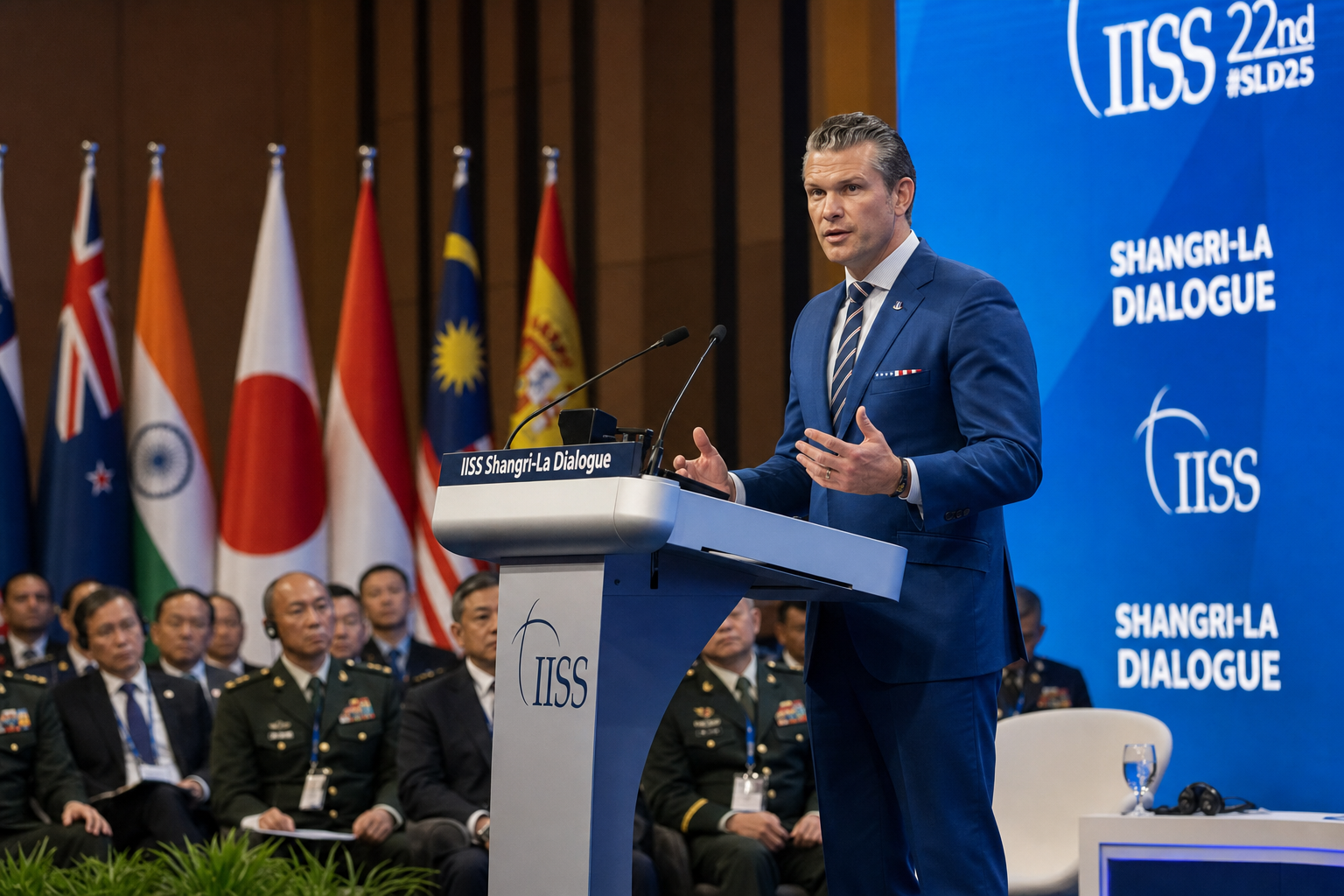
US Defense Secretary Pete Hegseth used a major security forum in Singapore to reassure Asian allies that the United States is not abandoning the region, even as he repeated his demand that they spend more on their own defence. Speaking at the Shangri-La Dialogue, Hegseth said Washington is balancing its commitments in Asia with other global military obligations, including preventing Iran from obtaining a nuclear weapon. He rejected concerns that the US was “turning its back” on the Indo-Pacific and argued that America can both maintain global responsibilities and remain deeply engaged with allies in the Pacific.
The speech came amid lingering worries about US reliability after a paused Taiwan arms package and wider uncertainty about the Trump administration’s foreign policy. Hegseth said the Taiwan pause should not be linked to broader US commitments and insisted the American munitions stockpile remains strong. He framed the US approach as one of “measured and deliberate strength,” emphasizing military power over what he called “empty globalist rhetoric.” He urged allies to spend 3.5% of GDP on defence and praised countries such as Japan, South Korea, Australia and the Philippines for increasing military cooperation and spending.
Hegseth’s comments on China were notably less confrontational than in the previous year. While acknowledging concern about China’s military buildup, he said the US does not seek “needless confrontation” and wants a stable regional balance where no country can impose hegemony. The article also notes that China again declined to send its defence minister to the forum, which underscores the cautious and competitive strategic climate in the region.
Entities: Pete Hegseth, Donald Trump, Xi Jinping, Shinjiro Koizumi, To Lam • Tone: analytical • Sentiment: neutral • Intent: inform
30-05-2026
U.S. Defense Secretary Pete Hegseth used a speech at the IISS Shangri-La Dialogue in Singapore to argue that the United States wants to preserve stability in the Asia-Pacific while pushing allies to take on more responsibility for their own defense. He praised several regional partners — including the Philippines, Australia, Indonesia, Malaysia, Singapore, Vietnam and India — for increasing their military readiness and sharing more of the defense burden. At the same time, he warned China against trying to expand its hegemony or destabilize the regional balance of power, saying the U.S. seeks a durable equilibrium where no state can threaten the security or prosperity of America and its allies.
Hegseth framed the Trump administration’s approach as one of “strong, quiet, clear” alliance management and said that “America first does not mean America alone.” He argued that too much of the region’s security has depended on American military power while allies let their own capabilities atrophy. He said the U.S. will prioritize “model allies” that meet Washington’s expectation of 3.5% of GDP in defense spending, offering them expedited arms sales, deeper industrial collaboration and expanded intelligence sharing. He also suggested that allies who do not contribute enough could face a different U.S. approach.
The comments drew skepticism from Sen. Tammy Duckworth, who accused the Trump-Hegseth national defense strategy of downgrading the importance of the Indo-Pacific and suggested the emphasis on quiet diplomacy could amount to deference toward China. The article also notes Hegseth’s criticism of Europe for failing to “pull their weight,” reflecting a broader Trump-era insistence that allies must pay more and carry more of the defense burden.
Entities: Pete Hegseth, Donald Trump, Tammy Duckworth, China, United States • Tone: analytical • Sentiment: neutral • Intent: inform
30-05-2026
US Defence Secretary Pete Hegseth’s speech at the Shangri-La Dialogue in Singapore offered a notably less combative message on China than his previous public remarks, while still reaffirming Washington’s core military strategy in the Indo-Pacific. The article frames the speech as a key indicator of how the Trump administration is interpreting the recent Xi Jinping–Donald Trump summit, especially on security and military issues.
Hegseth described China’s military expansion as a concern and said the United States remains committed to “deterrence by denial” along the first island chain, a posture widely understood as aimed at preventing the People’s Liberation Army from gaining an advantage in any Taiwan Strait conflict. At the same time, he emphasized that US-China relations are “better than they have been in many years,” and he praised the Xi-Trump talks in Beijing last month as “historic.”
The article highlights the contrast between this year’s tone and last year’s, when Hegseth sounded far more alarmed about the China threat and suggested the PLA might be preparing for an imminent confrontation. In this speech, by contrast, he chose a more measured approach, signaling a mix of strategic firmness and diplomatic restraint. The piece presents the speech as both a reassurance to allies in Asia and a sign that Washington may be calibrating its China policy after the recent leaders’ summit.
Entities: Pete Hegseth, Shangri-La Dialogue, Singapore, China, United States • Tone: analytical • Sentiment: neutral • Intent: inform
30-05-2026
The article is a live report previewing and tracking the Shangri-La Dialogue in Singapore, a major annual regional security forum attended by defence ministers, military chiefs, diplomats and analysts. It frames US Defence Secretary Pete Hegseth’s keynote address as the key event, saying it will offer the first clear indication of American policy direction in the Indo-Pacific since the recent Trump-Xi summit in Beijing, where Washington and Beijing agreed to reset ties and manage disputes. The piece emphasizes that Hegseth’s remarks are being closely watched for signs of how the US will approach China, regional security, and American commitments to allies.
The article highlights several issues likely to dominate Hegseth’s speech: the US commitment to the Asia-Pacific, tensions over the South China Sea and Taiwan, artificial intelligence rivalry, and the broader global impact of America’s war with Iran, which the article says has contributed to a severe energy crisis. It also notes that US allies in the region will want to hear whether Washington intends to continue pressing them to increase defence spending, as Hegseth did at the same forum a year earlier.
The report situates the forum within wider regional diplomacy, mentioning attendees from Japan, the Philippines, Vietnam, New Zealand and Australia, while noting that Chinese Defence Minister Dong Jun is absent for the second straight year because Beijing sees the event as US-led. The article also points out that China has been strengthening defence and security ties with neighbouring countries, especially in Southeast Asia. Overall, the piece is a snapshot of a high-stakes diplomatic and security gathering where US-China competition, alliance management and regional strategic uncertainty are central themes.
Entities: Shangri-La Dialogue, Pete Hegseth, Donald Trump, Xi Jinping, Singapore • Tone: analytical • Sentiment: neutral • Intent: inform
30-05-2026
US Secretary of War Pete Hegseth used his address at the 23rd Shangri-La Dialogue in Singapore to commend several Indo-Pacific countries for increasing defence spending and for being willing to share more of the security burden with the United States. He contrasted their response with that of some European allies and said Washington would reward “model allies” with faster arms sales, deeper industrial cooperation and expanded intelligence sharing. Hegseth named Australia, India, Indonesia, Japan, Malaysia, the Philippines, South Korea, Singapore, Thailand and Vietnam as countries stepping up, but notably did not mention Taiwan or New Zealand.
The speech signalled a more conciliatory tone toward China than some observers expected, especially after a recent summit between Donald Trump and Xi Jinping in Beijing, where the two leaders agreed on a framework of “constructive strategic stability.” Hegseth said the US seeks a durable balance of power in which no state, including China, can dominate the region. At the same time, the article highlights uncertainty over Washington’s commitment to Taiwan. Hegseth did not answer a question about arms sales to the island, and Trump’s recent comments about whether he would approve a major arms package have heightened concern in Taiwan and among regional partners.
The article also notes criticism from US Senator Tammy Duckworth, who said a recent national defence strategy appeared to downgrade the Indo-Pacific’s importance. Despite that, Hegseth insisted that US alliances only work as genuine partnerships shaped by each country’s geography and realities. The piece closes by situating the speech in the broader context of Trump-era strategy, regional anxieties over China, and the possible consequences of US policy on Asia-Pacific security, including energy security disruptions linked to the conflict with Iran.
Entities: Pete Hegseth, Donald Trump, Xi Jinping, Tammy Duckworth, Andrew Yang • Tone: analytical • Sentiment: neutral • Intent: inform
30-05-2026
US Defense Secretary Pete Hegseth used a major security summit in Singapore to signal that the United States remains militarily prepared for renewed conflict with Iran, even as the White House pursued a possible ceasefire or peace arrangement. The article says President Donald Trump was weighing a deal that would prevent Iran from developing nuclear weapons and would comply with his red lines, but Tehran denied that a final agreement had been reached. The backdrop is a volatile moment in the Middle East, with reported US strikes on the southern Iranian port of Bandar Abbas, Iranian retaliation, and diplomacy continuing in parallel over Lebanon. Hegseth’s remarks emphasized that US stockpiles and global force posture make it “more than capable” of restarting war if necessary, while Central Command also said American forces remain vigilant in the region. In Singapore, Hegseth also addressed broader Indo-Pacific security concerns, warning of “rightful alarm” over China’s military buildup but stressing that Washington does not seek “needless confrontation” and wants a stable regional balance that protects US and allied interests. He framed US policy toward China as one of “respectful” and “good-faith” engagement, while confirming there had been no change in US policy toward Taiwan, though future arms sales would remain the president’s decision. The article contrasts Hegseth’s tone with last year’s more confrontational stance and notes the absence of China’s defense minister from the summit.
Entities: Pete Hegseth, Donald Trump, Iran, United States, Pentagon • Tone: analytical • Sentiment: neutral • Intent: inform
30-05-2026
Dutch Deputy Prime Minister and Defence Minister Dilan Yesilgoz-Zegerius says the United States is justified in pressing NATO allies to raise defense spending, describing the message as clear, rightful, and necessary. Speaking at the IISS Shangri-La Dialogue, she argued that the Netherlands and other NATO members must do more to meet the alliance’s agreed defense target of 5% of GDP, split between direct military spending and related defense expenditures. Yesilgoz emphasized that the security environment has changed dramatically since Russia’s invasion of Ukraine, making stronger defense investment politically and strategically necessary. She noted that Dutch public support for higher spending has increased over the past five years, even though such a policy would once have been difficult to sell domestically. Her comments align with U.S. criticism, voiced by Secretary of War Pete Hegseth, that European allies have long relied too heavily on American support and should shoulder more of the burden themselves. Overall, the article highlights a broader transatlantic debate over burden-sharing within NATO and the push for European nations to strengthen their own military capabilities.
Entities: Dilan Yesilgoz-Zegerius, Dutch deputy prime minister, Netherlands, Amsterdam, NATO • Tone: analytical • Sentiment: neutral • Intent: inform