Articles in this Cluster
09-07-2026
CNN analysis argues that President Donald Trump’s latest claim that Iran has already been “denuclearized” conflicts sharply with his own recent statements and raises doubts about the stated rationale for the war with Iran. Trump originally justified military action by warning that Iran posed an imminent nuclear threat, even though he had previously said US and Israeli strikes in June 2025 had already “obliterated” the program. Now, after more than four months of conflict and major economic and strategic costs, Trump is suggesting the war may already have achieved its aim and that Iran no longer has a usable nuclear program. The article says this shift appears to be part of a broader effort to justify winding down the war without securing the key objectives the administration repeatedly said were essential: access to Iran’s nuclear materials and a durable deal preventing future weaponization. It notes Trump’s comments at a NATO summit in Turkey, where he insisted the US had effectively denuclearized Iran and that monitoring systems made the nuclear sites inaccessible. The analysis argues these claims are hard to reconcile with the administration’s prior insistence that obtaining the materials was a “red line,” as well as with the fact that major strikes occurred much earlier and the war’s active military phase ended months ago. The piece concludes that Trump may be preparing to exit the conflict despite failing to achieve his goals, leaving the US and global economy with significant costs, including the loss of 13 US service members, economic disruption, and uncertainty over Iran’s ability to threaten the Strait of Hormuz.
Entities: Donald Trump, Aaron Blake, Iran, United States, Israeli strikes • Tone: analytical • Sentiment: negative • Intent: analyze
09-07-2026
The article describes newly released footage from Iran showing the heavily damaged compound where Ayatollah Ali Khamenei was reportedly killed in a US-Israel airstrike at the beginning of the war. The video, released during funeral commemorations for Khamenei, presents a stark view of the destruction inside and around the compound: collapsed ceilings, exposed support beams, rubble, twisted metal, and blown-out doors. The report portrays the site as nearly unrecognizable after the Feb. 28 missile strikes and frames the attack as part of the broader conflict between Iran and the United States/Israel. It also says Khamenei’s successor, Mojtaba Khamenei, has not been publicly seen since the attacks and was absent from the funeral. In parallel, the article notes that President Trump declared the temporary cease-fire arrangement with Iran “over” after renewed Iranian attacks on commercial shipping near the Strait of Hormuz, and he threatened additional strikes while criticizing Iran’s leadership. The piece combines battlefield imagery, political developments, and escalating rhetoric to depict a continuing and volatile war environment.
Entities: Ayatollah Ali Khamenei, Mojtaba Khamenei, Iran, United States, Israel • Tone: urgent • Sentiment: negative • Intent: inform
09-07-2026
The article reports that Israeli officials are signaling willingness to join future U.S. military action against Iran if President Trump requests support. Citing sources in Jerusalem, The New York Post says Israel is prepared to “stand by” the United States and even strike Iran again if needed, though officials say they are not eager to return to conditions where civilians must seek shelter from Iranian missile and drone attacks. The piece situates these remarks amid renewed U.S. strikes on Iran, sharp anti-Iran rhetoric from Trump, and continued Israeli concern that Iran remains committed to hostile action despite negotiations and cease-fire efforts.
The story describes how Trump ordered another round of strikes on Iranian targets, including missile and drone sites, command centers, air defenses, radar, and logistics infrastructure, after accusing Iran’s leadership of being “evil” and “scum.” It also notes that Israeli Defense Minister Israel Katz said Israel is prepared to strike Iran again with greater force if warranted. Israeli sources and legal activist Nitsana Leitner argue that Israel would cooperate militarily if asked, and that Iran must be confronted rather than merely condemned. At the same time, Israeli intelligence reportedly assesses that Tehran does not currently want to draw Israel directly into the conflict.
The article emphasizes skepticism in Jerusalem about Iran’s intentions and highlights past tensions between Trump and Netanyahu over the handling of negotiations and the scope of any agreement, especially regarding Iran’s ballistic missile threat. Overall, the piece frames Israel as a willing but cautious U.S. partner, ready to reengage militarily if the conflict escalates further.
Entities: Israel, Iran, United States, Donald Trump, Benjamin Netanyahu • Tone: analytical • Sentiment: negative • Intent: inform
09-07-2026
The article reports that President Trump has authorized a renewed U.S. military campaign against Iran and is prepared for it to continue for days or weeks if Tehran keeps attacking shipping and U.S. interests. According to sources cited by The New York Post, some Trump advisers are privately describing the campaign with blunt language such as “Operation Bitch Slap,” emphasizing both punishment and the expectation that the strikes could be short-lived unless Iran escalates further. The piece says Trump has adopted a hard-line posture, publicly threatening Iran’s leaders, warning of broader attacks on infrastructure, a blockade, and possible seizure of Kharg Island. It also notes that his administration is leaving multiple paths open, including military escalation or renewed negotiations involving senior envoys and family members. The article describes the immediate trigger as Iranian attacks on ships near the Strait of Hormuz, followed by U.S. strikes on Iranian targets and Iranian missile-and-drone retaliation against American bases in several Middle Eastern countries. Iranian officials respond with defiance, warning that any strike will be met with counterstrikes and insisting the Strait of Hormuz will only open under Iranian terms. Overall, the article portrays a rapidly escalating confrontation shaped by Trump’s personal decision-making style, the possibility of wider war, and a tense exchange of threats between Washington and Tehran.
Entities: Donald Trump, Iran, United States, Strait of Hormuz, Islamic Republic • Tone: urgent • Sentiment: negative • Intent: inform
09-07-2026
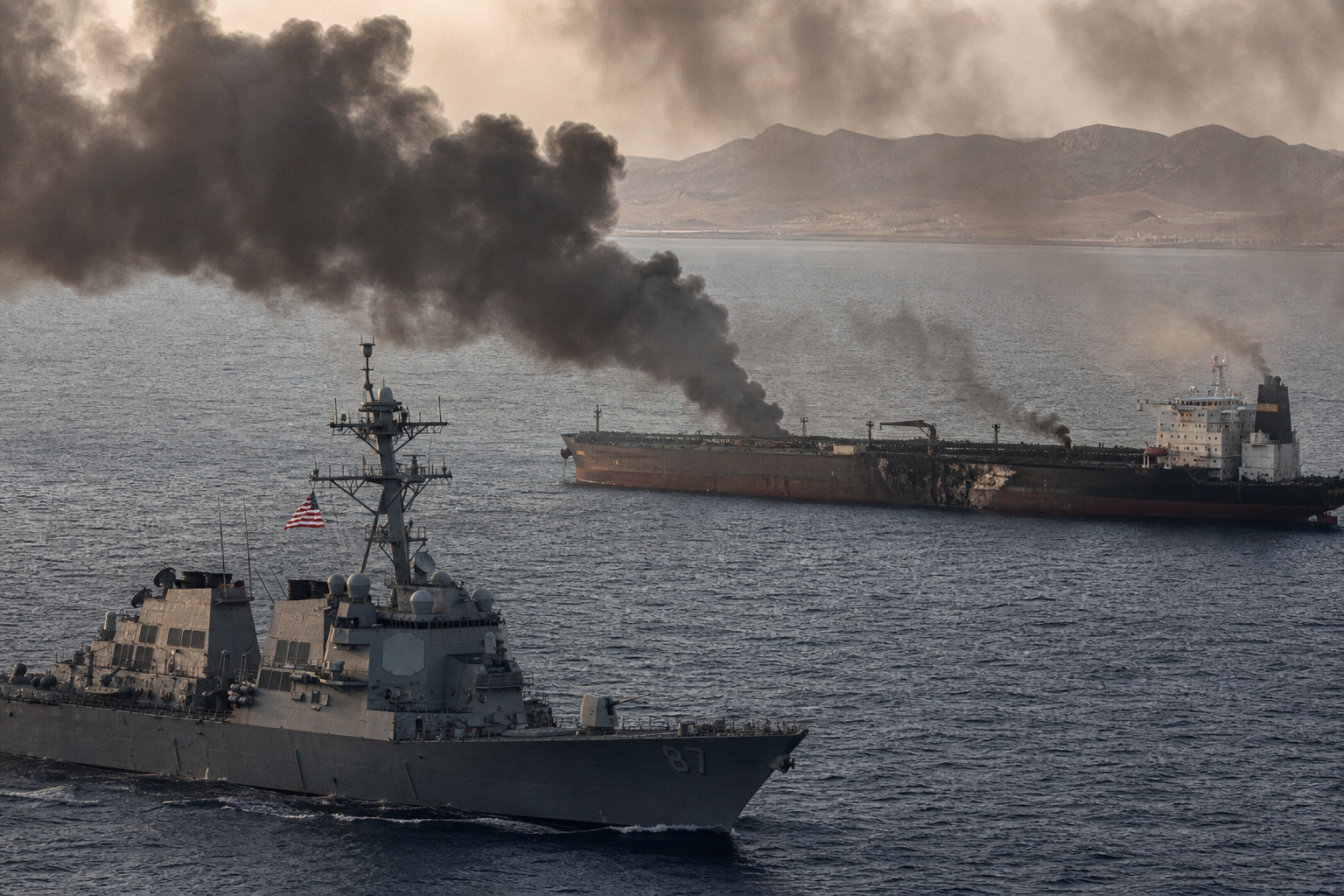
The article argues that Iran may be overplaying its hand by striking oil tankers in the Strait of Hormuz at a moment when negotiations with the United States are fragile and the risk of wider conflict is rising. Analysts quoted in the piece say Iran appears to believe it can leverage control of the vital shipping lane to extract economic relief and preserve its influence, but that tactic could instead provoke a major escalation. The article describes how both countries have threatened to abandon a June 17 Memorandum of Understanding that was meant to create a framework for peace talks and extend a cease-fire that has existed since April. While the agreement left hard issues like Iran’s nuclear program unresolved, it envisioned Iran reopening the strait to commercial shipping in exchange for sanctions relief. Instead, maritime traffic remains below normal, the U.S. Navy has encouraged ships to take a safer route, and Iran has grown frustrated that its demands are not being met. The piece also places the latest tanker attacks in a political context: Iranian leaders are holding funeral ceremonies for Ayatollah Ali Khamenei, killed in the war, and some officials are projecting defiance and triumphalism. U.S. officials and analysts suggest that President Trump is responding with increasingly harsh rhetoric and the possibility of more military action, while warning that Iran may be misjudging his willingness to restart hostilities. The article concludes by framing the standoff as part of a long Iranian pattern of taking risky bargaining positions that can backfire, citing historical precedents such as the 1979 hostage crisis and the prolonged Iran-Iraq war.
Entities: Iran, United States, Strait of Hormuz, Washington, Persian Gulf • Tone: analytical • Sentiment: negative • Intent: analyze
09-07-2026
The article argues that the recent cycle of violence between the United States and Iran should not be read as the breakdown of diplomacy, but rather as a new and dangerous form of it. According to the piece, both sides now treat talks and strikes as part of the same strategic process, using negotiations, air strikes, missile attacks, and signaling to manage conflict without sliding into full-scale war. The author frames the situation around the Gulf and the Strait of Hormuz, where a June memorandum of understanding between Washington and Tehran appears to have become the backdrop for ongoing confrontation rather than a genuine peace mechanism.
The article says the US and Iran are locked in a pattern where military action and diplomacy coexist. Recent US air strikes on Iran and Iranian missile barrages against Arab monarchies are presented not as separate failures of policy, but as complementary instruments in a broader contest. Iran is described as trying to assert control over the Strait of Hormuz through a vague memorandum, while the US insists that the legal status of the waterway cannot be altered and responds militarily when attacked. Regional Gulf states are shown as resisting Iranian pressure and becoming targets in the escalating exchange.
The piece also highlights the internal and external risks shaping this unstable balance. Gulf Arab monarchies oppose Iranian aggression, Iran’s internal power struggles complicate its strategy, and all sides appear determined to avoid a direct all-out war even while maintaining pressure. The result is a tense, unstable equilibrium in which violence and dialogue are intertwined, making the conflict more persistent and harder to resolve.
Entities: United States, Iran, Donald Trump, Marco Rubio, Scott Bessent • Tone: analytical • Sentiment: negative • Intent: analyze
09-07-2026
The article reports a rapid escalation in the conflict between the United States and Iran, centered on the Strait of Hormuz, a vital global shipping lane. U.S. forces struck 90 targets overnight, largely along Iran’s southern coastline near the strait, after President Donald Trump said a tentative truce was effectively over. Iran retaliated with drones and missiles aimed at U.S. forces and partner countries in Jordan and the Persian Gulf, including Bahrain, Kuwait, and Qatar. The fighting follows earlier U.S. strikes on port cities and a railway that killed and wounded dozens, as well as Iranian funeral ceremonies and vows of revenge after the assassination of Iran’s supreme leader, Ayatollah Ali Khamenei, which intensified public anger in Tehran.
Analysts quoted in the story warn that the conflict may be entering a more dangerous phase. Experts say the key strategic issue is control over the Strait of Hormuz, with each side interpreting prior understandings differently. Washington sees the U.S. as protecting freedom of navigation and commercial shipping, while Tehran believes it has gained leverage over the waterway. The article also notes a major policy shift: the U.S. Treasury revoked authorization for Iranian oil sales, eliminating a crucial source of revenue and potentially undermining the earlier agreement. That decision, combined with escalating strikes and retaliatory attacks, has heightened fears that the war could expand into a broader regional conflict or even full-scale war. Iran’s Revolutionary Guard warned that the current attacks are only the first stage and signaled further action if the U.S. air campaign continues.
Entities: United States, Iran, Strait of Hormuz, Donald Trump, Ayatollah Ali Khamenei • Tone: urgent • Sentiment: negative • Intent: inform
09-07-2026
The article reports a sharp escalation in hostilities between the United States and Iran, with both sides exchanging fresh strikes after President Trump said the cease-fire was effectively over. The U.S. military said it launched a new round of attacks on roughly 90 targets in Iran, including missile and drone storage sites and air defenses, to weaken Iran’s ability to threaten commercial shipping in the Strait of Hormuz. Iran responded with drone and missile strikes that it said targeted American bases in Kuwait and Bahrain, though no immediate damage was reported. The renewed fighting comes after a temporary cease-fire and last month’s agreement appeared increasingly fragile, especially as both sides accuse each other of violating its terms.
The story frames the Strait of Hormuz as the central flashpoint because of its importance to global energy supplies and shipping. Iran has claimed it should control routing through the waterway, while the United States says Iran has been attacking commercial vessels. The article notes that the conflict has already disrupted maritime traffic and prompted warnings from the International Maritime Organization. It also highlights the economic consequences: oil prices rose again, Brent crude climbed to around $79 a barrel, gasoline prices remain elevated, and investors are growing anxious about inflation and market volatility. The article captures a conflict that is both military and economic, with the cease-fire appearing precarious and the risk of broader regional escalation still unresolved.
Entities: United States, Iran, Donald Trump, Strait of Hormuz, U.S. Central Command • Tone: urgent • Sentiment: negative • Intent: inform
09-07-2026
Oil prices rose further after U.S. and Iranian forces exchanged a second round of strikes around the Persian Gulf, deepening market anxiety over the war’s potential effect on global energy supplies, shipping, and inflation. The article says Brent crude climbed above $79 a barrel and West Texas Intermediate rose above $74, reversing earlier declines and reflecting concerns that the cease-fire between the U.S. and Iran may be unstable. President Trump described the latest attacks as retaliation for Iranian strikes on commercial ships in the Strait of Hormuz, while Iran’s top peace negotiator rejected American pressure and insisted the strait would open only under Iranian terms.
The biggest immediate risk is to maritime traffic through the Strait of Hormuz, a critical route for oil exports. The International Maritime Organization has urged shipowners to avoid the strait, and Kpler data show ship crossings remain far below prewar levels despite some recovery. Many vessels are now using the Iranian corridor, while the U.S.-guided Omani route saw limited use. Analysts warn that the market had been too optimistic about a quick return to normal shipping and supply.
The article also describes broader financial ripple effects. Stock and bond markets were volatile, with S&P 500 futures flat, mixed trading in Asia, and rising Treasury yields as investors worried that higher oil prices could worsen inflation. The VIX volatility index reached a two-week high, and Federal Reserve officials have signaled willingness to raise rates if inflation does not cool. The IMF has also lowered its global growth forecast, underscoring wider economic risks from the conflict.
Entities: Oil prices, Brent crude, West Texas Intermediate, Strait of Hormuz, Persian Gulf • Tone: analytical • Sentiment: negative • Intent: inform