02-06-2026
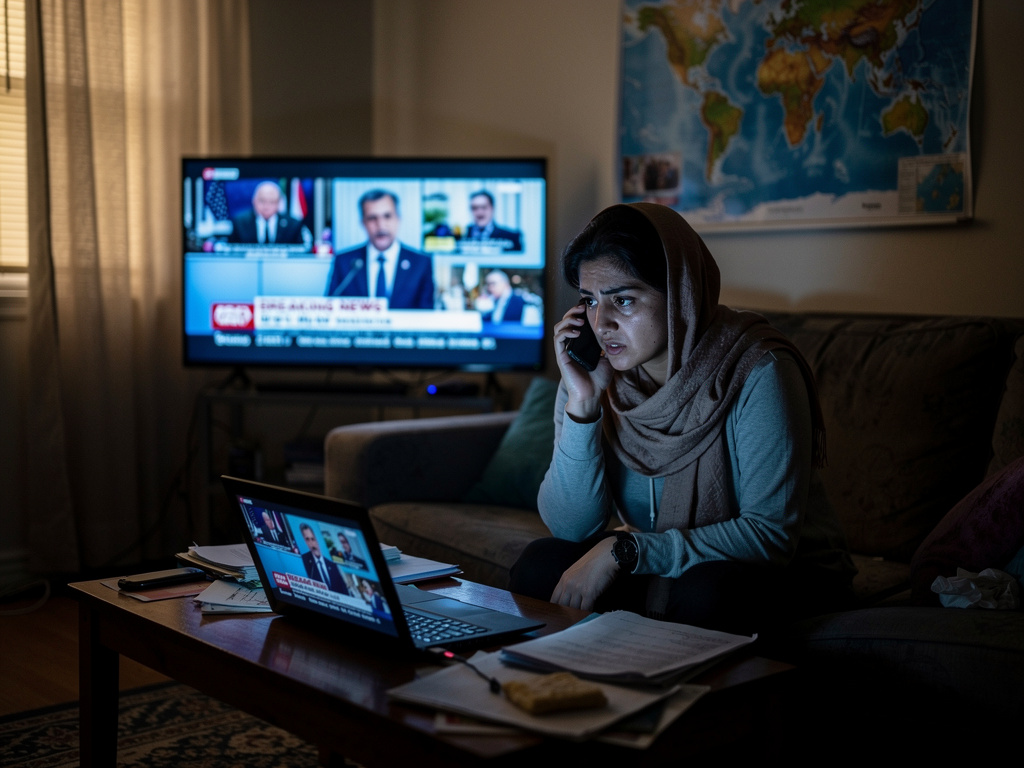
The article centers on Setareh, an Iranian woman living in the United States, who describes the fear and emotional distress she felt for her family and fellow civilians in Iran after former President Donald Trump posted a threatening message during heightened U.S.-Iran tensions. Trump wrote that "a whole civilization will die tonight," a statement Setareh says triggered intense terror because her relatives were still in Iran and she had no way of knowing what might happen to them. She explains that the threat made her feel physically paralyzed and unable to think, as she imagined the potential destruction of innocent lives, Iranian culture, and her own family’s safety.
The piece places her reaction in the broader context of the war and fluctuating conflict between the U.S. and Iran, noting that the threat came before a ceasefire agreement that was later tested. It also mentions U.S. military strikes on Iranian radar and drone sites after an alleged Iranian downing of a U.S. drone. Through Setareh’s testimony, the article emphasizes the human cost of geopolitical confrontation, showing how rhetoric from political leaders can deepen fear among people with personal ties to the conflict zone. The story is less about military developments than about the psychological and familial impact of escalating threats on ordinary civilians and diaspora communities.
Entities: Setareh, Donald Trump, CBS News, Lindsey Reiser, Iran • Tone: emotional • Sentiment: negative • Intent: inform
02-06-2026
The article examines President Trump’s shifting and at times contradictory posture toward negotiations with Iran, focusing on his recent comment that the talks were becoming “very boring.” Over several months, Trump has been deeply involved in the conflict, overseeing preparations for military action, grappling with the reopening of the Strait of Hormuz, and issuing dramatic statements about the stakes, including warnings about a potential civilizational catastrophe. He then backed away from escalation to announce a cease-fire and a naval blockade of Iranian ports.
By Monday, however, Trump appeared publicly dismissive of the negotiations, telling CNBC that he did not care whether they continued or failed. The article argues that his professed indifference is hard to take at face value, given the real political and economic consequences of the war. Gasoline prices have risen sharply, Republican voters are increasingly uneasy about the conflict, and Trump has also recently downplayed other issues with major political importance, such as the midterm elections and Americans’ financial concerns.
The piece emphasizes the tension between Trump’s casual public language and the high-stakes substance of the negotiations. It notes that only hours before dismissing the process as dull, he had said talks were continuing “at a rapid pace,” and reports had indicated he was tightening the requirements for a preliminary agreement over matters like frozen Iranian funds and uranium recovery. The article concludes by underscoring how important these technical details are, while contrasting them with Trump’s earlier assertion that there was “nothing boring” about confronting Iran.
Entities: Donald Trump, Iran, Eamon Javers, CNBC, Strait of Hormuz • Tone: analytical • Sentiment: neutral • Intent: analyze
02-06-2026
The article describes how Lebanon’s long-discussed effort to disarm Hezbollah appeared to gain traction in early 2026, only to run into serious political and practical obstacles and stall. Hezbollah, the Iran-backed militia and political force that has long operated with significant autonomy inside Lebanon, has resisted any move that would weaken its weapons arsenal or reduce its influence. The piece frames the disarmament effort as one of Lebanon’s most elusive national objectives, suggesting that leaders briefly seemed to be edging toward progress before the initiative lost momentum. The failure is presented in the context of Lebanon’s broader struggle to assert state authority over armed groups and to balance internal politics with regional pressures involving Iran and wider Middle East conflict dynamics. The headline and opening make clear that the core story is not a completed policy shift, but the collapse of a tentative and incremental attempt to change the status quo. Because the excerpt provided is very short and mostly consists of headline and introductory lines, the article’s full argument and details are not available here; however, the available text indicates that the central news is the stalling of a major disarmament push that many in Lebanon likely viewed as one of the best opportunities to curtail Hezbollah’s military power.
Entities: Lebanon, Hezbollah, Iran, Beirut, Tehran • Tone: analytical • Sentiment: negative • Intent: inform